Collagen for Dogs: Does It Actually Work? (UK Evidence Guide)

Collagen has jumped from a human wellness trend into one of the fastest-growing dog supplement categories in the UK, with search interest up nearly 50% in the past year. Unlike a lot of pet supplement trends, this one actually has real, published, peer-reviewed research behind it — including randomized controlled trials in dogs specifically. Here’s what the evidence actually shows.
Quick Answer
Collagen supplements, particularly a specific form called undenatured type II collagen (UC-II), have genuine clinical research support for improving mobility in dogs with osteoarthritis. Randomized, placebo-controlled trials in dogs have shown measurable improvements in mobility, pain, and joint metabolism within 4-8 weeks of daily use. Not every dog needs collagen — the strongest evidence is for dogs with existing joint issues or those recovering from joint surgery, not healthy young dogs “just in case.” The specific type of collagen matters far more than the word “collagen” on the label.
Table of Contents
- What Is Collagen, and Why Does It Matter for Joints?
- The Two Types That Actually Matter
- The Real Research: What Studies Actually Found
- Collagen vs Glucosamine and Chondroitin
- Should Your Dog Take Collagen? A Decision Guide
- Dosing: What the Studies Actually Used
- Where UC-II Actually Comes From
- What Makes This Research More Convincing
- How to Track Whether It’s Actually Working
- How to Choose a Quality Supplement
- Food Sources vs Supplements
- Possible Side Effects
- Who Benefits Most
- Does Collagen Work for Cats Too?
- FAQs
- Final Verdict
What Is Collagen, and Why Does It Matter for Joints? {#what-is-collagen}
Collagen is the most abundant protein in a dog’s body, forming a major structural component of skin, tendons, bones, and — most relevantly here — cartilage, the cushioning tissue in joints. Type II collagen specifically makes up the main structure of cartilage tissue. As dogs age, or in dogs prone to osteoarthritis (particularly large breeds), natural collagen production and joint cartilage quality can decline, contributing to the stiffness, reduced mobility, and pain associated with joint disease.

The theory behind collagen supplementation is that providing additional collagen — in one of a few specific forms — can either support the body’s own cartilage-maintenance processes or help modulate the inflammatory response that drives joint damage in osteoarthritis. Importantly, these aren’t just theoretical claims: this is one of the better-researched supplement categories in veterinary medicine, with actual randomized controlled trials to back it up.
The Two Types That Actually Matter {#two-types}
Not all “collagen” supplements work the same way, and understanding the difference matters more than almost anything else in this guide.
| Type | How It Works | Best Evidence For |
|---|---|---|
| Undenatured Type II Collagen (UC-II) | Works through an immune-mediated mechanism — small doses train the immune system to reduce autoimmune-style attacks on joint cartilage | Osteoarthritis, mobility improvement, often effective at very low doses |
| Hydrolyzed Collagen (collagen peptides) | Broken down into smaller peptides that are absorbed and may directly reach joint tissue, stimulating cartilage and joint fluid production | General joint support, possibly complementary to UC-II |
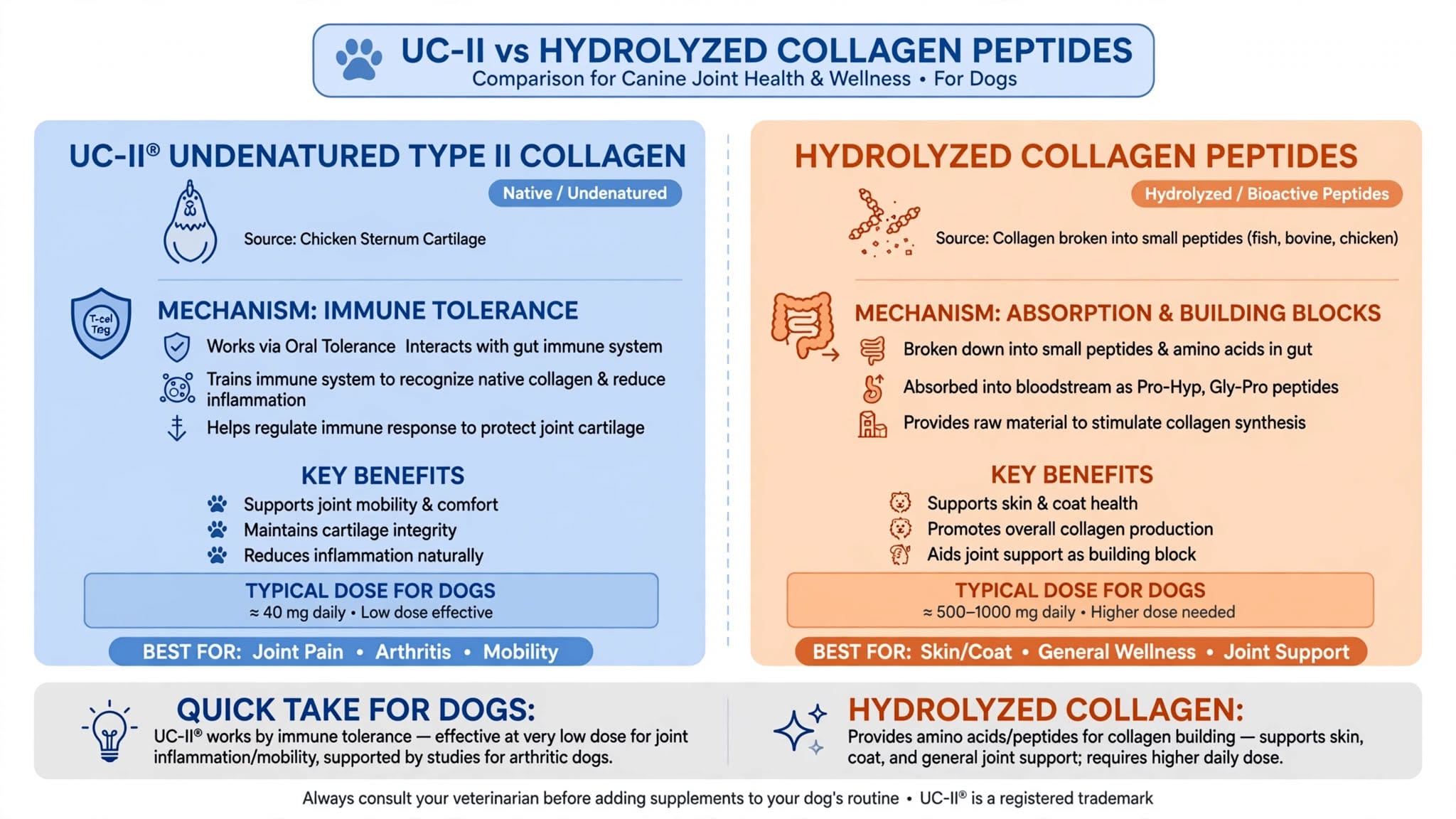
This distinction explains why two products can both say “collagen” on the label while working through completely different mechanisms — and why checking which type a product actually contains matters more than the word “collagen” appearing anywhere on the packaging.
The Real Research: What Studies Actually Found {#the-research}
This is genuinely one of the more rigorously studied joint supplements available for dogs, which is worth knowing given how much of the wider supplement industry runs on thin evidence.
A randomized, double-blind, placebo-controlled crossover trial involving dogs with mild-to-moderate osteoarthritis tested a UC-II supplement (often combined with Boswellia serrata) against a placebo over 8 weeks, with a washout period and crossover. Using the validated Liverpool Osteoarthritis in Dogs (LOAD) scale alongside objective mobility and pain measures, the supplemented group showed measurable improvement in mobility starting as early as 4 weeks, while the placebo period showed increased risk of an osteoarthritis flare-up and a lower pain threshold in the affected joint.
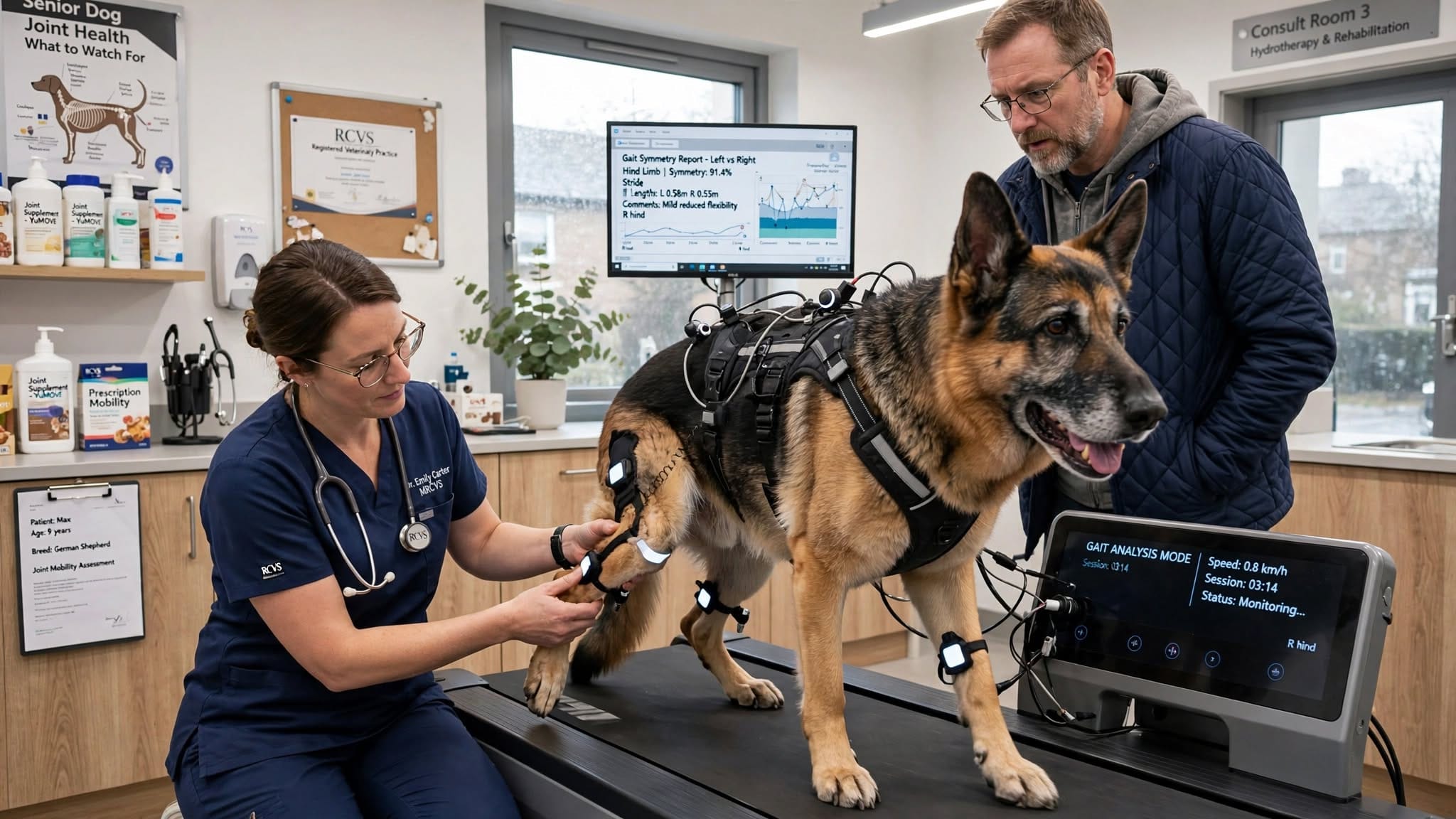
A post-surgical recovery study looked specifically at dogs recovering from TPLO surgery (a common procedure for cranial cruciate ligament rupture, a frequent cause of osteoarthritis in dogs) given a high-concentration UC-II supplement, using objective treadmill gait analysis rather than just owner-reported impressions. Results were described as encouraging for recovery of limb function.
A broader scoping review covering 26 separate studies on UC-II and Boswellia serrata in dogs found consistent evidence that UC-II reduces clinical signs of osteoarthritis, improving overall condition with reduced lameness and increased activity, though the review authors noted more research is still needed to establish whether it can prevent osteoarthritis from developing in the first place, as opposed to managing it once present.
Notably, some research has found UC-II effective at smaller doses than glucosamine and chondroitin, the traditional go-to joint supplements — one commonly cited detail is that UC-II has shown benefit at doses as low as 4mg daily in some studies, compared to the much larger doses typically needed for glucosamine and chondroitin to show effect.
Collagen vs Glucosamine and Chondroitin {#vs-glucosamine}
| Factor | UC-II Collagen | Glucosamine/Chondroitin |
|---|---|---|
| Typical daily dose | Very low (studies have used as little as 4-40mg) | Much higher (often hundreds to thousands of mg) |
| Mechanism | Immune-mediated tolerance response | Provides raw materials for cartilage repair |
| Evidence base | Growing, includes dog-specific RCTs | Long-established, extensive but more mixed results overall |
| Often combined with | Boswellia serrata | Often included in the same product together |
These aren’t necessarily competing options — some joint supplements combine collagen with glucosamine and chondroitin, working through complementary mechanisms rather than one replacing the other.
Should Your Dog Take Collagen? A Decision Guide {#decision-guide}
Use this simple flow to think through whether collagen is worth discussing with your vet for your specific dog:
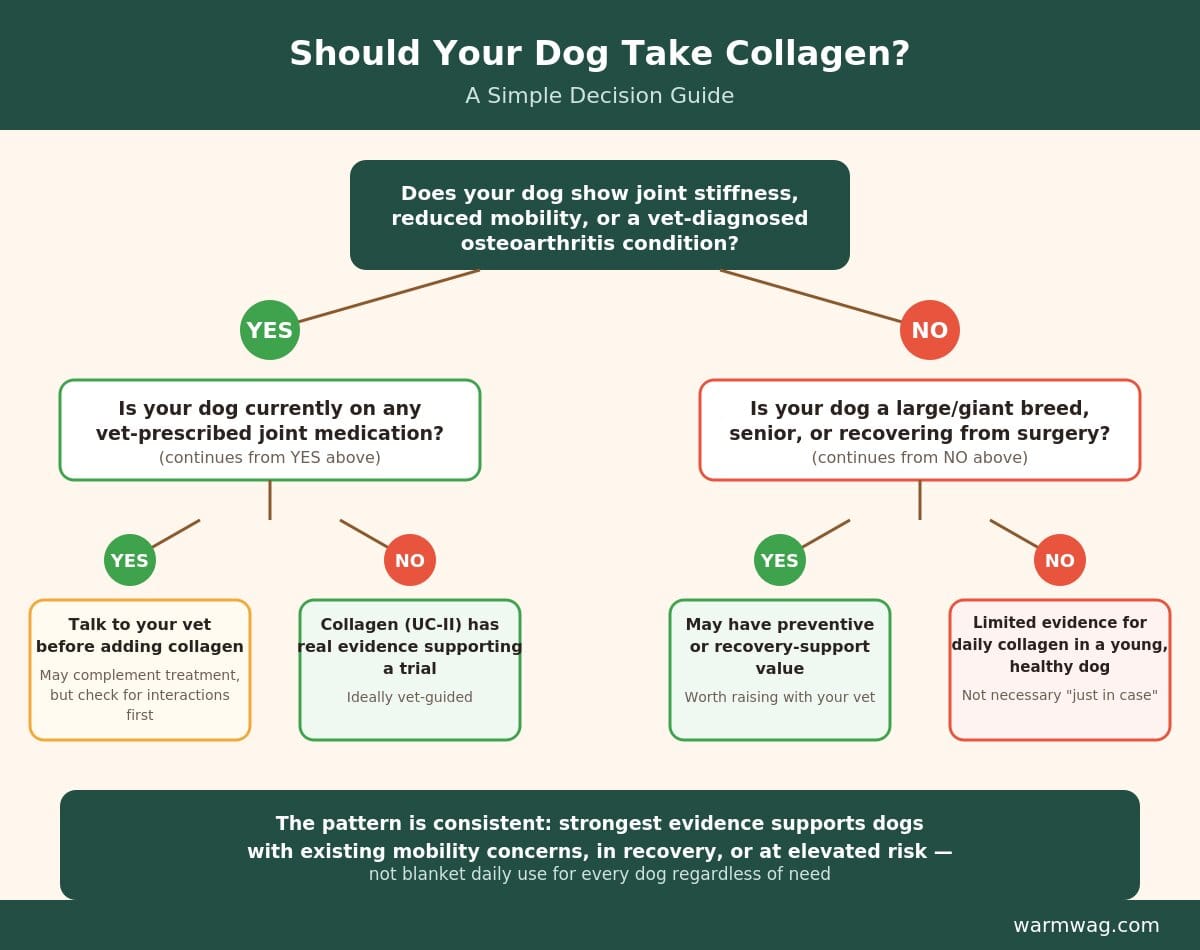
The pattern across the evidence is consistent: collagen’s strongest, most researched use case is joint support for dogs with existing mobility concerns, in recovery, or at elevated risk — not blanket daily supplementation for every dog regardless of need.
Dosing: What the Studies Actually Used {#dosing}
Dosing varies by product concentration and collagen type, so following the specific product’s label — or your vet’s guidance — matters more than a generic universal number. That said, it’s useful to know what’s actually been studied:
| Collagen Type | Studied Dose Range | Notes |
|---|---|---|
| UC-II | As low as 4mg to 40mg daily in various studies | Low-dose effectiveness is one of UC-II’s most distinctive features |
| Hydrolyzed collagen | Varies significantly by product and dog size | Less standardised across studies than UC-II dosing |
Because effective UC-II doses can be so low, it’s genuinely possible to under-dose or over-dose based on assumptions borrowed from glucosamine/chondroitin products — checking the specific studied dose for the specific product type you’re using matters more here than with many other supplements.
Where UC-II Actually Comes From {#sourcing}
Undenatured type II collagen used in most studied supplements is derived from chicken sternum cartilage, processed in a way specifically designed to preserve its natural, undenatured structure — this matters because the immune-mediated mechanism researchers believe drives UC-II’s effect depends on the collagen retaining its original molecular structure rather than being broken down through heat or aggressive processing, which is a different manufacturing goal entirely from hydrolyzed collagen, where breaking the structure down into peptides is the intended outcome. This is part of why checking that a product is specifically labelled “undenatured” matters — a poorly processed or denatured version of type II collagen may not work through the same mechanism the research is actually based on.
What Makes This Research More Convincing Than Typical Supplement Claims {#why-credible}
A lot of pet supplement marketing leans on vague claims — “supports joint health,” “may help mobility” — without much behind them. It’s worth understanding why the UC-II research specifically stands out from that pattern:
Randomization and blinding matter. The strongest studies used randomized, double-blind, placebo-controlled designs — meaning neither the dog’s owner nor the researchers assessing outcomes knew which dogs received the real supplement versus a placebo during data collection, reducing the risk of biased reporting or unconscious influence on results.
Objective measures, not just owner opinion. Some studies used treadmill gait analysis and synovial fluid metabolic profiling alongside owner questionnaires, adding objective, measurable data rather than relying solely on subjective impressions of whether a dog “seemed” more mobile.
Crossover design strengthens findings. In a crossover trial, the same dogs receive both the real supplement and the placebo (in different periods, with a washout in between), which controls for individual dog variation far better than comparing entirely separate groups of dogs would.
Published in peer-reviewed veterinary journals. These aren’t internal company studies or marketing materials — they’ve been through independent peer review, the same standard applied to other veterinary medical research.
None of this means the evidence is absolutely final or beyond further study — science continues to build on itself — but it’s a meaningfully more rigorous evidence base than most trending pet supplements can point to.
How to Track Whether It’s Actually Working {#tracking-results}
Since collagen’s benefits build gradually over weeks rather than appearing immediately, having a simple way to track change makes it much easier to judge whether it’s genuinely helping your specific dog rather than guessing based on impression alone.
Keep a simple mobility log before starting. Note how easily your dog manages stairs, jumps onto furniture (if they normally do), rises after resting, and their general activity level during a normal day — this baseline matters more than most owners realise, since gradual change is easy to miss without something to compare against.
Reassess at the 4-week and 8-week marks, matching the timeline used in the actual research. Look for the same specific behaviours you tracked at baseline, rather than a vague overall impression.
Involve your vet in the assessment, particularly if your dog has a formally diagnosed condition — a professional mobility assessment provides a more objective comparison than owner impression alone, similar to how the actual clinical trials combined owner-reported outcomes with objective measures.
Give it a genuine, consistent trial period before deciding it isn’t working — stopping and restarting inconsistently makes it much harder to judge true effect, and the studied benefit period (4-8 weeks of daily use) is a reasonable minimum trial length to commit to before drawing conclusions.
How to Choose a Quality Supplement {#how-to-choose}
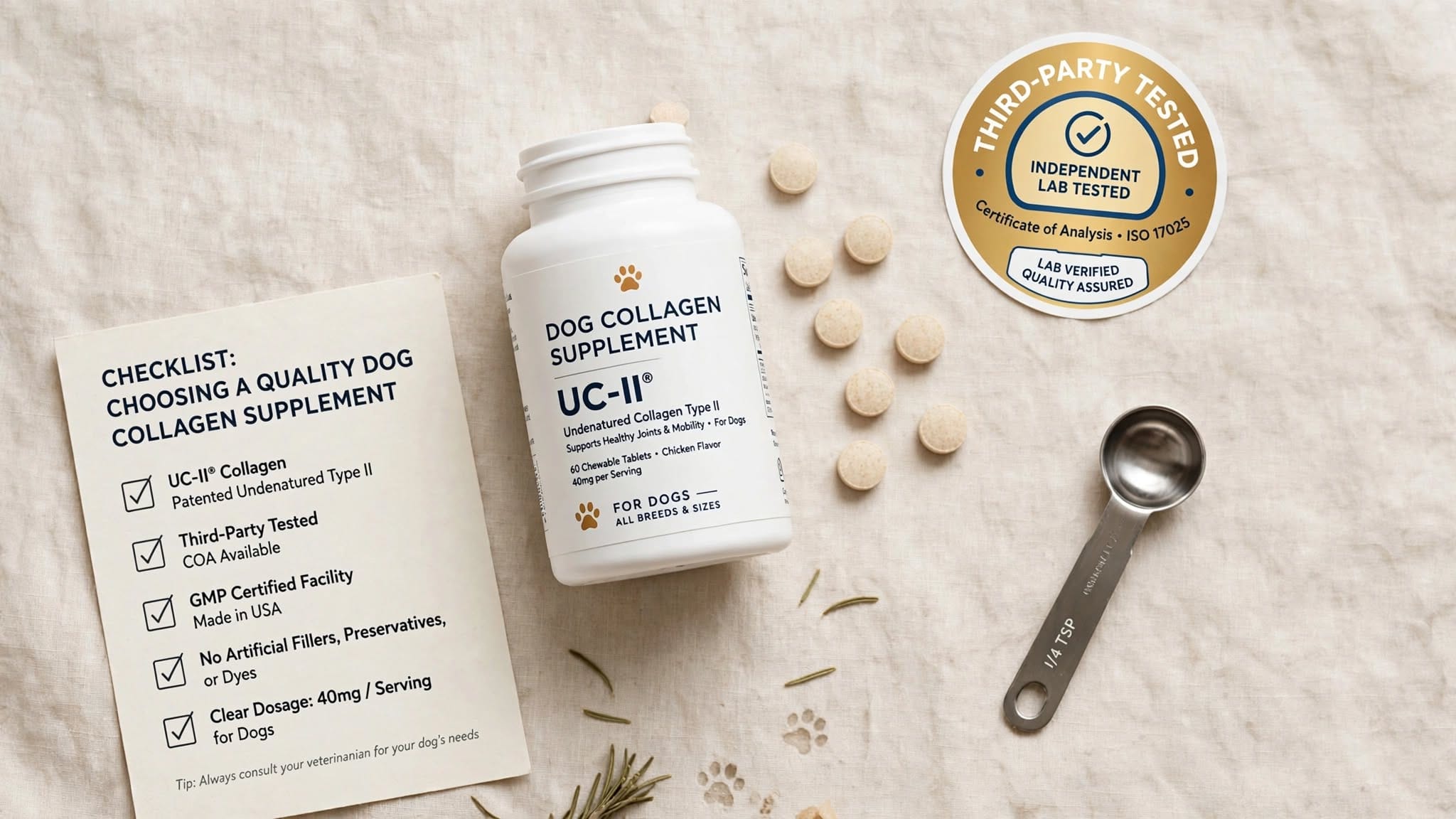
- Check for the specific type — “UC-II” or “undenatured type II collagen” specifically, not just “collagen” as a vague ingredient
- Look for third-party testing or quality certifications where available, particularly given how much variation exists in raw material sourcing and purity across manufacturers
- Check the actual dose against studied amounts — a product with a UC-II dose wildly different from studied ranges is worth questioning
- Be cautious of “proprietary blends” that don’t clearly state the collagen type and amount
- Consider combination products carefully — UC-II with Boswellia serrata has real combined-study support, but check that both ingredients are dosed at levels similar to what was actually studied
Food Sources vs Supplements {#food-sources}
Collagen naturally occurs in connective tissue, skin, and cartilage — bone broth and cartilage-rich cuts are sometimes suggested as natural collagen sources for dogs. However, the clinical research showing measurable joint benefits has been conducted using specific, standardised, concentrated supplement forms (particularly UC-II), not home-prepared food sources. This doesn’t mean natural sources have zero value, but it does mean the evidence for meaningful osteoarthritis improvement specifically applies to tested supplement products, not an assumption that any collagen-containing food will produce the same effect.
Possible Side Effects {#side-effects}
Collagen supplements, including UC-II, are generally well tolerated in the studies conducted so far, with research specifically noting no detrimental effects on kidney or liver function in some trials. As with any supplement, individual dogs can react differently, and mild digestive upset is possible when introducing any new supplement. Dogs on other medications, particularly for joint conditions, should have any new supplement checked against their existing treatment plan by their vet first, rather than adding it independently.
Who Benefits Most {#who-benefits}

| Dog Profile | Likely Benefit Level |
|---|---|
| Large/giant breed, senior | Higher — this group is most represented in the supporting research |
| Diagnosed with osteoarthritis | Higher — this is the primary population studied |
| Recovering from joint surgery (e.g., TPLO) | Higher — specific research supports this use case |
| Young, healthy, no joint issues | Lower — limited evidence supports preventive use in this group |
| Small breed, no mobility concerns | Lower — less represented in current research |
Does Collagen Work for Cats Too? {#cats}
Most of the strongest published research on UC-II and joint collagen has focused specifically on dogs, though some reviews do include cats alongside dogs and horses as companion animals studied for joint health applications. Osteoarthritis is also common in cats, particularly as they age, though it’s often under-diagnosed since cats are notoriously good at hiding mobility discomfort compared to dogs. If you’re considering a joint supplement for a cat, the same core principle applies — look for a product specifically formulated and dosed for cats, check for the specific collagen type, and discuss it with your vet, since cat-specific dosing research is generally less extensive than the dog-specific evidence covered throughout this guide.
FAQs {#faqs}
Is collagen for dogs actually backed by science, or is it just a trend? Genuinely backed by science, at least for UC-II specifically — multiple randomized, placebo-controlled trials in dogs have shown measurable mobility improvements, which is a stronger evidence base than many pet supplement categories can claim.
What’s the difference between UC-II and regular hydrolyzed collagen? UC-II works through an immune-mediated mechanism at very low doses; hydrolyzed collagen is broken into smaller peptides that may be absorbed and reach joint tissue directly. They’re different mechanisms, and research has focused more heavily on UC-II specifically for osteoarthritis.
How long does it take to see results? Studies have shown measurable improvement starting around 4 weeks, with continued benefit through 8 weeks of consistent daily use — collagen isn’t a fast-acting or as-needed supplement, and requires consistent use to show effect.
Can I just give my dog bone broth instead of a supplement? Bone broth contains some collagen, but the clinical evidence for measurable joint improvement comes from standardised, concentrated supplement forms tested in research, not home-prepared food sources — bone broth isn’t harmful, but it isn’t a proven substitute for a properly dosed supplement if you’re specifically targeting osteoarthritis management.
Is collagen safe to give alongside glucosamine and chondroitin? Generally yes — some products combine them, and they work through different mechanisms rather than competing, though it’s worth checking with your vet, particularly if your dog is on other joint medication.
Does every dog need a collagen supplement? No — the strongest evidence supports dogs with existing joint issues, seniors, large/giant breeds, or those recovering from joint surgery, not blanket use in every healthy young dog regardless of need.
Is UC-II collagen the same as what’s used in human collagen supplements? The underlying compound (undenatured type II collagen) is used in both human and veterinary research, though dosing and specific product formulations differ — don’t assume a human supplement is appropriately dosed for a dog.
Can puppies take collagen supplements? Most of the research supporting collagen supplementation focuses on adult and senior dogs with existing joint concerns rather than growing puppies, so this is worth a specific conversation with your vet rather than assuming the same guidance applies to a developing skeleton and joints.
Does collagen help with hip dysplasia specifically, or only general osteoarthritis? Since hip dysplasia commonly leads to secondary osteoarthritis, the same joint-support evidence broadly applies, though hip dysplasia itself is a structural condition that collagen supplementation doesn’t correct — it may help manage associated joint inflammation and discomfort as part of a broader treatment plan rather than functioning as a standalone fix. Dogs with confirmed hip dysplasia often benefit from a combined approach involving weight management, controlled exercise, and sometimes surgical options alongside any supplement strategy, so collagen is best viewed as one component of a wider plan developed with your vet rather than a complete solution on its own.
How is collagen different from fish oil or omega-3 supplements for joints? They work through different mechanisms — omega-3 fatty acids primarily have an anti-inflammatory effect, while collagen (particularly UC-II) works through structural support and immune-mediated pathways specific to cartilage. Some multi-ingredient joint products combine both, targeting inflammation and cartilage health through separate routes simultaneously, which is one reason combination joint supplements have become increasingly common on the UK market.
Final Verdict {#final-verdict}
Collagen for dogs — specifically undenatured type II collagen — is a rare example of a trending pet supplement with genuine, published, dog-specific clinical research behind it, including randomized controlled trials showing measurable mobility improvement in as little as 4 weeks. It’s not a supplement every dog needs, but for dogs with osteoarthritis, seniors, large and giant breeds, or those recovering from joint surgery, the evidence genuinely supports a conversation with your vet about trying it — just make sure whatever product you choose clearly states the collagen type and dose, rather than trading on the word “collagen” alone.
Given how much of the wider pet supplement market runs on vague marketing rather than genuine evidence, collagen — done right, with the correct type and dose — stands out as one of the more legitimately research-backed options currently available, which is exactly why it’s worth understanding properly rather than dismissing as just another trend, or accepting uncritically just because it’s popular.
This guide is for general information and isn’t a substitute for professional, individualised veterinary advice. Talk to your vet before starting any new supplement, especially if your dog is currently on existing medication or has a diagnosed underlying health condition that might interact with joint supplementation.
Further reading:
- PMC: Collagen Supplementation for Joint Health
- PMC: Undenatured Type II Collagen in Companion Animals
Related guides on WarmWag:
Both guides, like this one, are grounded in published veterinary and nutritional research rather than marketing claims — the same standard applied consistently across every article on WarmWag.