Can Cats Eat Eggs UK? Safe Serving Size & Feeding Guide (2026)
Eggs are one of the most common “can my cat have this?” questions UK cat owners search for — and it’s an easy one to get slightly wrong. Cooked eggs are a genuinely useful, protein-rich treat for most cats. Raw eggs are a different story, and portion size matters more than most people think, because a single egg is bigger than it looks next to a cat’s daily calorie needs.
This guide covers exactly how to serve eggs safely, how much is too much, what to do about raw eggs and eggshells, and when to skip eggs altogether.
Quick Answer
Yes, cats can eat eggs — but only fully cooked, plain, and in small amounts. A cooked egg (boiled or dry-scrambled, no butter, oil, salt, or seasoning) is safe for most healthy adult cats as an occasional treat, not a daily food. Raw eggs should be avoided because of Salmonella and E. coli risk, plus a raw-egg-white compound that can interfere with biotin absorption over time. As a rough guide, around a tablespoon (roughly 15g) of cooked egg once or twice a week is a sensible upper limit for an average adult cat — see the serving table below for how this scales by weight.
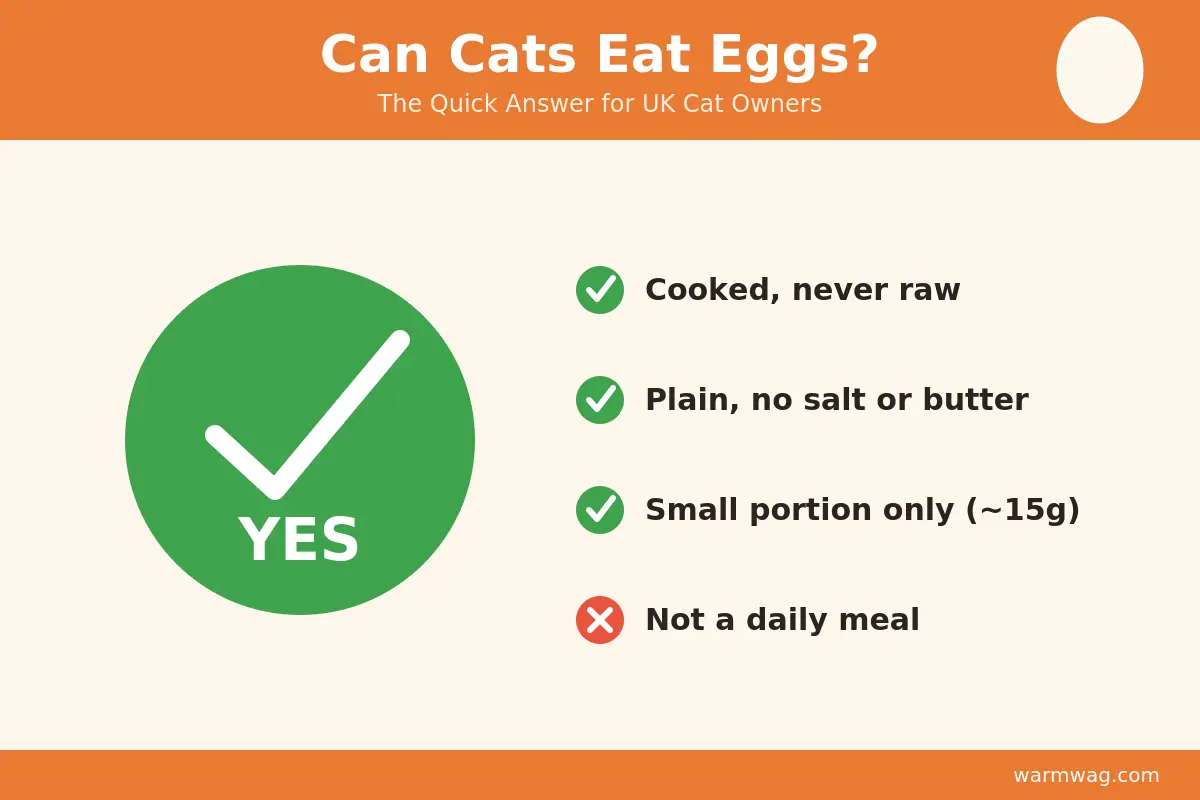
Table of Contents
- Can Cats Eat Eggs?
- Are Eggs Actually Good for Cats?
- Raw Eggs vs Cooked Eggs — What’s the Risk?
- Egg Whites vs Egg Yolks
- How to Cook Eggs for Cats Safely
- How Much Egg Can a Cat Eat? Serving Size Guide
- Can Kittens Eat Eggs?
- Can Cats Eat Eggshells?
- Cats Who Should Avoid Eggs
- Signs of an Egg Intolerance or Allergy
- What to Do if Your Cat Eats Too Much Egg
- Common Mistakes Owners Make
- FAQs
- Final Verdict
Can Cats Eat Eggs? {#can-cats-eat-eggs}
Cats are obligate carnivores, which means their bodies are built to run almost entirely on animal protein. Eggs fit naturally into that picture — they’re a concentrated source of protein and several nutrients cats can actually use, which is part of why cooked egg shows up so often as a home-prepared treat or as an ingredient in some commercial cat foods.
That said, “safe” doesn’t mean “unlimited.” A cat’s stomach is small relative to its size, and most cats only need somewhere in the region of 200–300 calories a day depending on their weight, age, and activity level. A single large egg contains roughly 70–90 calories — which sounds small until you realise that’s close to a third of an average cat’s entire daily energy needs in one item. That’s the main reason portion control matters more with eggs than with lower-calorie treats like plain cooked chicken.
The short version: cooked eggs, served plain and in small portions, are a safe and useful treat for most healthy adult cats. They should never replace a complete, balanced cat food, and raw eggs come with risks that make them not worth the trouble.
Are Eggs Actually Good for Cats? {#nutrition}
Eggs bring a genuinely useful nutritional profile to the table. One large cooked egg (roughly 50g edible portion) typically provides approximately:
| Nutrient | Amount (approx., 1 large cooked egg) | Why It Matters for Cats |
|---|---|---|
| Protein | ~6g | Supports muscle maintenance — cats need more dietary protein than dogs |
| Calories | ~70–90 kcal | High-density energy — easy to over-serve |
| Fat | ~5g | Energy source, but adds up quickly in small cats |
| Vitamin B12 | Good source | Supports nerve function and red blood cell production |
| Riboflavin (B2) | Good source | Supports energy metabolism |
| Selenium | Good source | Antioxidant support |
| Choline | Good source | Supports liver and brain function |
Eggs do not contain meaningful taurine, the amino acid cats specifically require and that’s usually the headline nutrient owners look for. So while eggs are a fine occasional protein boost, they’re not a substitute for a taurine-rich, cat-specific complete diet — that distinction is worth keeping in mind if you’re tempted to make eggs a bigger part of your cat’s routine than an occasional treat.
Raw Eggs vs Cooked Eggs — What’s the Risk? {#raw-vs-cooked}
This is the part of the “can cats eat eggs” question where owners most often go wrong, usually because raw-food diets for cats are a popular (and debated) topic online.
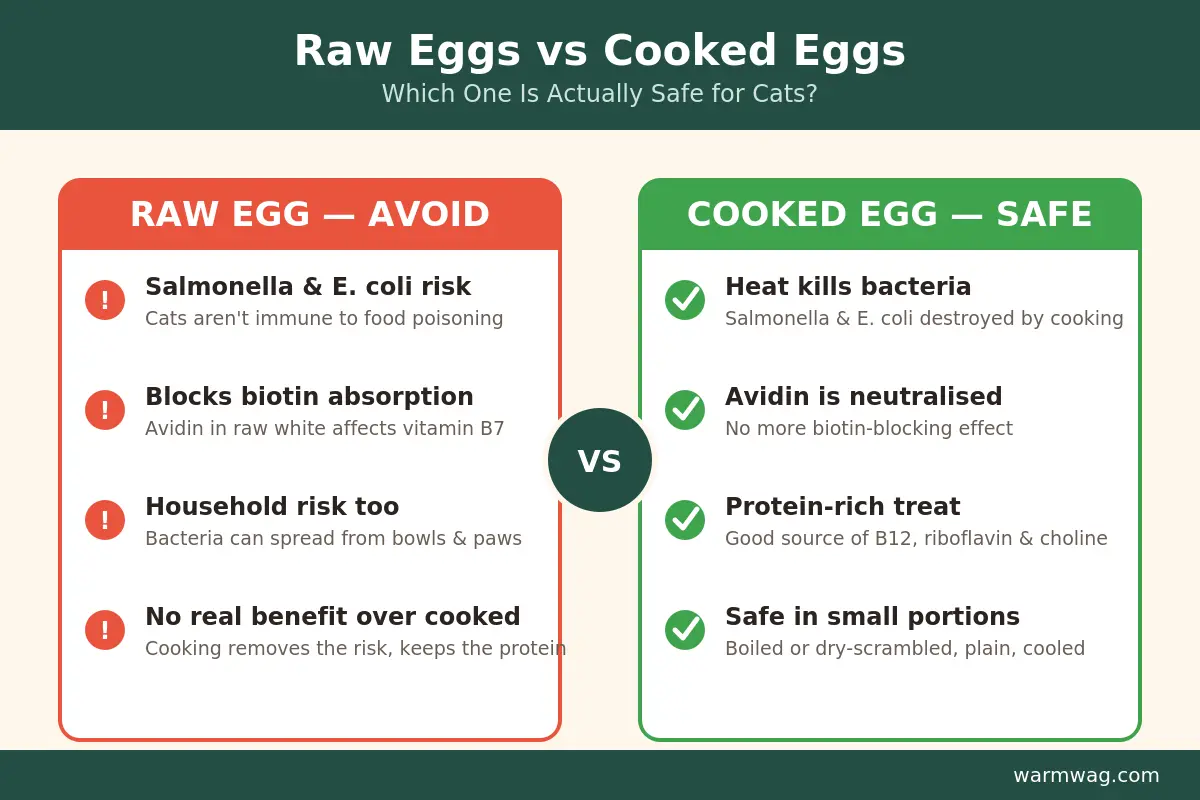
Raw eggs carry two specific risks:
Salmonella and E. coli. Raw eggs, like raw meat, can carry these bacteria. Cats have a shorter, more acidic digestive tract than humans and are somewhat more resistant to food-borne bacteria than we are — but they’re not immune, and a contaminated egg can cause vomiting, diarrhoea, and lethargy. There’s also a household risk: raw egg residue on bowls, worktops, or your cat’s whiskers and paws can transfer bacteria to humans in the home, particularly children, elderly relatives, or anyone immunocompromised.
Avidin and biotin deficiency. Raw egg white contains a protein called avidin, which binds to biotin (vitamin B7) and prevents the body from absorbing it properly. An occasional raw egg white isn’t going to cause a deficiency, but regular raw egg feeding over weeks or months could contribute to biotin deficiency, which shows up as skin and coat problems. Cooking egg whites deactivates avidin almost completely, which is the simplest reason to just cook the egg.
Cooked eggs solve both problems. Heat kills Salmonella and E. coli and neutralises avidin, which is why boiled or scrambled (dry, no fat) egg is the version worth feeding, and raw egg is the version worth skipping — even if your cat is otherwise on a raw meat diet, since raw meat and raw egg carry different specific risks.
Egg Whites vs Egg Yolks {#whites-vs-yolks}
Both parts are fine for cats once cooked, but they’re not identical:
- Egg yolk carries most of the fat, most of the calories, and most of the useful vitamins (B12, choline, selenium). It’s the tastier, more nutrient-dense part, but also the part that adds up fastest calorically — which matters for cats prone to weight gain or with a history of pancreatitis.
- Egg white is almost pure protein with very little fat, making it the better choice for overweight cats or cats on a fat-restricted diet. It’s less exciting nutritionally but lower risk for cats who need to watch their weight.
For a healthy cat at a normal weight, a small amount of whole cooked egg (yolk and white together) is perfectly fine. For an overweight or pancreatitis-prone cat, sticking to plain cooked egg white — or skipping eggs altogether and asking your vet for a lower-fat treat option — is the safer call.
How to Cook Eggs for Cats Safely {#how-to-prepare}
The preparation method matters as much as the amount. Here’s the safest approach:
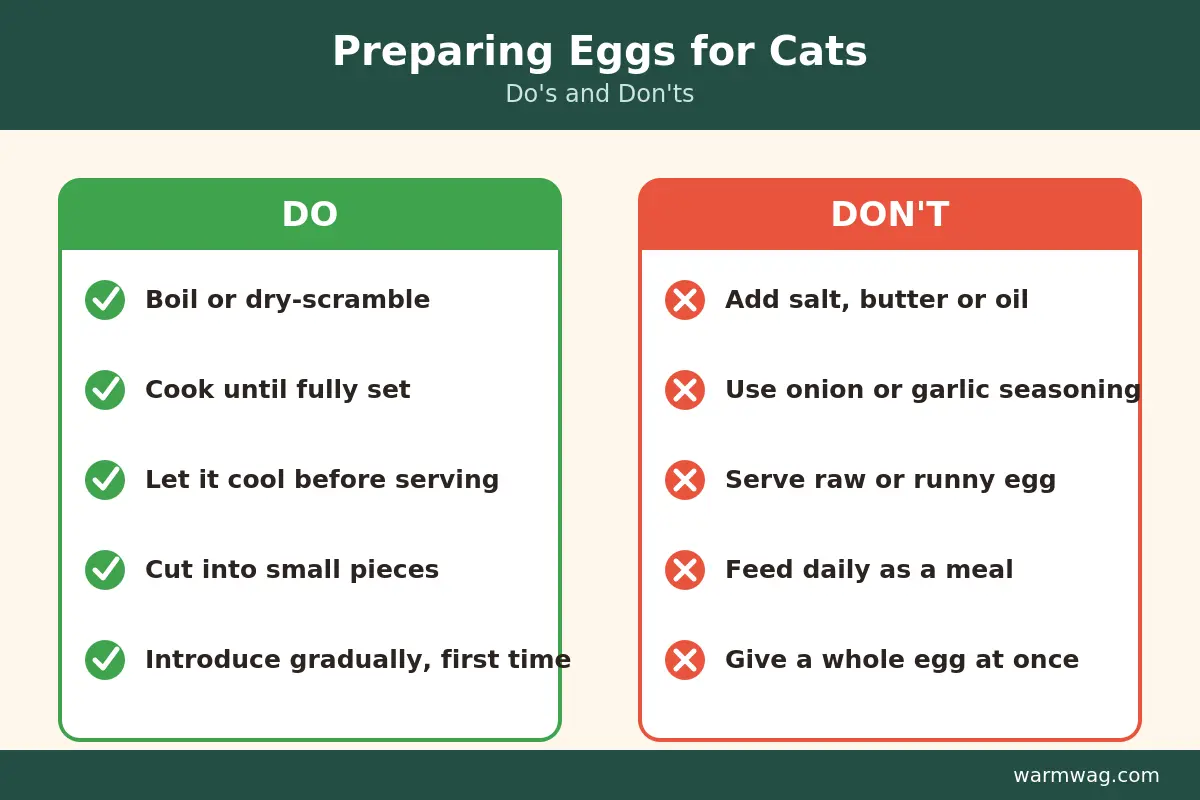
- Cook it plain. No butter, oil, milk, cream, salt, pepper, or seasoning. Onion and garlic powder — common in scrambled egg recipes for humans — are toxic to cats even in small amounts, so double-check any pre-made seasoning blend before using it near your cat’s portion.
- Boil or dry-scramble. A hard-boiled or dry-scrambled egg (cooked in a non-stick pan with no added fat) is the simplest, lowest-risk preparation.
- Cook it through. No runny yolks or soft-set whites — cook until fully set to eliminate bacterial risk.
- Let it cool. Serve at room temperature, not straight from the pan.
- Cut or mash it into small pieces. Especially for smaller cats or kittens, to reduce any choking risk and make it easier to portion accurately.
- Serve it alone or mixed into their regular food. Some cats take to egg immediately; others are indifferent. Don’t force it, and introduce it gradually the first time to watch for any digestive reaction.
Avoid egg-based dishes made for humans — quiche, omelettes with cheese or ham, or anything containing onion, garlic, excess salt, or dairy your cat may not tolerate well.
How Much Egg Can a Cat Eat? Serving Size Guide {#serving-size}
The most useful rule of thumb vets commonly apply to any treat — eggs included — is that treats shouldn’t make up more than about 10% of a cat’s daily calorie intake. Everything else (their main meals) should come from a complete, balanced cat food that meets their full nutritional needs.
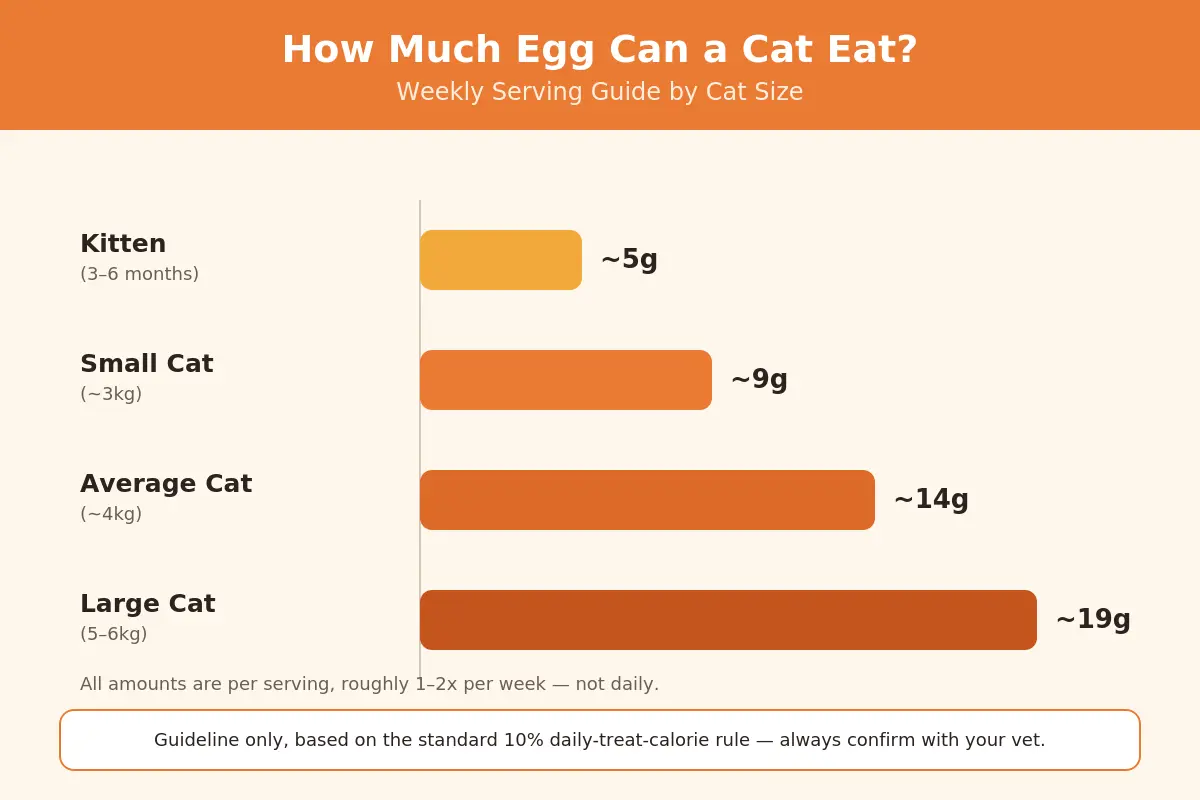
Using that rule and typical daily calorie needs by size, here’s roughly how much cooked egg fits within that 10% allowance:
| Cat Size / Weight | Typical Daily Calories | ~10% Treat Allowance | Approx. Cooked Egg Portion | Suggested Frequency |
|---|---|---|---|---|
| Kitten (3–6 months) | 150–200 kcal | 15–20 kcal | ~1 teaspoon (5g) | Occasionally, once weaned onto solids |
| Small adult cat (3kg) | 180–220 kcal | 18–22 kcal | ~1–1.5 teaspoons (8–10g) | 1x per week |
| Average adult cat (4kg) | 200–250 kcal | 20–25 kcal | ~1 tablespoon (12–15g) | 1–2x per week |
| Large adult cat (5–6kg) | 250–300 kcal | 25–30 kcal | ~1.5 tablespoons (18–20g) | 1–2x per week |
| Senior or less active cat | Lower than average | Lower than average | Smaller portion, same ratio | Less frequent |
These are general estimates, not precise medical dosing. Individual cats vary based on activity level, neuter status, and health conditions, so if your cat has any ongoing health issue, ask your own vet what’s appropriate rather than relying on a generic chart — this table is a starting point, not a substitute for that conversation.
The key mistake to avoid: treating a whole egg as “one serving.” A whole large egg is roughly 70–90 calories, which for an average 4kg cat is close to their entire daily treat allowance and then some — a whole egg is a meal-sized portion for a cat, not a snack.
Can Kittens Eat Eggs? {#kittens}
Kittens can be introduced to small amounts of well-cooked, plain egg once they’re eating solid food (generally from around 8–12 weeks, alongside their regular kitten food). Kittens have more sensitive digestive systems than adult cats, so the same rules apply but with smaller portions and more caution:
- Always fully cooked, never raw
- Start with a very small amount (a pea-sized piece) to check for any digestive upset
- Kitten food should remain the primary source of nutrition — kittens have higher and more specific nutritional needs than adult cats, and treats (including egg) shouldn’t crowd out their complete kitten diet
- If in doubt, ask your vet before introducing any new food to a kitten under 12 weeks old
Can Cats Eat Eggshells? {#eggshells}
Whole or sharp pieces of eggshell are not recommended — they pose a choking and digestive tract injury risk, and cats have no nutritional need for them if they’re on a complete, balanced diet. Some people grind eggshell into a fine powder as a home-made calcium supplement, but this isn’t necessary for cats eating a proper commercial cat food, and getting the calcium-to-phosphorus ratio wrong in home-prepared diets can cause more harm than good. If you’re considering any kind of home-made or supplemented diet, that’s a conversation for your vet or a veterinary nutritionist, not a DIY eggshell powder.
Cats Who Should Avoid Eggs {#avoid}
Eggs aren’t right for every cat. Speak to your vet before offering eggs if your cat has:
- A known egg allergy or previous reaction — rare, but it happens
- Pancreatitis (current or a history of it) — the fat content in egg yolk specifically can be a trigger
- Obesity or a vet-prescribed weight management plan — the calorie density makes eggs an easy way to undo dietary progress
- Kidney disease — your vet may want to manage protein intake carefully, and adding extra protein sources without guidance isn’t advisable
- Diabetes — while eggs are low in carbohydrate, any new food should be cleared with your vet if your cat’s diet is being carefully managed
Signs of an Egg Intolerance or Allergy {#signs}
True egg allergies in cats are uncommon, but food intolerance (which is different from an allergy) is more common and usually shows up as mild digestive upset. Watch for:
- Vomiting or loose stool within a few hours of eating egg
- Excessive itching, scratching, or skin irritation
- Lethargy or reduced appetite
- In rare true allergic reactions: facial swelling or difficulty breathing (this warrants an emergency vet visit immediately)
If you’re trying egg for the first time, offer a small amount and wait 24 hours before giving more, so you can clearly link any reaction to the new food.
What to Do if Your Cat Eats Too Much Egg {#overfed}
If your cat manages to steal a larger portion than intended — say, they got into a plate of scrambled egg — the most likely outcome is mild, short-lived digestive upset: soft stool, mild vomiting, or a temporarily reduced appetite. In most healthy adult cats, this resolves on its own within 24 hours with access to fresh water and their normal food.
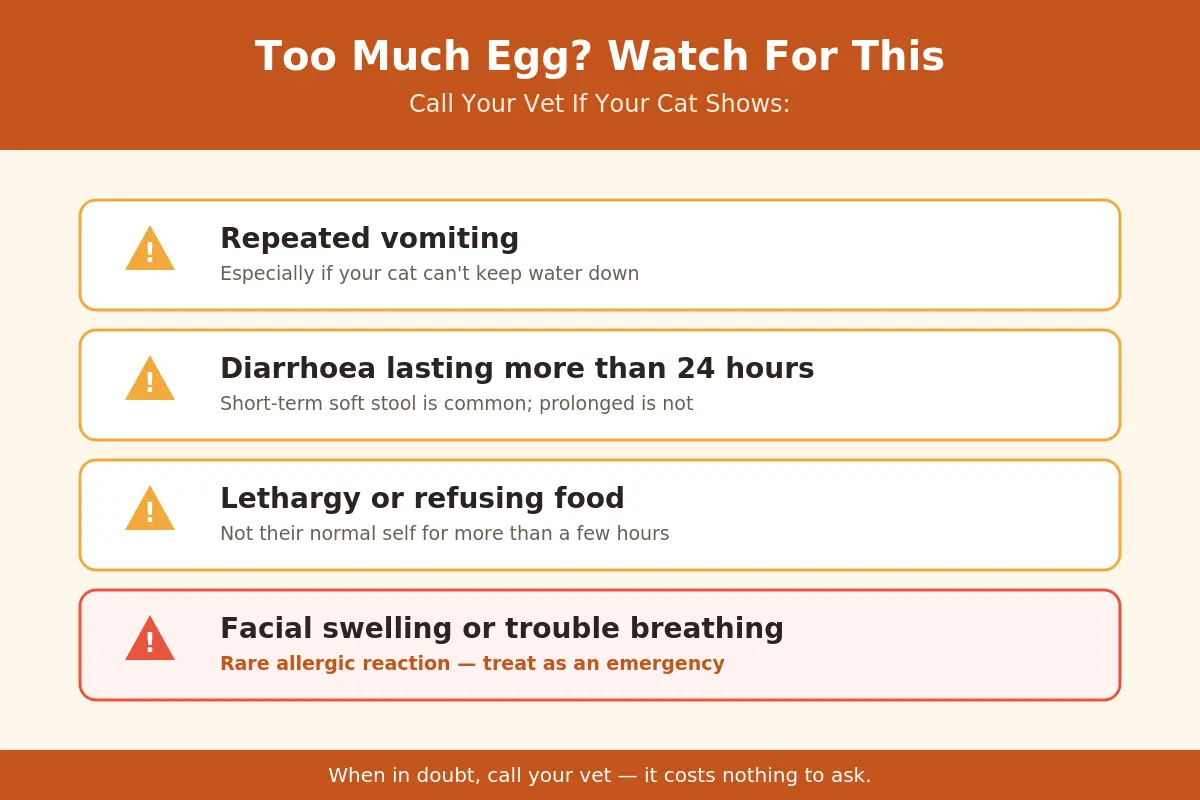
Contact your vet or an emergency vet service if your cat:
- Vomits repeatedly or can’t keep water down
- Has diarrhoea lasting more than 24 hours
- Seems lethargic, painful, or won’t eat at all
- Ate raw egg and starts showing signs of illness (possible bacterial infection)
- Has an existing health condition like pancreatitis or kidney disease
When in doubt, a phone call to your vet costs nothing and can quickly tell you whether it’s a “monitor at home” situation or one that needs a visit.
Common Mistakes Owners Make {#mistakes}
- Serving raw egg because “cats are carnivores anyway.” Being a carnivore doesn’t make a cat immune to Salmonella — cook it.
- Adding salt, butter, or seasoning because that’s how humans like their eggs. Cats don’t need any of it, and some seasonings (onion/garlic powder) are actively toxic.
- Treating a whole egg as a single “treat” portion. As covered above, a whole egg is disproportionately large for a cat’s daily calorie budget.
- Feeding eggs daily. An occasional treat (1–2x a week) is very different from a daily habit — daily egg feeding can meaningfully shift a cat’s calorie and fat intake over time.
- Using egg as a meal replacement instead of a complete cat food, especially for kittens or cats with health conditions.
FAQs {#faqs}
Can cats eat scrambled eggs? Yes — as long as they’re cooked plain (no butter, oil, milk, salt, or seasoning) and fully set, not runny. Dry-scrambled in a non-stick pan is the simplest safe method.
Can cats eat raw eggs? It’s not recommended. Raw eggs carry a Salmonella and E. coli risk, and raw egg white contains avidin, which can interfere with biotin absorption if fed regularly. Cooking eliminates both issues.
Can cats eat boiled eggs? Yes, hard-boiled egg (cooked until fully set, then cooled and cut into small pieces) is one of the easiest and safest ways to serve egg to a cat.
Can cats eat just the egg yolk? Yes, but yolk is the higher-fat, higher-calorie part of the egg, so it’s worth being extra mindful of portion size — especially for cats who are overweight or prone to pancreatitis.
Can cats eat eggshells? It’s best avoided. Shells pose a choking and injury risk, and cats don’t need the extra calcium if they’re already eating a complete, balanced diet.
How often can cats eat eggs? Once or twice a week as an occasional treat is a sensible upper limit for most healthy adult cats, using the general 10%-of-daily-calories treat guideline.
Can kittens eat eggs? Small amounts of well-cooked, plain egg are generally fine once a kitten is eating solid food, but their main nutrition should come from a complete kitten food — ask your vet before introducing new foods to very young kittens.
What if my cat steals a large piece of raw or cooked egg? Cooked egg: monitor for mild digestive upset over the next 24 hours. Raw egg: watch closely for signs of illness (vomiting, lethargy, diarrhoea) over the following days, and contact your vet if anything develops or if your cat has an existing health condition.
Final Verdict {#final-verdict}
Cooked eggs — plain, fully set, and served in small amounts — are a safe, protein-rich occasional treat for most healthy adult cats. Raw eggs aren’t worth the Salmonella and biotin-absorption risk, and no cat needs a whole egg in one sitting; a tablespoon or less (roughly 15g) once or twice a week is a sensible guideline for an average adult cat, scaled down for kittens and smaller cats. As with any new food, introduce it gradually, watch for reactions, and check with your vet first if your cat has an existing health condition.
This guide reflects general feeding advice consistent with published UK veterinary and animal welfare guidance on treat feeding and food safety. It isn’t a substitute for individual veterinary advice — always check with your own vet about your cat’s specific dietary needs.
Related guides: