Is Chocolate Toxic to Cats? UK Emergency Guide
Chocolate poisoning is talked about far more often in dogs, but cats are just as vulnerable — arguably more so, since cats are typically more sensitive to theobromine relative to their smaller body size. If your cat has gotten into any chocolate, here’s exactly what you need to know and do.
Quick Answer
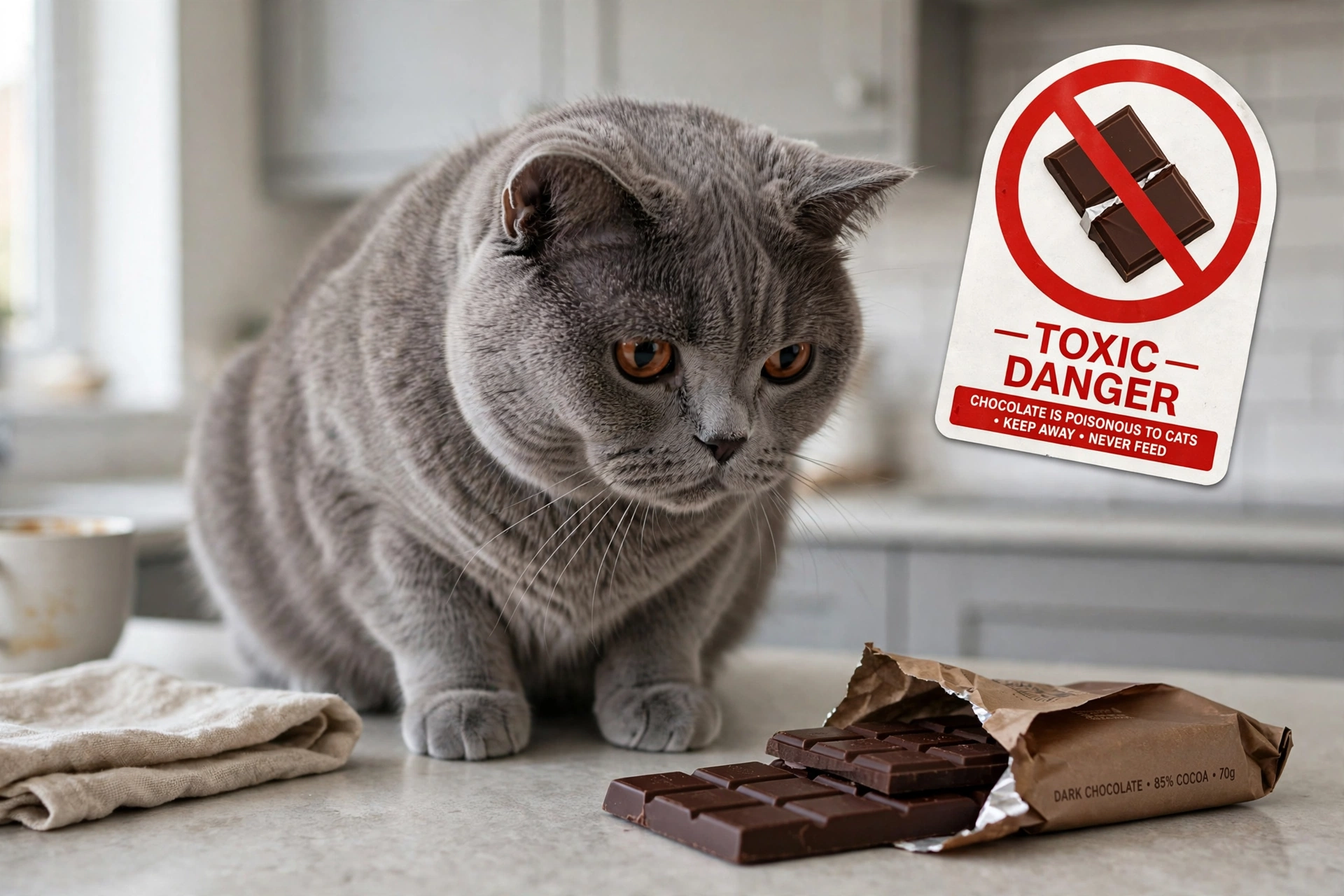
Yes, chocolate is toxic to cats, and there’s no truly “safe” amount. Chocolate contains theobromine, which cats can’t metabolise efficiently, so even small amounts can cause illness, and larger amounts can be life-threatening. Cats are generally less likely than dogs to eat chocolate voluntarily since they can’t taste sweetness, but it does happen — often through curiosity, or because chocolate is left somewhere accessible. If your cat has eaten any chocolate, contact your vet or an emergency vet immediately rather than waiting to see if symptoms develop.
Table of Contents
- Why Is Chocolate Toxic to Cats?
- Which Chocolate Is Most Dangerous?
- Symptoms Timeline
- What to Do If Your Cat Eats Chocolate
- How Vets Treat Chocolate Poisoning in Cats
- Are Kittens More at Risk?
- Why Do Cats Even Eat Chocolate?
- Prevention Tips
- FAQs
- Final Verdict
Why Is Chocolate Toxic to Cats? {#why-toxic}
Chocolate contains theobromine and caffeine, both part of a family of compounds called methylxanthines. Cats, like dogs, lack the enzyme efficiency needed to break these down quickly, so the compounds build up in their system rather than clearing out the way they would in a human. Cats tend to be particularly sensitive to theobromine relative to their body weight, which is part of why even a small amount can be a genuine concern for an average-sized cat.
Unlike dogs, cats generally aren’t drawn to chocolate by taste — cats lack the taste receptors for sweetness, so voluntary chocolate-eating is less common in cats than in dogs. That doesn’t make it a non-issue, though: cats are curious, and chocolate left within reach (on a counter, in an open bag, or as part of a dropped snack) can still end up eaten, licked, or investigated in a way that leads to exposure.
Which Chocolate Is Most Dangerous? {#which-chocolate}
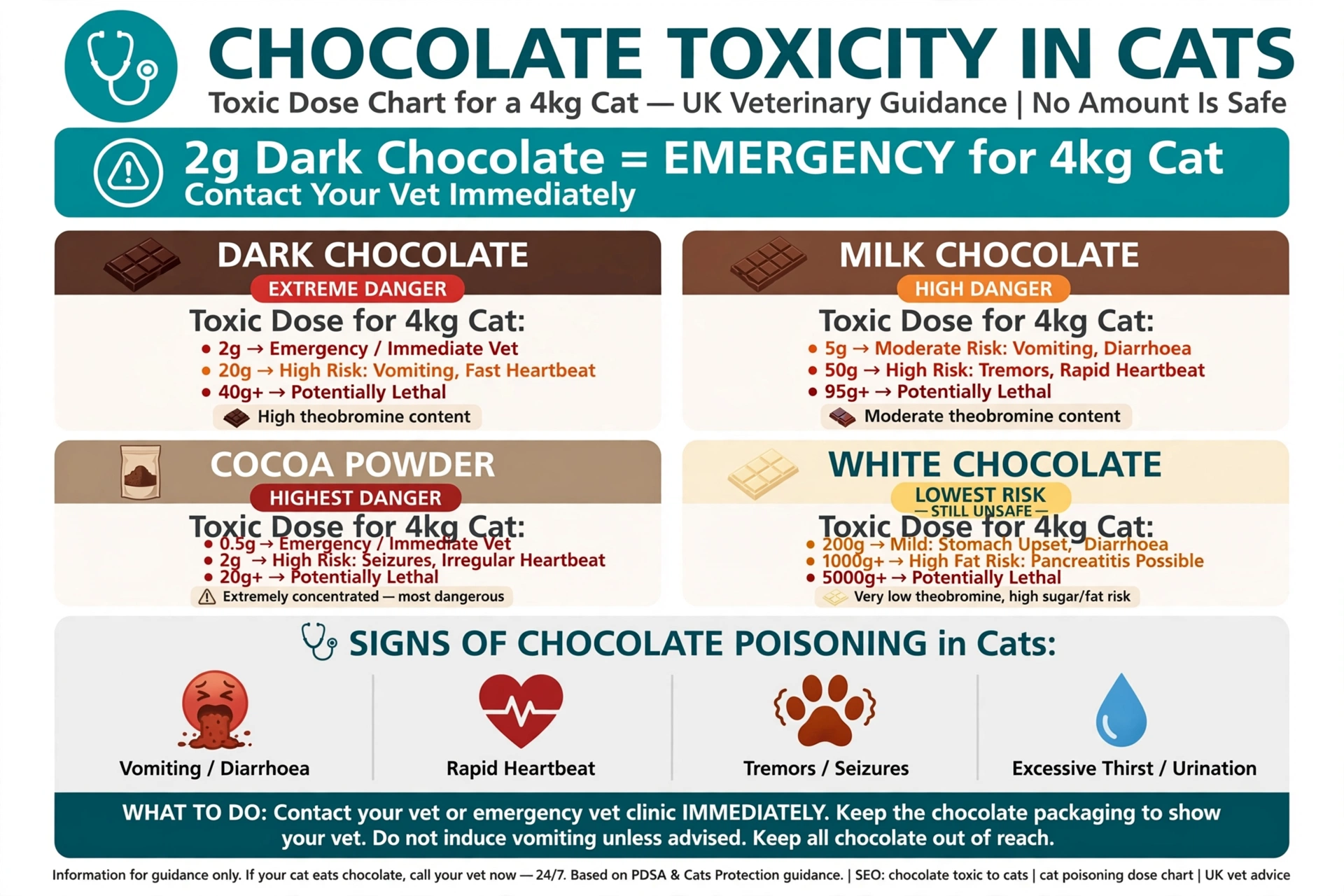
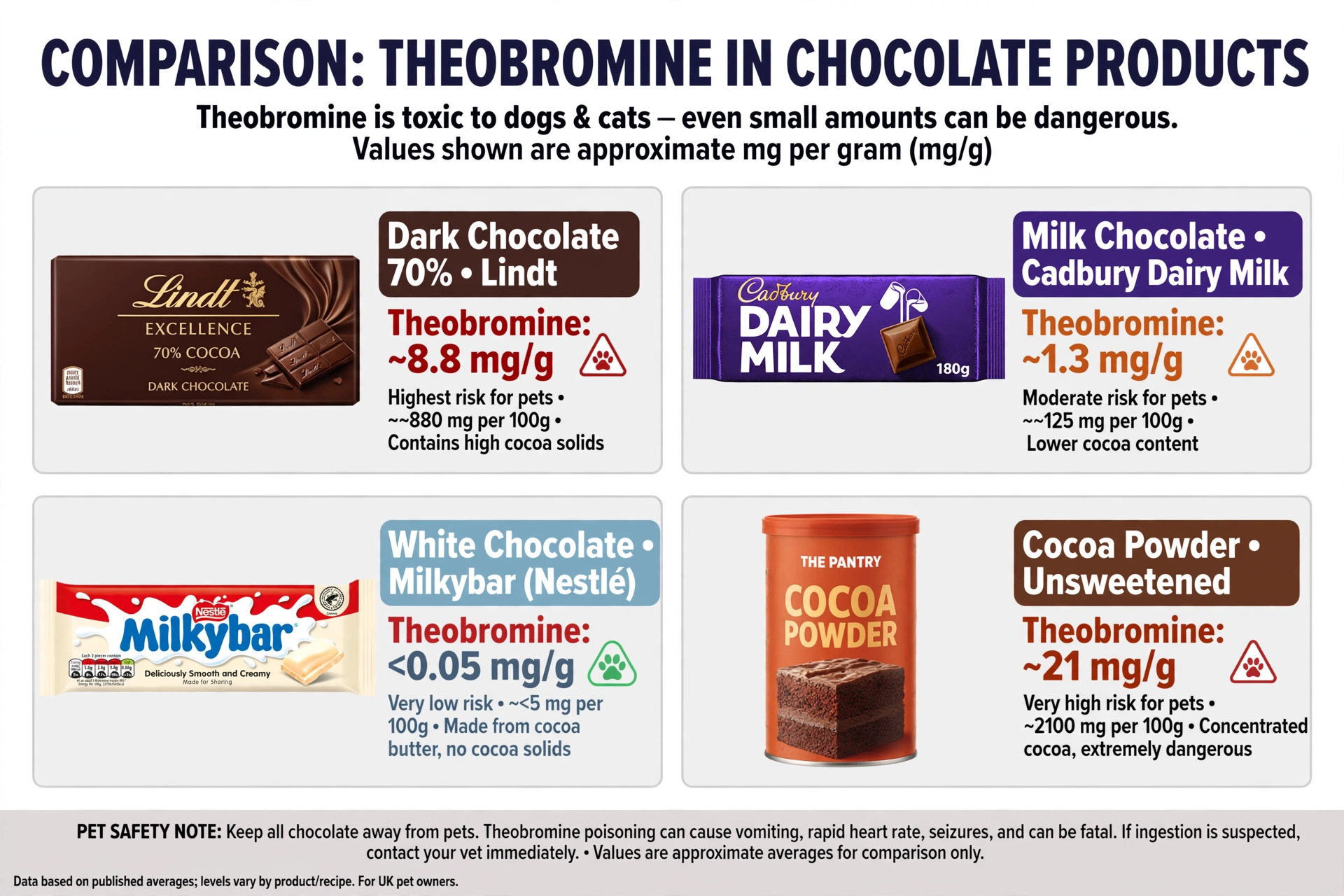
As with dogs, the theobromine content varies significantly by chocolate type, and this is the main factor in how dangerous a given amount is:
| Chocolate Type | Relative Danger | Notes |
|---|---|---|
| Baking chocolate / cocoa powder | Most dangerous | Highest theobromine concentration by far |
| Dark chocolate | High danger | Significantly more theobromine than milk chocolate |
| Milk chocolate | Moderate danger | Lower theobromine, but still a genuine risk in a small cat |
| White chocolate | Low theobromine risk | Minimal theobromine, but high fat and sugar can still cause digestive upset or pancreatitis |
Given how much smaller the toxic threshold is for a typical cat compared to a typical dog, any chocolate exposure in a cat is worth treating seriously and contacting your vet about, regardless of the type.
Symptoms Timeline {#symptoms}
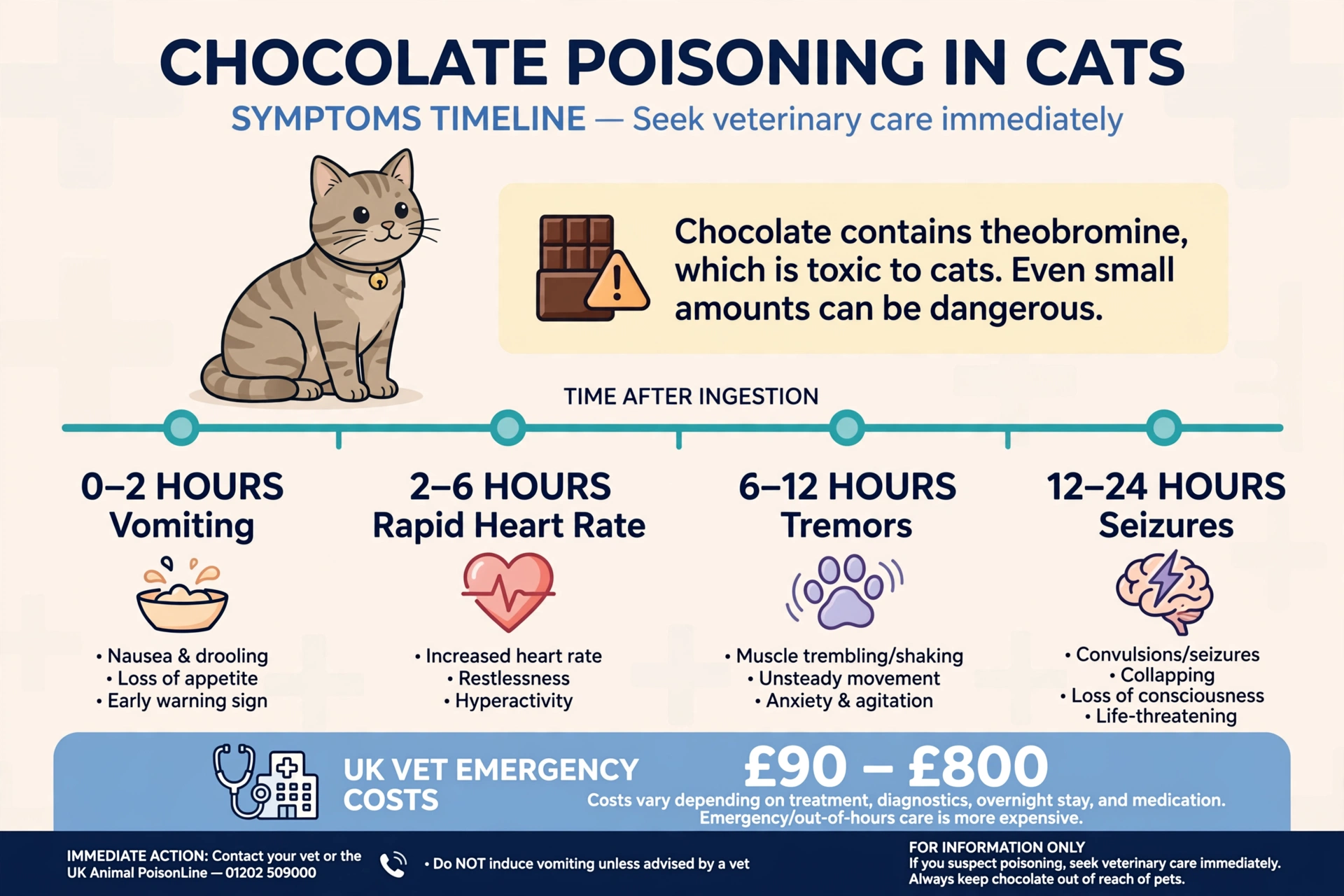
Early signs (within a few hours): Vomiting, diarrhoea, restlessness, increased thirst, and a faster heart rate.
As it progresses: Muscle tremors, agitation, a significantly elevated heart rate, and in more serious cases, seizures.
Delayed complications: Heart rhythm problems can develop later than the initial digestive symptoms, which is why vets often want to monitor a cat for longer than just the first few hours after a known exposure, even if early symptoms seem to resolve.
What to Do If Your Cat Eats Chocolate {#what-to-do}
- Remove any remaining chocolate so your cat can’t access more.
- Note the details — the type of chocolate, roughly how much, and how long ago it happened. This helps your vet judge urgency and treatment.
- Call your vet or an emergency vet immediately. Don’t wait for symptoms to appear.
- Don’t try to induce vomiting at home unless specifically told to — this needs to be judged and, if appropriate, done by a vet.
- Don’t give milk or other home remedies — these don’t neutralise theobromine and can delay proper treatment.
How Vets Treat Chocolate Poisoning in Cats {#treatment}
Treatment approaches are similar to those used in dogs. If a cat is seen soon after eating chocolate, a vet may induce vomiting to remove as much as possible before it’s absorbed. Beyond that early window, treatment typically shifts to activated charcoal to bind remaining theobromine in the gut, along with IV fluids to support hydration and help flush the compound out of the system. Heart rate and rhythm are monitored closely, since that’s where more serious complications tend to appear, and medication may be used if the heart rate is dangerously elevated or irregular.

There’s no specific antidote for chocolate poisoning — treatment is entirely supportive, which is exactly why getting to a vet quickly matters so much: the sooner supportive treatment starts, the better the odds of a full recovery.
Are Kittens More at Risk? {#kittens}
Yes. Kittens have a much smaller body weight, meaning a given amount of chocolate represents a proportionally larger dose than it would for an adult cat. Their organs are also still developing, which can make them more vulnerable generally to toxins and slower to recover. Any chocolate exposure in a kitten is worth treating as more urgent than the same exposure in a healthy adult cat.
Why Do Cats Even Eat Chocolate? {#why-eat-it}
Since cats can’t taste sweetness, chocolate exposure in cats is less often about a cat deliberately seeking it out and more often about curiosity, texture, or simply investigating something new and accessible — licking wrapping, nosing at an open box, or getting into something left on a counter or low table. This is worth knowing because it shifts the prevention focus: it’s less about “keeping chocolate away from a cat with a sweet tooth” and more about general accessibility — the same reasoning that applies to keeping any unfamiliar substance out of reach of a curious cat.
Prevention Tips {#prevention}
- Store chocolate in a closed cupboard rather than left out on a counter or table
- Be extra mindful around Christmas, Easter, and Valentine’s Day, when chocolate is more likely to be sitting out at accessible heights
- Keep an eye on wrapping and packaging too, not just the chocolate itself, since curious licking or chewing on wrappers is part of how exposure often happens
- Let visitors and family members know chocolate needs to stay out of reach, the same way you would for any household hazard
FAQs {#faqs}
Is a small amount of chocolate actually dangerous for a cat? Yes — cats are quite sensitive to theobromine relative to their size, so even a small amount is worth taking seriously and contacting your vet about.
Is dark chocolate worse than milk chocolate for cats? Yes, significantly — dark and baking chocolate contain far more theobromine per gram than milk chocolate.
What if my cat only licked a small amount? Still contact your vet. It’s better to get guidance on a minor exposure than to wait and potentially miss the window where treatment is most effective.
Can white chocolate harm my cat? The theobromine risk is low, but the high fat and sugar content can still cause digestive upset or, in some cases, contribute to pancreatitis — it’s not a “safe” option even if the classic toxicity risk is lower.
How long does it take for symptoms to appear? Early symptoms often appear within a few hours, but heart-related complications can develop later, which is why vets may want to monitor a cat for longer than just the first few hours.
Is there a treatment that reverses chocolate poisoning? No specific antidote exists — treatment is supportive (fluids, charcoal, monitoring), which is why prompt veterinary attention matters so much for the best outcome.
Final Verdict {#final-verdict}
Chocolate is genuinely toxic to cats, and while cats are less likely than dogs to seek it out due to their inability to taste sweetness, accidental exposure still happens and should always be taken seriously. There’s no reliably “safe” amount, and no antidote once poisoning occurs — the best outcome comes from prompt veterinary attention rather than a wait-and-see approach. Keeping chocolate stored well out of reach is a simple habit that removes the risk entirely.
This guide is for general information and isn’t a substitute for professional veterinary advice. If your cat has eaten chocolate, contact your vet or an emergency vet service directly.
Further reading:
Related guides: