Can Cats Eat Raw Chicken? UK Safety & Feeding Guide (2026)
Chicken is the single most common protein in cat food, so it’s a natural question: if it’s already in the bowl, why not skip the cooking? This is one of the more genuinely debated questions in cat feeding — raw-feeding advocates and mainstream vets don’t fully agree — so this guide gives you both sides plainly, along with the practical safety information you need either way.
Quick Answer
Cats can technically eat raw chicken, but most UK vets recommend cooked chicken instead. Raw chicken carries a real risk of Salmonella and Campylobacter, which can make your cat ill and can also spread to people in the household. If you do want to raw-feed, it needs to be done properly — with good sourcing, safe handling, and a nutritionally complete formulation, not just raw muscle meat on its own. Cooked, plain, boneless chicken remains the simpler, lower-risk way to give your cat this protein.
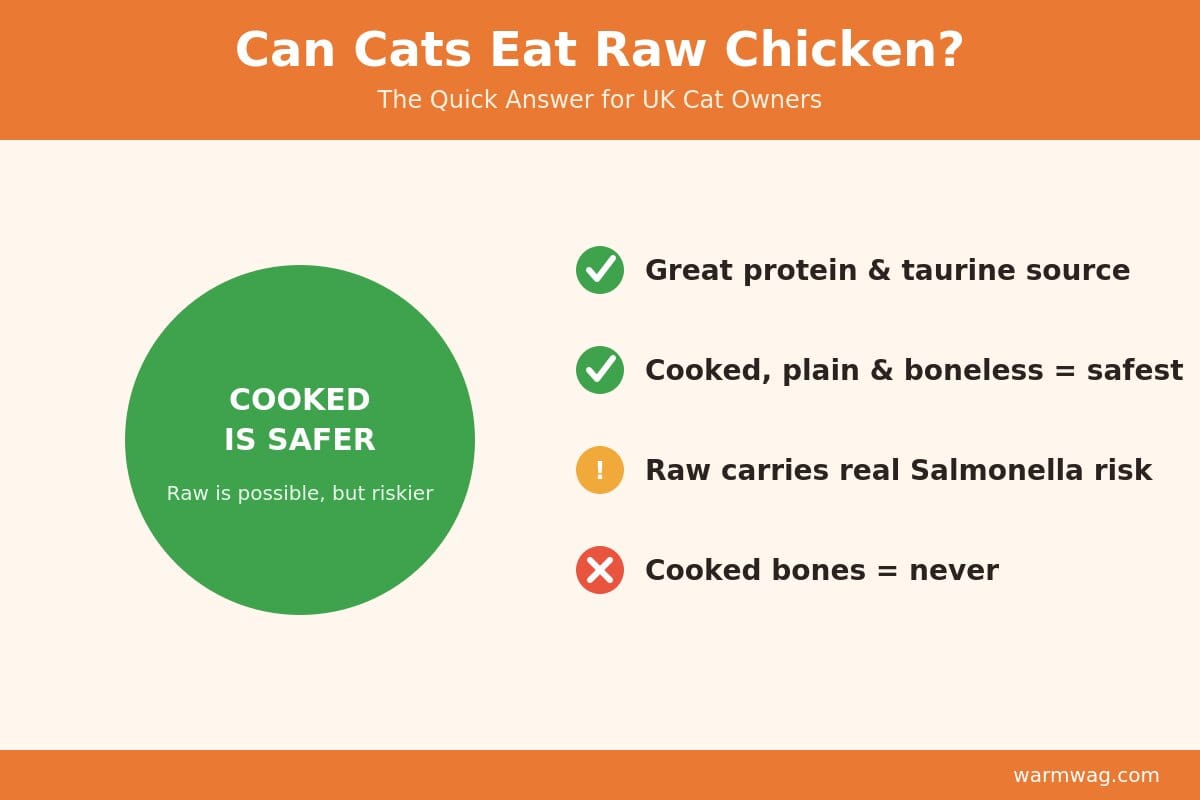
Table of Contents
- Can Cats Eat Raw Chicken?
- Why Chicken Is Actually Good for Cats
- The Raw Chicken Risk: Salmonella & Campylobacter
- The Raw Feeding Debate — Both Sides
- Chicken Bones: Raw vs Cooked
- How to Prepare Chicken for Cats Safely
- How Much Chicken Can a Cat Eat?
- Cats Who Should Never Have Raw Chicken
- Signs of Food Poisoning in Cats
- What to Do if Your Cat Eats Raw Chicken Unsupervised
- Common Mistakes Owners Make
- FAQs
- Final Verdict
Can Cats Eat Raw Chicken? {#can-cats-eat-raw-chicken}
Cats are obligate carnivores — unlike dogs, they can’t thrive on a plant-heavy diet and are biologically built to eat meat. Chicken fits that description well: it’s lean, high in protein, and naturally contains taurine, an amino acid cats must get from their diet because their bodies can’t produce enough of it themselves (a taurine deficiency can eventually cause serious heart and eye problems). In that sense, chicken is a genuinely good fit for a cat’s biology, in a way that fruit or vegetables never really are.
The debate isn’t really about whether chicken is good for cats — it clearly can be. It’s about whether it should be served raw or cooked. Raw feeding has a passionate following among some cat owners who see it as closer to a cat’s natural, ancestral diet. Most veterinary bodies, meanwhile, continue to recommend cooked chicken for the average household, largely because of bacterial risk. Both positions have real reasoning behind them, which is why this guide covers both rather than picking a side for you.
Why Chicken Is Actually Good for Cats {#nutrition}
Cooked, skinless chicken breast (roughly 100g) provides approximately:
| Nutrient | Amount (approx., cooked chicken breast) | Why It Matters for Cats |
|---|---|---|
| Calories | ~165 kcal | Energy-dense, lean protein source |
| Protein | ~31g | Supports muscle mass — cats need more protein than most mammals |
| Taurine | Naturally present | Essential amino acid cats can’t synthesise enough of themselves |
| Fat | ~3.6g (skinless breast) | Moderate — useful without being excessive |
| Vitamin B6 | Good source | Supports metabolism and immune function |
| Phosphorus | Good source | Supports bone health (alongside calcium) |
This is part of why chicken is such a common base ingredient in both wet and dry cat food — nutritionally, it’s a strong match for what cats actually need. The open question is purely about the safest way to serve it at home.
The Raw Chicken Risk: Salmonella & Campylobacter {#risks}
This is the central safety issue, and it’s worth being direct about it rather than downplaying it either way.
For your cat: Cats have a shorter, more acidic digestive tract than humans, which gives them some natural resistance to food-borne bacteria — but “some resistance” isn’t the same as immunity. Raw poultry can carry Salmonella and Campylobacter, and cats can and do get sick from both, with symptoms including vomiting, diarrhoea (sometimes bloody), fever, and lethargy. Kittens, senior cats, and cats with existing health conditions are more vulnerable.
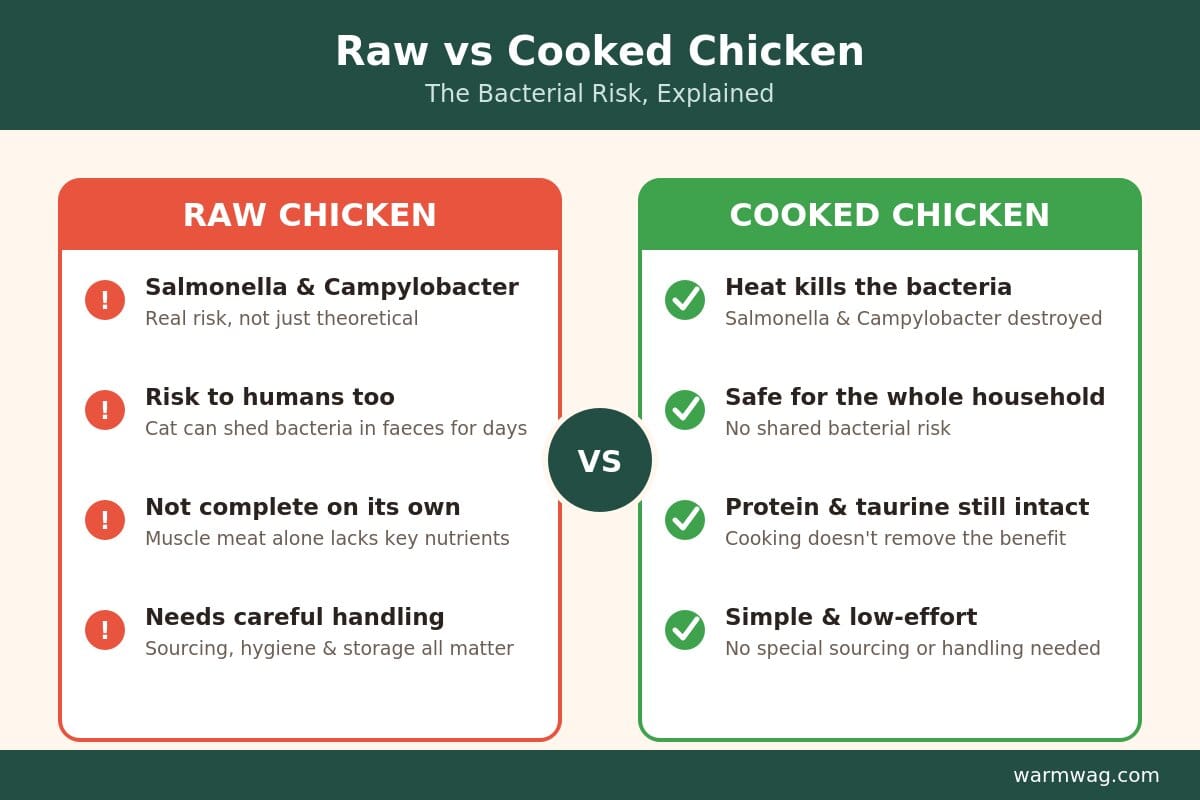
For your household: This is the risk that’s often underweighted in raw-feeding discussions. A cat eating raw chicken can shed Salmonella or Campylobacter in their faeces for days afterwards, even without showing symptoms themselves. Bacteria can also spread from food bowls, prep surfaces, and your cat’s mouth or paws. This matters more if anyone in the household is pregnant, elderly, very young, or immunocompromised, since they’re more vulnerable to food-borne illness than a healthy adult.
Cooking chicken to a safe internal temperature kills both bacteria, which is the simplest reason cooked chicken carries meaningfully less risk than raw.
The Raw Feeding Debate — Both Sides {#debate}
This is genuinely a topic where reasonable, informed people land in different places, so here’s a fair summary of both:
The case raw-feeding advocates make:
- Cats evolved eating raw prey, and a raw, meat-based diet is argued to be closer to what a cat’s digestive system is “designed” for
- Some raw-feeding owners report improvements in coat condition, energy, stool quality, and dental health, though this is based on personal observation rather than large-scale controlled studies
- Properly formulated raw diets (commercial raw or a carefully balanced homemade recipe) can meet a cat’s nutritional needs when done correctly
The case mainstream veterinary bodies make:
- Major veterinary and public health organisations generally advise against raw feeding, primarily due to the Salmonella/Campylobacter risk to both pets and humans
- Raw muscle meat alone (just chicken breast, for example) is not nutritionally complete for a cat — it’s missing the correct calcium-to-phosphorus ratio, adequate taurine levels, and various vitamins and minerals a cat would get from eating a whole prey animal (organs, bone, and all)
- Homemade raw diets that aren’t carefully formulated (ideally with input from a veterinary nutritionist) carry a real risk of long-term nutritional deficiency, even if the cat seems fine in the short term
- There’s also a parasite consideration — raw meat can carry parasites that cooking eliminates
The practical middle ground most vets are comfortable with: if you want to raw-feed, use a commercially prepared, complete-and-balanced raw cat food from a reputable manufacturer (rather than feeding plain raw chicken breast on its own), follow safe handling practices, and discuss it with your vet — particularly if your cat is a kitten, senior, pregnant, or has any health condition. If that’s more commitment than you want, cooked chicken gets you the protein and taurine benefits without the bacterial and nutritional-completeness concerns.
Chicken Bones: Raw vs Cooked {#bones}
This is one area where raw and cooked genuinely aren’t equivalent, and it’s worth understanding why.
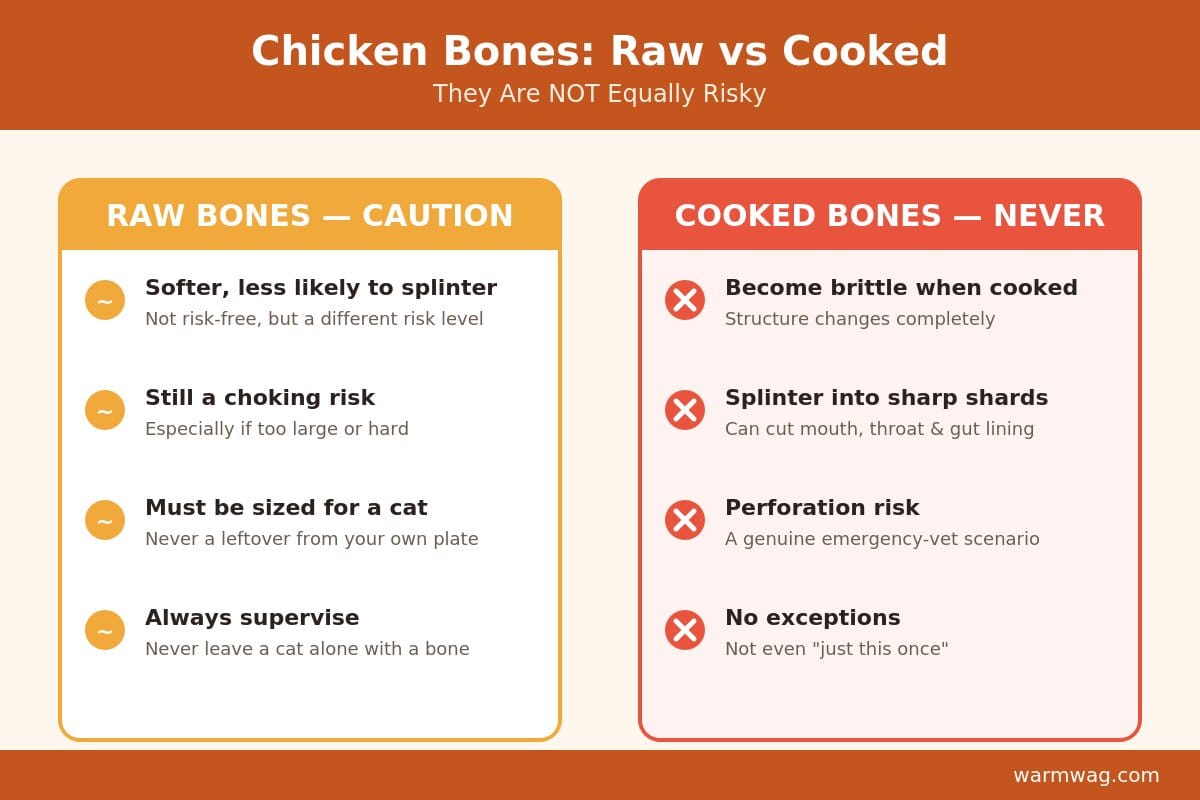
Cooked bones should never be given to cats, no exceptions. Cooking changes the bone’s structure, making it brittle. Cooked bones splinter into sharp shards that can cause choking, damage to the mouth and throat, or perforate the stomach or intestines — this is a real emergency-vet scenario, not a theoretical risk.
Raw bones are a genuinely different case, but still not risk-free. Raw bones are softer and less prone to splintering than cooked ones, which is why some raw-feeding advocates include appropriately sized raw meaty bones as part of a cat’s diet, often for dental benefits. However, they still carry a risk of choking, tooth fracture, or gastrointestinal obstruction, especially if the bone is too large, too hard (weight-bearing bones like drumsticks are firmer than rib or wing bones), or your cat tends to gulp rather than chew. Any bones should be sized appropriately for a cat (not a leftover from your own dinner) and always supervised.
The simplest and lowest-risk approach for most owners: boneless chicken, whether cooked or raw. It removes this entire category of risk without giving up any of the nutritional benefit.
How to Prepare Chicken for Cats Safely {#preparation}
If serving cooked chicken (the lower-risk, more common approach):
- Boil, poach, or bake plain — no salt, no seasoning, no oil or butter
- Skip anything containing onion or garlic powder — both are toxic to cats even in small amounts, and they’re common in pre-made seasoning blends
- Remove all bones and skin (skin adds unnecessary fat)
- Cook until fully done, then let it cool before serving
- Cut or shred into small, cat-appropriate pieces
If you’re committed to raw feeding:
- Use a commercially prepared, complete-and-balanced raw cat food rather than plain raw chicken breast alone
- Buy from a reputable supplier and follow the same food-safety practices you would for raw meat you’re preparing for yourself — separate chopping boards, thorough handwashing, and prompt refrigeration
- Don’t leave raw food sitting out — bacteria multiply quickly at room temperature
- Wash your cat’s bowl thoroughly after every raw meal, ideally with hot, soapy water
- Talk to your vet first, especially for kittens, senior cats, or cats with any health condition — and be extra cautious if anyone in your household is pregnant, elderly, very young, or immunocompromised
How Much Chicken Can a Cat Eat? {#serving-size}
If chicken is being used as a treat or food topper alongside a complete cat food (rather than as the entire diet), the same general 10%-of-daily-calories treat guideline applies:
| Cat Size / Weight | Typical Daily Calories | ~10% Treat Allowance | Approx. Cooked Chicken Portion |
|---|---|---|---|
| Kitten (3–6 months) | 150–200 kcal | 15–20 kcal | ~10g |
| Small adult cat (3kg) | 180–220 kcal | 18–22 kcal | ~12g |
| Average adult cat (4kg) | 200–250 kcal | 20–25 kcal | ~14g |
| Large adult cat (5–6kg) | 250–300 kcal | 25–30 kcal | ~17g |
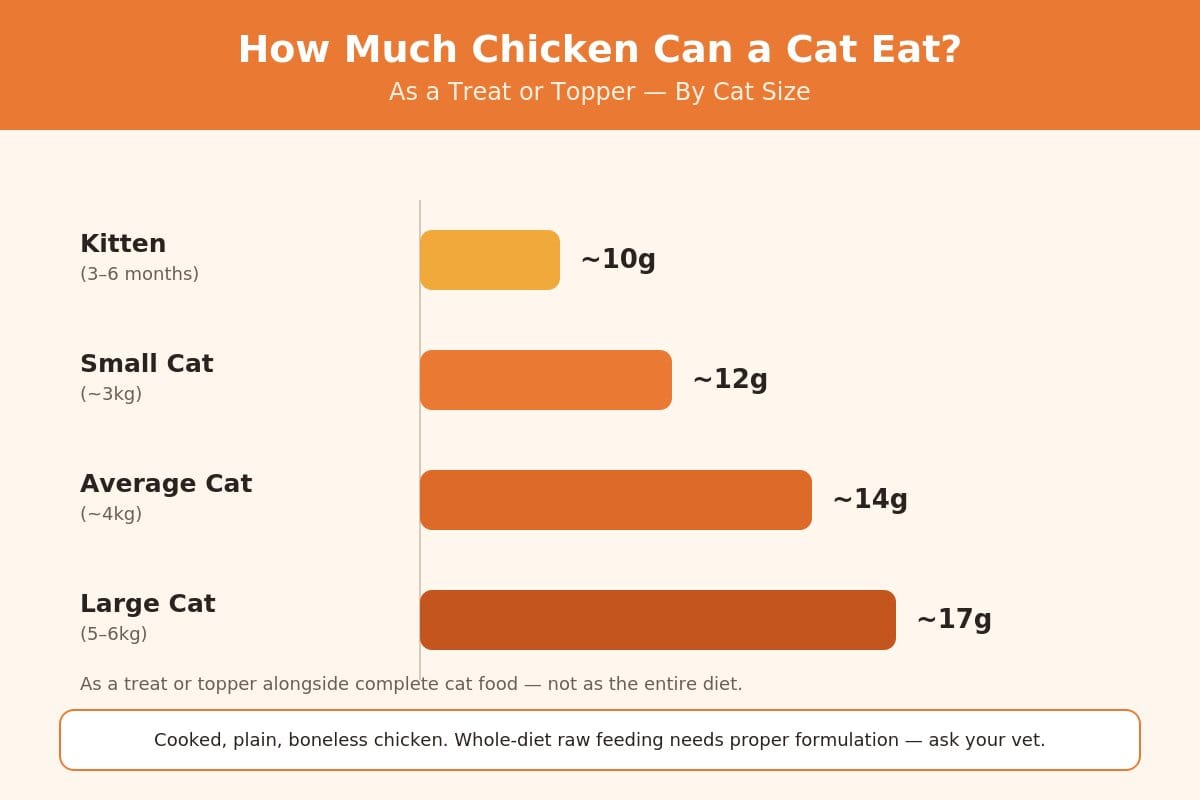
Important distinction: this table is for chicken as an occasional addition to a complete diet, not for chicken as a cat’s entire diet. If you’re moving toward chicken (raw or cooked) as a significant part of what your cat eats, that’s a different conversation — plain chicken alone isn’t nutritionally complete, and you’d need either a properly formulated commercial raw/fresh food or veterinary guidance on supplementation (calcium, taurine, and other nutrients a cat would otherwise get from organs and bone).
Cats Who Should Never Have Raw Chicken {#avoid}
Raw chicken specifically (as opposed to cooked chicken, which is fine for most cats) is best avoided for:
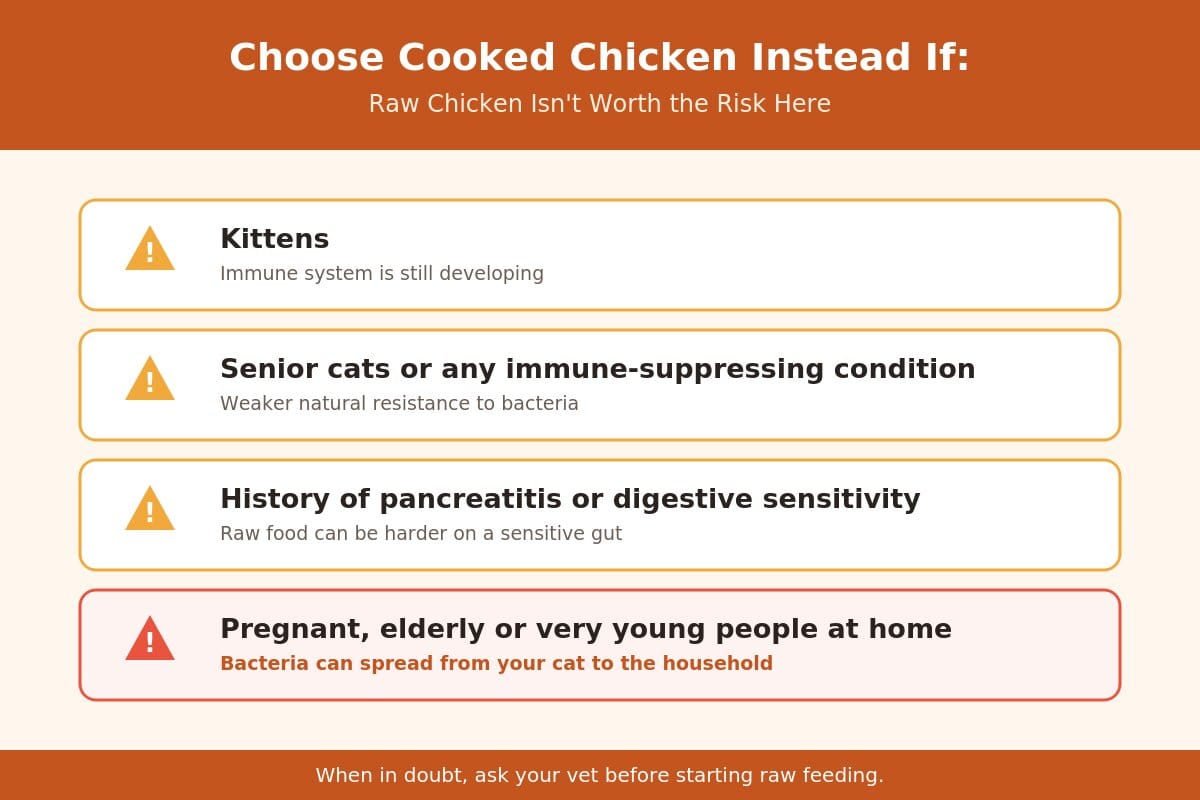
- Kittens — still-developing immune systems make them more vulnerable to Salmonella and Campylobacter
- Senior cats — often have a somewhat weaker immune response
- Cats with any immune-suppressing condition, or those on immunosuppressive medication
- Cats with a history of pancreatitis or digestive sensitivity — introducing raw food can be harder on an already sensitive digestive system
- Any household with a pregnant, elderly, very young, or immunocompromised person, given the shared bacterial risk
If any of these apply, cooked chicken gives you the same nutritional benefit without the added risk.
Signs of Food Poisoning in Cats {#signs}
If your cat has eaten raw chicken and picks up a Salmonella or Campylobacter infection, watch for:
- Vomiting
- Diarrhoea, sometimes with blood or mucus
- Fever
- Lethargy or noticeably reduced energy
- Loss of appetite
- Abdominal discomfort (a hunched posture, reluctance to be touched around the belly)
Symptoms typically appear within a few days of exposure, though timing varies.
What to Do if Your Cat Eats Raw Chicken Unsupervised {#unsupervised}
If your cat manages to snatch a piece of raw chicken off the counter, don’t panic — most cats won’t come to harm from a single, small, unplanned taste, especially if the chicken was fresh and properly refrigerated beforehand. Still, it’s worth:
- Monitoring your cat over the next few days for any of the symptoms above
- Checking there are no bones involved, or that any bone fragments were small and unlikely to cause obstruction
- Washing your hands and any surfaces your cat’s mouth may have touched, as a general hygiene precaution
- Contacting your vet if your cat shows any symptoms, ate a large amount, ate bones, or falls into one of the higher-risk groups above (kitten, senior, or an existing health condition)
Common Mistakes Owners Make {#mistakes}
- Feeding raw chicken breast alone as a “healthy treat” without realising that regular raw feeding needs proper formulation to stay nutritionally complete
- Giving cooked bones, not realising they’re genuinely more dangerous than raw ones due to splintering
- Not accounting for household risk — treating raw feeding as purely a “will my cat be okay” question when it’s also a “will my family be okay” question
- Leaving raw food out for grazing rather than serving a fresh portion and removing what’s left after a reasonable window
- Skipping the vet conversation before starting raw feeding, especially for kittens or cats with existing health conditions
FAQs {#faqs}
Can cats eat raw chicken?
Yes, technically, but most UK vets recommend cooked chicken instead because of the Salmonella and Campylobacter risk to both cats and the humans in the household.
Is raw chicken better for cats than cooked?
It’s genuinely debated. Raw-feeding advocates argue it’s closer to a cat’s natural diet; most veterinary bodies favour cooked chicken due to bacterial risk. Nutritionally, properly formulated versions of either can work — the deciding factor for most owners is risk tolerance and how carefully the diet is put together.
Can cats eat raw chicken bones?
Raw bones are less likely to splinter than cooked ones, but they still carry a choking, tooth-fracture, or obstruction risk. If included at all, they should be appropriately sized and always supervised — boneless is the lower-risk default for most owners.
Can cats eat cooked chicken bones?
No — never. Cooked bones become brittle and splinter into sharp pieces that can injure a cat’s mouth, throat, or digestive tract.
How much raw or cooked chicken can a cat eat?
As an occasional treat or topper alongside a complete cat food, around 10–17g depending on your cat’s size is a sensible guideline (see the table above). As a larger part of the diet, it needs to be nutritionally complete, not just muscle meat.
Is raw chicken safe for kittens?
It’s best avoided. Kittens have less mature immune systems and are more vulnerable to food-borne bacteria than adult cats.
Can raw chicken make humans sick too, not just cats?
Yes — this is an important and often overlooked part of the raw-feeding conversation. Salmonella and Campylobacter can spread from your cat’s food, bowl, or waste to people in the household.
Final Verdict {#final-verdict}
Chicken itself is a genuinely good fit for a cat’s nutritional needs — lean, protein-rich, and a natural source of taurine. Whether to serve it raw or cooked is a real, ongoing debate rather than a settled question: raw feeding has legitimate advocates and, done properly, can work, but it comes with bacterial and nutritional-completeness responsibilities that cooked chicken simply doesn’t. For most UK households, cooked, plain, boneless chicken remains the lower-effort, lower-risk way to give a cat this protein. If you’re drawn to raw feeding, do it with a complete commercial raw product, good food hygiene, and your vet’s input — rather than plain raw chicken breast on its own.
This guide reflects general feeding information consistent with published UK veterinary guidance on raw feeding and food safety. It isn’t a substitute for individual veterinary advice — talk to your own vet about what’s right for your cat, especially before starting any raw diet.
Related guides:
 Can Cats Eat Eggs UK? →
 Can Cats Eat Cheese UK? →
 Is Chocolate Toxic to Cats? →