Do Dogs Need Probiotics? Complete UK Guide
Probiotics have exploded from a niche supplement into one of the most searched dog health topics in the UK — but the honest answer to “does my dog need one” is more nuanced than most product pages let on. Some uses have real, published evidence behind them. Others are still genuinely uncertain. This guide covers both, without overselling either way.

Quick Answer
Most healthy dogs with normal digestion don’t need a daily probiotic. Where the evidence is strongest is for shorter-term situations: during and after a course of antibiotics, during bouts of diarrhoea, and around stressful events or diet changes. A handful of specific, well-studied strains (not “probiotics” as a vague category) have genuine published evidence behind them — the strain matters far more than the marketing on the packet. Talk to your vet before starting one, especially for puppies, senior dogs, or dogs with an existing health condition.
Table of Contents
- What Are Probiotics, Actually?
- Does the Science Actually Support Them?
- When Probiotics Genuinely Help
- Specific Strains and What They’re Good For
- Human Probiotics vs Dog-Specific Ones
- Food Sources vs Supplements
- How to Choose a Probiotic Supplement
- Dosing and How Long to Use One
- Possible Side Effects
- When to See a Vet Instead
- The Gut-Skin-Immune Connection
- Common Myths About Dog Probiotics
- FAQs
- Final Verdict
What Are Probiotics, Actually? {#what-are-they}
Probiotics are live beneficial microorganisms — mostly specific strains of bacteria — that support a dog’s gut microbiome, the vast community of microbes living in their digestive tract. A healthy, balanced gut microbiome helps with digestion, supports the gut’s barrier function (keeping harmful bacteria and toxins from crossing into the bloodstream), and interacts with the immune system in ways researchers are still actively mapping.
The idea behind supplementing with probiotics is straightforward: add more of the “good” bacteria to help crowd out harmful ones and support a gut that’s under strain — from illness, stress, antibiotics, or a sudden diet change.
Does the Science Actually Support Them? {#the-science}
This is worth answering honestly rather than with marketing language. Veterinary research into probiotics is genuinely still developing, and it’s fair to say the evidence is stronger for some specific uses than for others, and stronger for some specific strains than for “probiotics” as a vague blanket category.
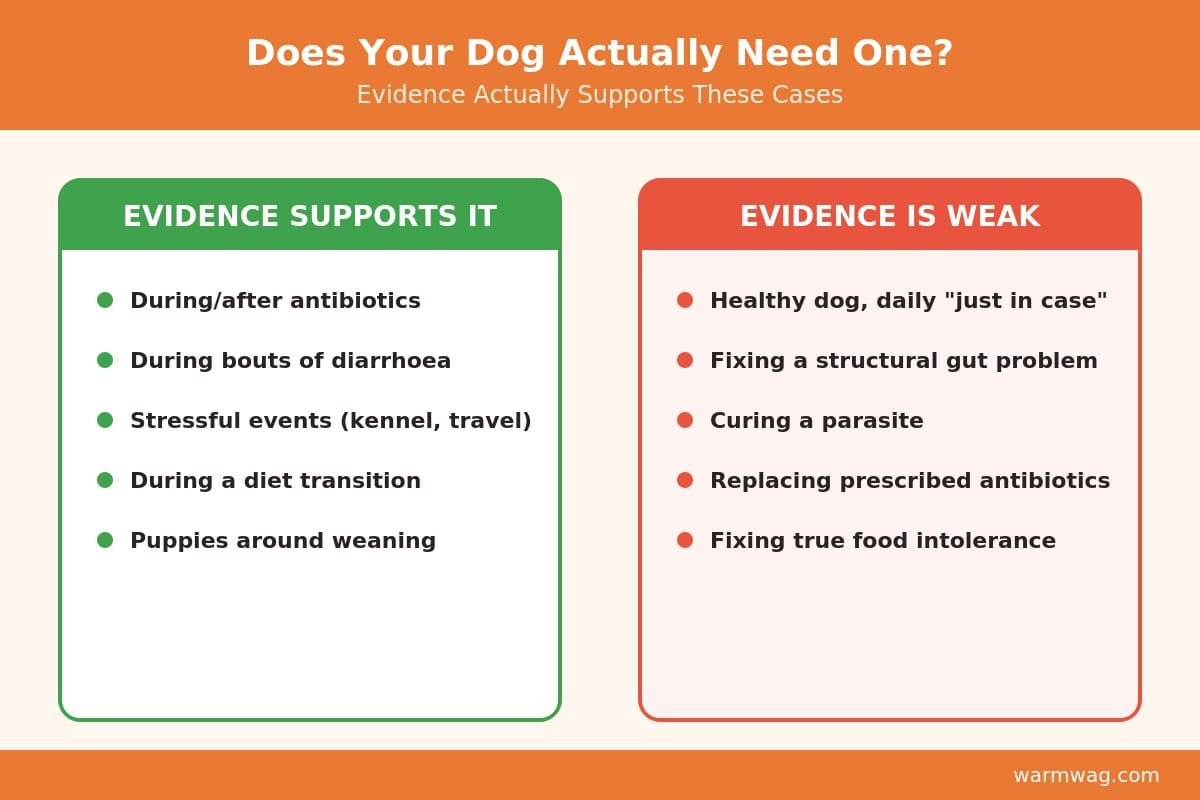
Where the evidence is reasonably solid: shortening the duration of acute diarrhoea, and supporting gut recovery after a course of antibiotics (which wipe out beneficial bacteria along with harmful ones). Where the evidence is more mixed or still emerging: general immune support, allergic skin conditions, and anxiety — some studies show promising results for specific strains, but the research base is smaller and less consistent than for digestive uses.
A genuinely healthy dog eating a complete, balanced diet with no digestive issues doesn’t have strong evidence behind giving them a daily probiotic “just in case.” That’s a meaningfully different situation from a dog going through a course of antibiotics, recovering from a stomach bug, or dealing with ongoing loose stools — where the evidence is more supportive of trying one.
When Probiotics Genuinely Help {#when-they-help}
During and after antibiotics. Antibiotics don’t discriminate between harmful and beneficial bacteria — they wipe out both, which is why digestive upset is such a common side effect of antibiotic treatment. Probiotics given alongside or after a course can help the gut microbiome recover faster.
During bouts of diarrhoea. This is where the evidence is strongest. Certain strains have been shown to shorten how long acute diarrhoea lasts, though probiotics work best alongside — not instead of — proper veterinary assessment, especially if symptoms are severe or don’t improve within a day or two.
Around stressful events or environment changes. Kennel stays, house moves, new pets in the household, and travel can all disrupt a dog’s digestion, and some owners find a short course of probiotics around these events helps keep things steadier.
During a diet transition. Switching food too quickly is one of the most common causes of loose stools in dogs, and a probiotic can sometimes help smooth that transition alongside the standard advice of mixing old and new food gradually over a week or more.
For puppies, especially around weaning. Diarrhoea is particularly common in young puppies — acute diarrhoea affects roughly 8% of dogs annually overall, but rates run considerably higher in puppies around the weaning period, when their gut microbiome and immune system are still developing.
Specific Strains and What They’re Good For {#strains}
This is the detail most generic articles skip, but it’s the part that actually matters — “probiotic” covers a huge range of different organisms, and the evidence is strain-specific, not a blanket claim that applies to every product on the shelf.
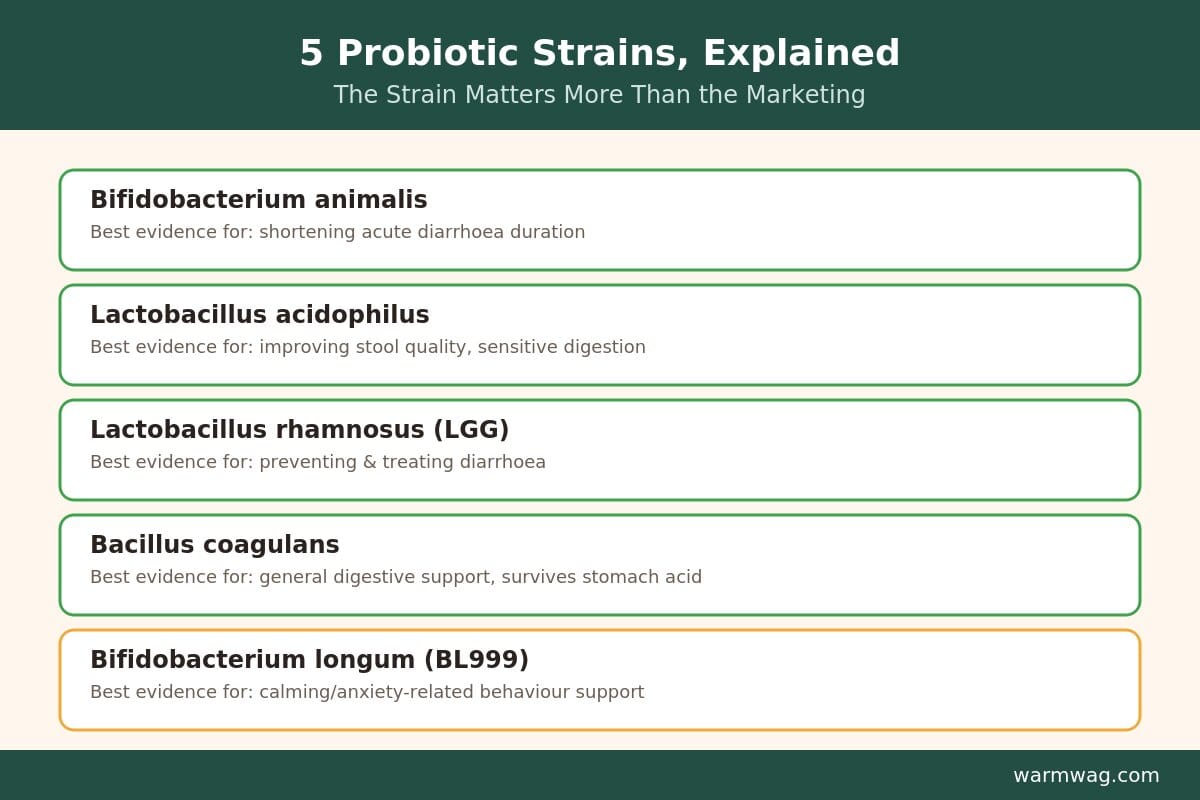
| Strain | Best Evidence For | Notes |
|---|---|---|
| Bifidobacterium animalis | Shortening duration of acute diarrhoea | One of the more researched strains in dogs specifically |
| Lactobacillus acidophilus | Improving stool quality in dogs with sensitive digestion | Commonly included in multi-strain products |
| Lactobacillus rhamnosus (LGG) | Preventing and treating diarrhoea | Strong human evidence; canine evidence still developing |
| Bacillus coagulans | General digestive support | Forms a hardy spore, survives stomach acid well |
| Bifidobacterium longum (BL999) | Calming/anxiety-related behaviour support | The strain with the most specific evidence for this use — found in some calming-focused products |
If a product’s label just says “proprietary probiotic blend” without naming specific strains, that’s a genuine red flag — it makes it impossible to know whether you’re getting something with actual evidence behind it or not.
Human Probiotics vs Dog-Specific Ones {#human-vs-dog}
Human probiotic supplements aren’t toxic or harmful to dogs, but they’re not really formulated with a dog’s gut in mind either. Dogs have a different gut microbiome composition than humans, and dog-specific products are formulated and dosed with that difference in mind. There’s also emerging research suggesting that strains originally isolated from dogs themselves (rather than from humans) may colonise a dog’s gut more effectively and produce more consistent results than human-sourced strains repackaged for pets.
Practically speaking: if you only have a human probiotic on hand in an emergency, it’s not going to cause harm, but a dog-specific product is the better choice for anything beyond a one-off situation.
Food Sources vs Supplements {#food-vs-supplement}
Plain, unsweetened yoghurt or kefir with live active cultures can offer a small amount of beneficial bacteria, and some owners use a spoonful as an occasional addition to food. That said, this comes with real caveats: many dogs are lactose-sensitive to some degree, portion needs to stay small, and the specific strains and quantities in a tub of yoghurt aren’t standardised or dosed the way a purpose-made supplement is. Fermented vegetables occasionally show up in homemade “gut health” recipes too, but there’s limited canine-specific evidence for this route compared to a proper supplement.
For anything beyond an occasional treat-level addition, a dog-specific supplement with a named, dosed strain is the more reliable option if you’re trying to address an actual digestive issue rather than just offering a treat.
How to Choose a Probiotic Supplement {#how-to-choose}
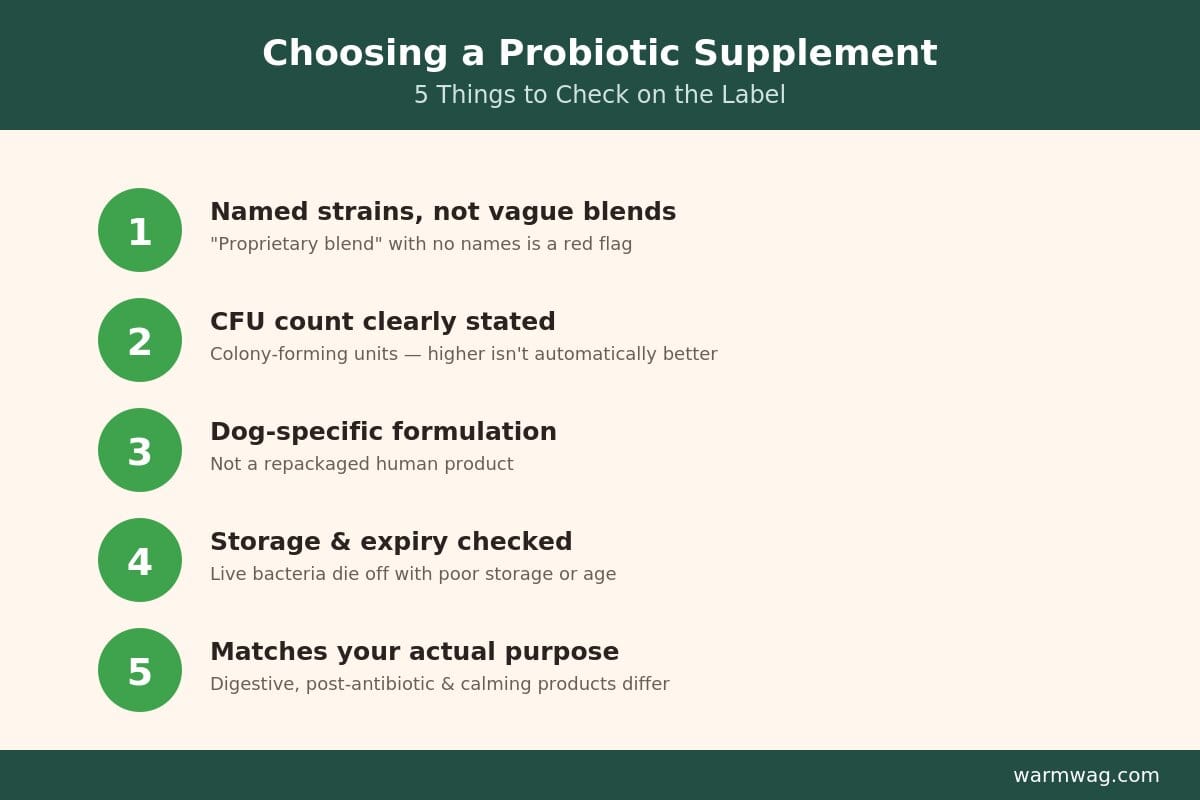
- Named strains, not vague blends. Look for specific strain names (like the ones in the table above), not just “probiotic blend” with no detail.
- CFU count. This stands for colony-forming units — the amount of live bacteria in each dose. Higher isn’t automatically better, but a product should state this clearly rather than omitting it.
- Dog-specific formulation. Formulated and dosed for canine use rather than a repackaged human product.
- Storage and expiry. Live bacteria can die off over time or with poor storage — check whether the product needs refrigeration and respect the expiry date, since an expired probiotic may have far fewer live organisms than the label suggests.
- Match the product to the purpose. A general digestive-support product, a post-antibiotic product, and a calming-focused product (built around different strains) aren’t interchangeable — check what a product is actually formulated to do before buying.
Dosing and How Long to Use One {#dosing}
Dosing varies significantly between products depending on the strain, concentration, and your dog’s size, so following the specific product’s label — or your vet’s guidance — matters more than a generic rule of thumb here. As a general pattern, probiotics for acute situations (diarrhoea, a course of antibiotics, a stressful event) are typically used for a defined, shorter period rather than indefinitely, while some owners of dogs with ongoing digestive sensitivity use a lower daily maintenance dose longer-term under veterinary guidance.
If you’re not seeing any improvement after a couple of weeks of consistent use for a specific issue, that’s worth discussing with your vet rather than assuming a longer course will eventually work.
Possible Side Effects {#side-effects}
Probiotics are generally considered safe for most dogs when used as directed, but a few things are worth watching for:
- Temporary worsening before improvement. It’s not unusual for digestive symptoms to seem slightly worse in the first few days before settling — this is usually not a reason to panic, but is worth monitoring.
- Changes in appetite. Sometimes an early sign of an adverse reaction rather than the probiotic itself working.
- Higher-risk dogs. Very young puppies, immunocompromised dogs, and dogs with serious underlying conditions may be at higher risk of complications from probiotic supplementation, which is exactly why a vet conversation matters more for these dogs than for an otherwise healthy adult.
If your dog doesn’t respond well, or symptoms worsen rather than improve after the initial adjustment period, stop and talk to your vet rather than continuing to wait it out.
When to See a Vet Instead {#see-a-vet}
A probiotic is not a substitute for veterinary care in these situations:
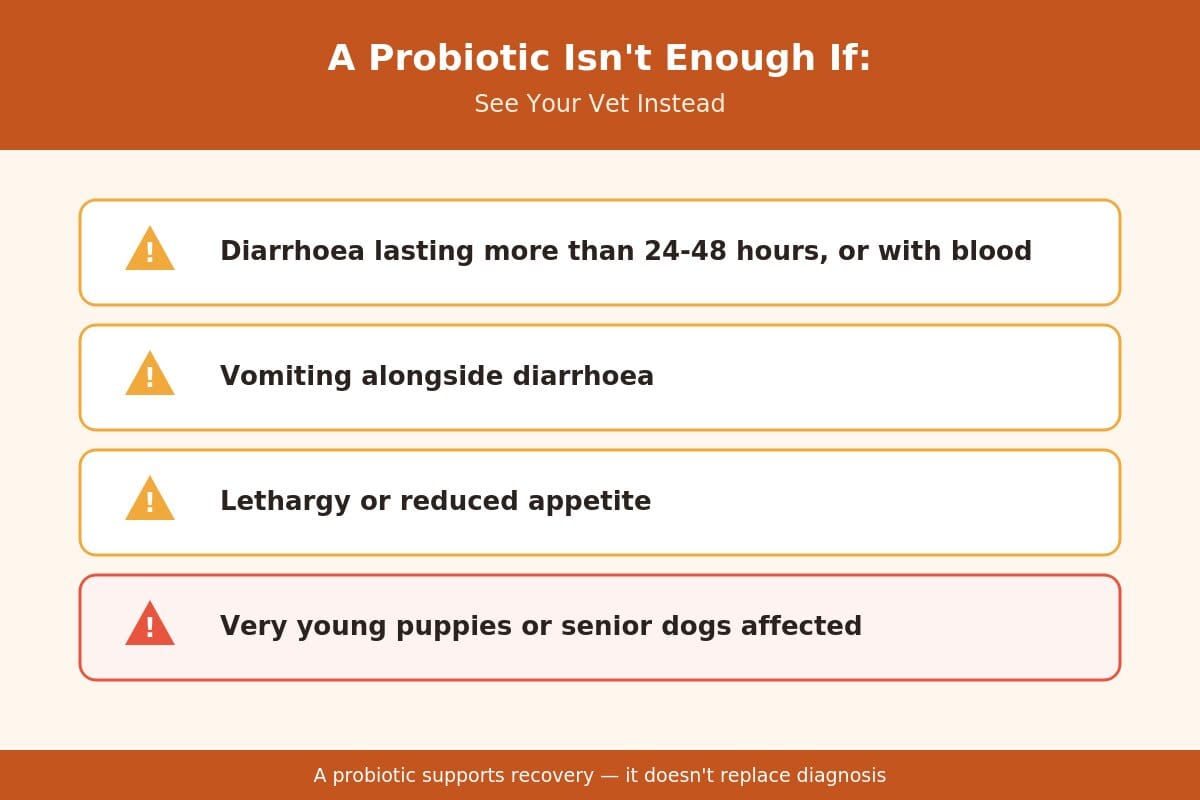
- Diarrhoea lasting more than 24-48 hours, or containing blood
- Vomiting alongside diarrhoea
- Lethargy, reduced appetite, or your dog seeming generally unwell
- Very young puppies or senior dogs with digestive symptoms
- Any suspicion of a structural issue, parasite, or food intolerance — a probiotic won’t fix any of these underlying causes, even if it modestly eases symptoms
Probiotics can genuinely help support recovery alongside proper treatment, but they’re a supporting tool, not a diagnosis or a cure for whatever’s actually causing ongoing digestive problems.
The Gut-Skin-Immune Connection {#gut-skin}
One of the more interesting areas of current research looks beyond digestion entirely. A dog’s gut microbiome interacts closely with the immune system — a significant portion of the body’s immune activity is actually based in and around the gut lining. This is part of why researchers have started investigating probiotics for conditions that don’t look obviously digestive on the surface, like allergic skin disease.
Early research on dogs with atopic dermatitis (a common allergic skin condition) has looked at whether specific probiotic strains can help modulate the immune response involved in allergic flare-ups, by influencing inflammatory markers like IgE antibodies. This research is still developing and isn’t yet at the point of a slam-dunk recommendation, but it’s a genuinely active and promising area — a good example of how gut health research keeps finding connections to parts of the body that seem unrelated at first glance.
None of this means a probiotic is a treatment for skin allergies on its own — allergic skin disease in dogs typically needs proper veterinary diagnosis and a treatment plan — but it’s a reasonable area to ask your vet about if your dog has both digestive sensitivity and skin issues, since the two may be more connected than they first appear.
Common Myths About Dog Probiotics {#myths}
“More CFUs always means a better product.” Not necessarily — a very high CFU count with a poorly-matched or unstudied strain isn’t automatically better than a lower, well-dosed count of a strain with actual evidence behind it for your dog’s specific issue.
“Natural means it doesn’t need proper dosing.” Live bacteria are still something you’re introducing in a specific quantity for a specific purpose — treating a probiotic as something you can’t really overdo or mis-dose isn’t accurate.
“If a little helps, more will help faster.” Overloading the gut with a very high dose isn’t shown to speed up results and is more likely to just cause the temporary digestive upset mentioned earlier.
“All probiotics are basically the same product with different branding.” This is probably the most consequential myth, given how strain-specific the evidence actually is — a product built around Bifidobacterium longum BL999 for calming behaviour and a product built around Bifidobacterium animalis for diarrhoea are doing genuinely different jobs, despite both being marketed under the same “probiotic” umbrella.
“Once symptoms clear up, you should stop immediately.” For acute issues this is often fine, but for antibiotic recovery specifically, some vets recommend continuing for a short period after the antibiotic course ends, since gut recovery can lag slightly behind symptom improvement — worth asking your vet about the specific situation rather than assuming.
Do healthy dogs need a daily probiotic? Not based on current evidence — a healthy dog on a balanced diet with normal digestion doesn’t have strong evidence supporting daily supplementation “just in case.”
What’s the single best-evidenced use for dog probiotics? Shortening the duration of acute diarrhoea and supporting gut recovery during and after antibiotics are the uses with the most consistent evidence behind them.
Can I just give my dog my own probiotic supplement? It won’t harm them, but it’s not optimised for a dog’s gut microbiome. A dog-specific product with named strains is the better choice for anything beyond a one-off situation.
Is yoghurt a good substitute for a proper probiotic supplement? It can offer a small benefit as an occasional addition, but the strains and doses aren’t standardised the way a purpose-made supplement is, and not all dogs tolerate dairy well.
How quickly should I see results? This varies by strain and purpose — for acute diarrhoea, some improvement within a few days is reasonable to expect; for general digestive support, it may take a couple of weeks. If there’s no change after that, check in with your vet.
Are probiotics safe for puppies? Often yes, but puppies are also more vulnerable if something else is going on, so a vet conversation matters more here than for a healthy adult dog with a clear, short-term reason for using one.
Can probiotics replace antibiotics my dog was prescribed? No — never stop or replace a prescribed antibiotic course with a probiotic. They’re often used alongside each other, with the probiotic supporting recovery rather than treating the underlying infection.
Do probiotics help with dog bad breath? There’s some anecdotal interest in this, but strong published evidence specifically linking probiotics to fresher breath in dogs is limited — persistent bad breath is worth mentioning to your vet, since it can also signal dental disease that a probiotic won’t address.
My dog has a sensitive stomach all the time, not just occasionally — should they be on probiotics long-term? This is a genuinely reasonable conversation to have with your vet rather than a DIY decision — chronic digestive sensitivity sometimes benefits from longer-term, lower-dose probiotic use, but it’s also worth ruling out an underlying condition (food intolerance, inflammatory bowel disease, pancreatic issues) that a probiotic alone won’t resolve.
Do senior dogs benefit more from probiotics than younger adult dogs? Some vets do consider gut health support more relevant for senior dogs, partly because digestive efficiency and immune function can shift with age, but this is an individual conversation — a healthy senior dog with no digestive complaints doesn’t automatically need one just based on age.
Final Verdict {#final-verdict}
Probiotics for dogs sit in a genuinely honest middle ground: not the cure-all some marketing suggests, but not worthless either. The evidence is real and reasonably solid for specific situations — diarrhoea, antibiotic recovery, dietary transitions — and for specific, named strains rather than vague “probiotic blend” products. For a healthy dog with no digestive issues, there’s little evidence a daily probiotic is necessary. For a dog going through one of the situations where the evidence is stronger, a well-chosen, strain-specific product is a reasonable thing to try — ideally with your vet’s input, especially for puppies, seniors, or dogs with existing health conditions.
This guide is for general information and isn’t a substitute for professional veterinary advice. Talk to your vet before starting any new supplement, especially if your dog has an ongoing health condition.
Further reading:
Related guides on WarmWag: