Cat Grimace Scale: How to Tell If Your Cat Is in Pain
Cats are experts at hiding pain — it’s an instinct left over from being both predator and prey in the wild, where looking weak makes you a target. That’s exactly why a scientifically validated tool called the Feline Grimace Scale has become so widely used by vets and cat owners alike: it reads pain directly from a cat’s face, using signs that are far harder to fake or hide than behaviour alone.
Quick Answer
The Feline Grimace Scale (FGS) is a validated pain-assessment tool that scores five facial features — ear position, eye tightening, muzzle tension, whisker position, and head position — on a scale of 0 to 2 each, for a total out of 10. A total score of 4 or higher suggests your cat is likely in pain and should be seen by a vet. It was developed by researchers at the University of Montreal and published in the journal Scientific Reports, and it’s designed to be usable by ordinary cat owners, not just vets.
Table of Contents
- Why Cats Hide Pain So Well
- What Is the Feline Grimace Scale?
- The 5 Facial Action Units, Explained
- How to Score Your Cat, Step by Step
- What Your Cat’s Score Means
- When to Use the Grimace Scale
- Limitations — What It Can’t Tell You
- Other Signs of Pain in Cats
- The Science Behind It — How the Study Actually Worked
- How the Cat Version Compares to Other Species
- Common Mistakes When Scoring
- FAQs
- Final Verdict
Why Cats Hide Pain So Well {#why-hide}
Unlike dogs, who often make their discomfort fairly obvious, cats are built to mask it. In the wild, a cat that visibly limps, whimpers, or withdraws is signalling weakness to predators and rivals — and cats retain that same instinct even as thoroughly domesticated pets curled up on your sofa. This is exactly why so many owners are shocked to learn, after a vet visit, that their cat has been dealing with a painful condition like arthritis or dental disease for months, sometimes with almost no obvious sign at home.
Facial expression turns out to be one of the few things cats genuinely struggle to consciously control, which is precisely why a scale built around facial features works as well as it does — it reads something closer to an involuntary response rather than a behaviour a cat can choose to hide.
What Is the Feline Grimace Scale? {#what-is-it}
The Feline Grimace Scale was developed by researchers at the University of Montreal, led by Dr. Paulo Steagall and Dr. Marina Evangelista, and validated in a formal clinical study published in Scientific Reports (part of the Nature research family) in 2019. The study compared painful and pain-free cats, scoring their facial features and checking those scores against other already-validated pain assessment methods — the results showed a strong correlation, meaning the facial scoring genuinely tracked real pain levels rather than just looking plausible.
What makes it particularly useful for pet owners rather than just vets: a follow-up study found that ordinary cat guardians, not just veterinary professionals, could use the scale accurately, with agreement between owners and vets on four of the five action units. The only one owners found slightly harder to judge consistently was muzzle tension — everything else was picked up just as reliably by pet owners as by trained vets.
The 5 Facial Action Units, Explained {#action-units}
Each of these five features is scored 0 (not present), 1 (moderately present or uncertain), or 2 (clearly present), based on looking at your cat’s face while they’re awake and not distracted by grooming, eating, or interacting with you.
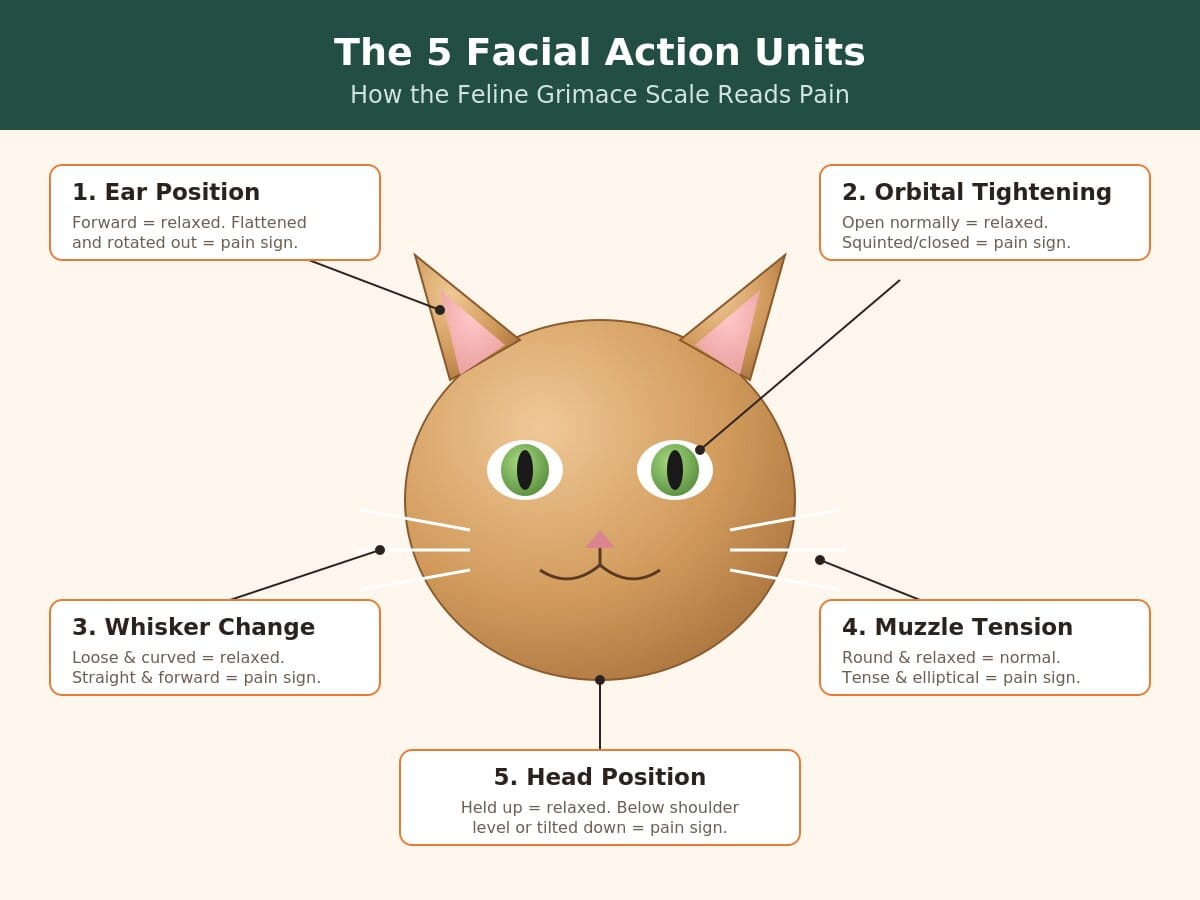
1. Ear Position
- 0: Ears facing forward, in their normal relaxed position
- 1: Ears slightly pulled apart or rotated
- 2: Ears flattened and rotated outward, pulled down and to the sides
2. Orbital Tightening (the eyes)
- 0: Eyes open normally
- 1: Eyes partially closed or squinting slightly
- 2: Eyes noticeably squinted or tightly closed
3. Muzzle Tension
- 0: Muzzle relaxed, rounded in its normal shape
- 1: Slightly tense
- 2: Muzzle tense and more elliptical/tightened in shape
4. Whisker Change
- 0: Whiskers loose and curved, in their normal resting position
- 1: Slightly less curved, or pushed slightly forward
- 2: Whiskers noticeably straighter and pushed forward, or clumped together
5. Head Position
- 0: Head held up, in a normal alert position
- 1: Head held at the same level as the shoulders
- 2: Head held notably below shoulder level, or tilted down
Add up the scores from all five categories for a total out of 10.
How to Score Your Cat, Step by Step {#how-to-score}
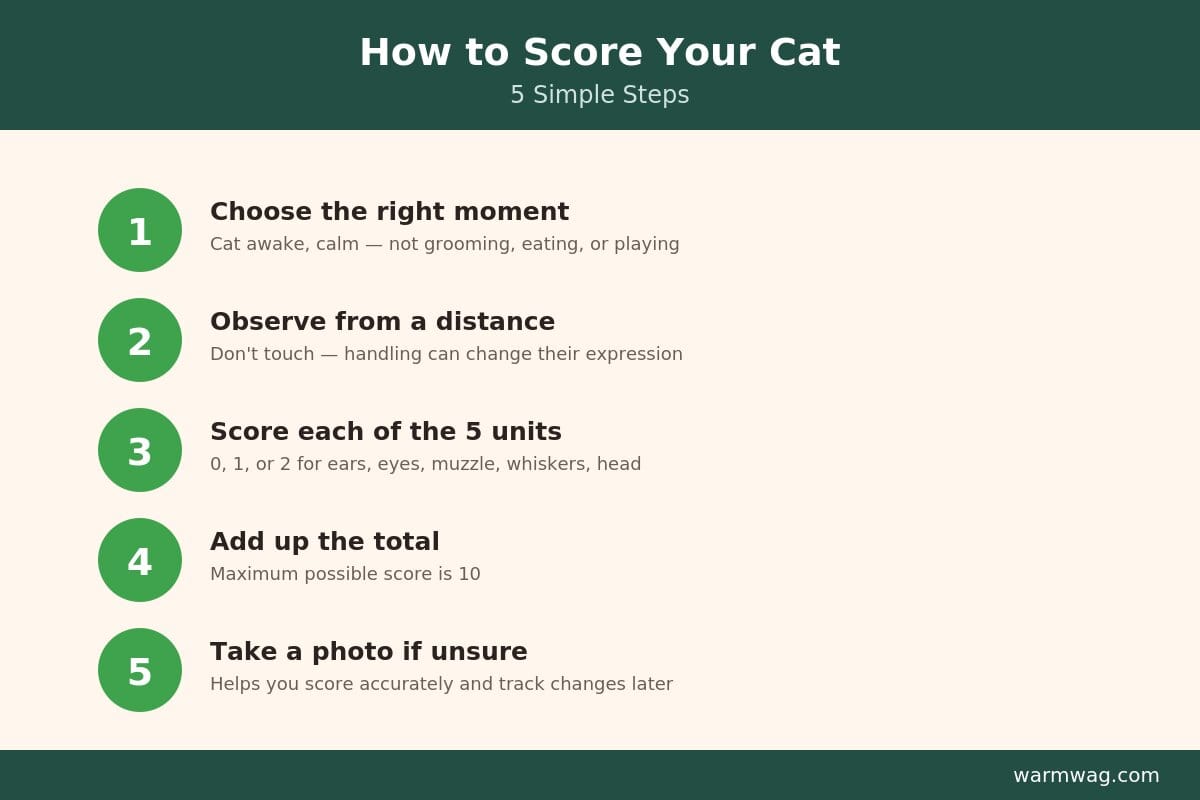
- Choose the right moment. Your cat needs to be awake, calm, and not mid-activity — not grooming, not eating, not actively playing or interacting with you. A quiet moment where they’re simply resting or sitting is ideal.
- Observe from a short distance. You don’t need to touch or disturb your cat — in fact, it’s better not to, since handling can itself change their expression. Just watch their face for a minute or so.
- Score each of the 5 action units using the 0-2 descriptions above. If you’re unsure between two scores, it’s generally reasonable to score the middle option (1) rather than guessing at an extreme.
- Add up the total. The maximum possible score is 10 (2 points × 5 action units).
- Consider taking a photo. A clear, well-lit photo of your cat’s face at rest can help you score more accurately, and is useful to show your vet or compare against later if you want to track changes over a few days.
What Your Cat’s Score Means {#what-it-means}
| Total Score | Likely Meaning | Suggested Action |
|---|---|---|
| 0-3 | Pain unlikely based on facial signs | Continue normal monitoring |
| 4-5 | Pain possible — worth a closer look | Watch closely, consider a vet check especially if other symptoms are present |
| 6-10 | Pain likely | Contact your vet, particularly if this follows surgery, injury, or a sudden change |
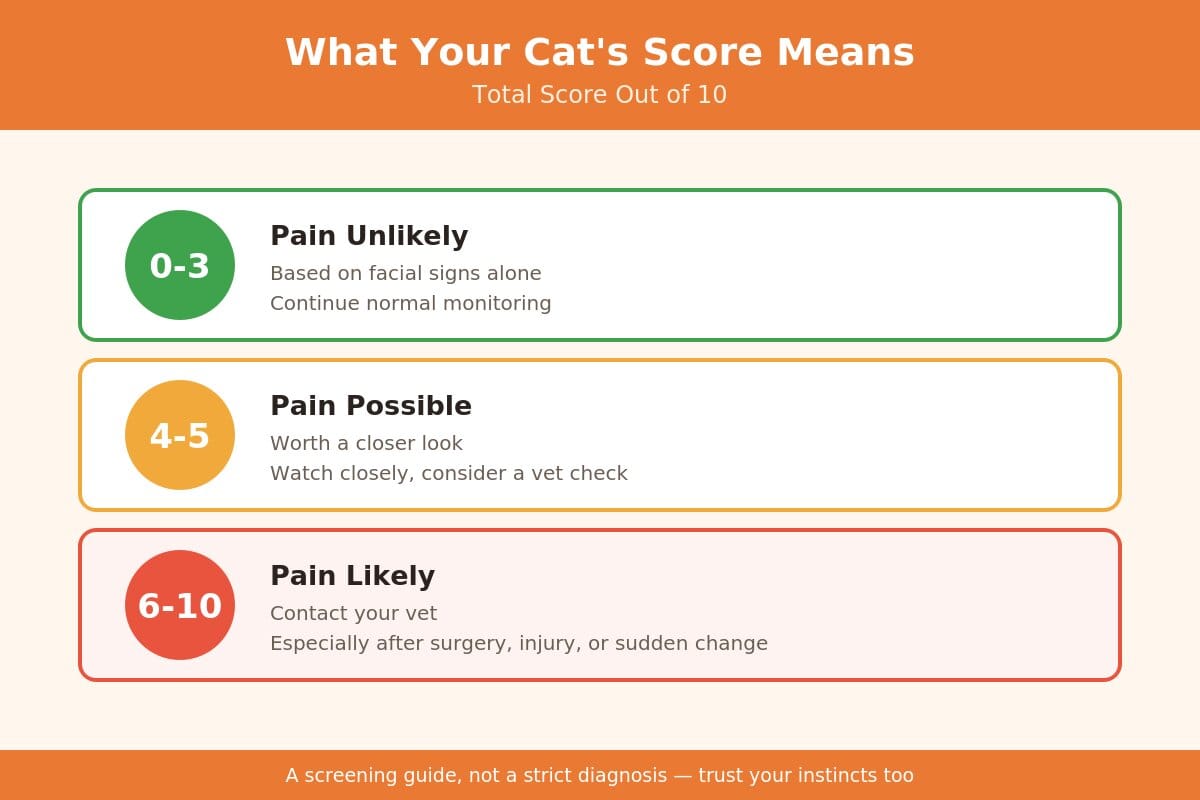
This isn’t a strict diagnostic cutoff carved in stone — it’s a screening guide. A score of 3 in a cat who’s also limping and hiding is still worth a vet visit regardless of the exact number, and a score of 4 in a cat who otherwise seems completely normal is still worth watching closely rather than panicking immediately.
When to Use the Grimace Scale {#when-to-use}
The scale was originally validated for acute pain — the kind that comes on suddenly, such as after surgery, an injury, or a sudden illness. It’s particularly useful in situations like:
- After a spay/neuter or other surgery, to judge whether your cat needs more pain relief than they’ve been given
- After a suspected injury (a fall, being caught in a door, a fight with another animal) when you’re not sure how much it’s actually hurting them
- When your cat’s behaviour has changed — hiding more, eating less, being unusually withdrawn — and you want another data point before deciding whether to call the vet
- Tracking recovery by scoring once or twice a day after a painful event, to see whether the score is trending down as they heal
A Simple Way to Track Scores Over Time
If you’re monitoring recovery after surgery or an injury, a basic daily log makes patterns much easier to spot than trying to remember scores from memory:
| Day | Ear Position | Eyes | Muzzle | Whiskers | Head | Total |
|---|---|---|---|---|---|---|
| Day 1 (pre-treatment) | ||||||
| Day 1 (post-treatment) | ||||||
| Day 2 | ||||||
| Day 3 |
A downward trend over several days is a good sign recovery is on track. A score that stays flat or climbs again after initially dropping is worth flagging to your vet, even if your cat seems otherwise okay.
Limitations — What It Can’t Tell You {#limitations}
Being honest about what this tool doesn’t do is just as important as explaining what it does:
- It’s a screening tool, not a diagnosis. A high score tells you pain is likely, not what’s causing it.
- It was validated for acute pain, not specifically for chronic, ongoing conditions like long-term arthritis — though many owners and some vets still find it a useful part of the picture for chronic conditions alongside other signs.
- Some individual cats are naturally more expressive than others, so a single score is more useful in the context of that specific cat’s normal baseline expression than as an absolute number compared across different cats.
- It requires the right conditions to score accurately — a cat that’s mid-groom, distracted, or actively interacting with you won’t give you a reliable read.
- It doesn’t replace a vet visit. Whatever the score, ongoing behaviour changes, loss of appetite, or clear signs of illness deserve a proper veterinary check regardless of what the facial score alone suggests.
Other Signs of Pain in Cats {#other-signs}
The Grimace Scale works well alongside — not instead of — the more familiar behavioural signs of pain in cats, which include:
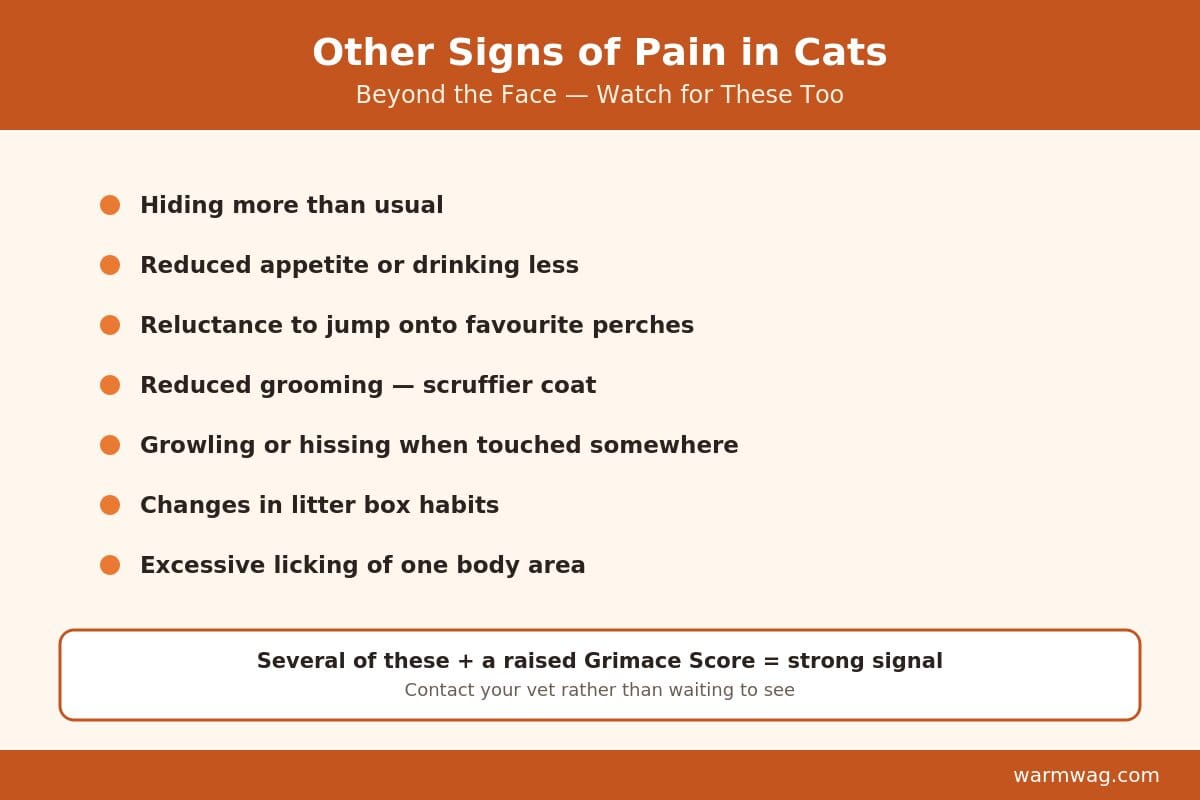
- Hiding more than usual, or withdrawing from family members
- Reduced appetite or drinking less
- Reluctance to jump, or noticeably less use of favourite high perches
- Reduced grooming, leading to a scruffier-looking coat
- Growling, hissing, or unusual aggression when touched in a specific area
- Changes in litter box habits
- Excessive licking of one particular area of the body
If you’re noticing several of these alongside a raised Grimace Scale score, that combination is a stronger signal than either on its own.
The Science Behind It — How the Study Actually Worked {#the-science}
It’s worth understanding how the scale was actually validated, since that’s what separates it from countless informal “signs your pet is in pain” lists floating around online. Researchers recorded 35 client-owned cats who were genuinely experiencing pain, alongside 20 control cats with no pain, all filmed undisturbed in their normal cages rather than being handled or provoked. The painful cats were then given proper pain relief, and filmed again about an hour later.
Four independent observers, without knowing which cats were which, scored photographs taken from these recordings using the five action units. The scores from painful cats, before treatment, were significantly higher than both the control cats and the same cats after receiving pain relief — meaning the scale wasn’t just picking up on generic “stressed cat” signals, it was specifically tracking pain and responding correctly when that pain was treated.
The tool also showed excellent consistency — the same observer scoring the same photo on different occasions reached similar results, and different observers scoring the same photo largely agreed with each other too. In research terms, this reliability is what makes a tool trustworthy enough for real clinical use rather than just an interesting idea.
How the Cat Version Compares to Other Species {#other-species}
The Feline Grimace Scale isn’t a one-off idea — it’s part of a broader scientific approach called facial action coding, originally developed for reading human expressions and since adapted for a number of species. A Rat Grimace Scale and Mouse Grimace Scale, for instance, use a similar principle with four facial action units instead of five, and researchers have even built automated, AI-based scoring systems for these that match trained human scorers with high accuracy. Primates have their own version too, built around orbital tightening, brow lowering, and cheek tightening.
What this tells us is that the cat scale isn’t a novelty — it’s a well-established branch of a genuinely serious area of pain research that spans multiple species, adapted specifically to the facial anatomy and behaviour of domestic cats. Dogs, interestingly, don’t have an equivalent grimace scale in as widespread clinical use, partly because their pain behaviours (limping, vocalising, avoidance) tend to be more overt and easier to read without needing to focus on facial expression specifically.
Common Mistakes When Scoring {#mistakes}
Scoring a cat who’s mid-groom or eating.
Both activities naturally change facial muscle tension in ways that can look similar to pain signs — always wait for a genuinely resting moment.
Scoring immediately after handling.
Picking your cat up or examining them can itself cause a stress response that shows up on the face, muddying the read. Observe from a short distance instead.
Treating one score as the whole picture.
A single score is a snapshot, not a trend — scoring once or twice a day over several days, especially during recovery from surgery or injury, gives a far more useful picture than one isolated reading.
Not accounting for your cat’s normal resting face.
Some cats naturally have a slightly tenser or more squinted resting expression than others, particularly in certain breeds. Where possible, compare against a photo of your own cat looking genuinely comfortable and pain-free, rather than an average or a stock photo.
Ignoring flat-faced breed differences.
Breeds with very flat faces (like Persians) or unusually large eyes can be harder to score consistently using the standard visual cues, since their baseline facial structure already looks different from the cats used in the original validation study. Use extra caution and lean more heavily on behavioural signs for these breeds.
Is the Feline Grimace Scale scientifically proven?
Yes — it was developed and validated through a formal clinical study at the University of Montreal, published in the peer-reviewed journal Scientific Reports in 2019, with strong correlation to other already-validated pain assessment tools.
Can I really use this myself, or do I need a vet?
Studies specifically tested this and found that ordinary cat owners scored the facial features about as accurately as trained veterinary professionals, with the exception of muzzle tension being slightly harder for owners to judge.
What score means my cat definitely needs a vet?
A score of 4 or higher out of 10 is generally taken as an indication that pain is likely present, but use your judgement alongside it — any other worrying symptoms warrant a vet visit regardless of the exact score.
Does this work for kittens or senior cats differently?
The core facial action units are the same across ages, though very young kittens and cats with certain facial conformations (like flat-faced breeds) can be slightly harder to score consistently — take the score as one part of the picture rather than the whole answer for these cats.
Is there an app for this?
Yes — the researchers behind the scale have made an official app and website available, which can make consistent scoring easier than working from memory alone.
Can this scale be used for chronic pain like arthritis?
It was formally validated for acute pain, but many owners and vets still find scoring useful as one part of monitoring chronic conditions — just don’t rely on it as the sole measure for long-term pain management decisions.
My cat scored low but I still think something’s wrong — what do I do?
Trust your instincts alongside the score, not instead of them. You know your cat’s normal behaviour better than any scale does — a low facial score with other worrying signs still warrants a vet visit.
Why don’t dogs have a widely-used grimace scale too?
Dog pain research has largely focused on behavioural scales instead, partly because dogs tend to show pain more openly through limping, whining, and avoidance behaviours, making facial-expression-specific tools less necessary for clinical use — though facial coding research exists for dogs too, it just hasn’t reached the same level of everyday, owner-friendly adoption yet.
Can stress or fear at the vet affect the score, separate from actual pain?
Yes, potentially — a frightened or highly stressed cat can show some facial tension that overlaps with pain signs, which is part of why scoring your cat in their own calm home environment tends to be more reliable than trying to score them in a stressful carrier or exam room.
Final Verdict {#final-verdict}
The Feline Grimace Scale is a rare thing in pet care advice: a genuinely validated, peer-reviewed scientific tool that ordinary cat owners can use accurately at home, developed specifically because cats are so good at masking pain in ways that put them at real risk of suffering unnoticed. It’s not a replacement for veterinary care, but it is a real, evidence-based way to catch pain earlier — which, for a species that hides discomfort as well as cats do, can genuinely make a difference.
This guide is for general information and isn’t a substitute for professional veterinary advice. If you’re concerned your cat may be in pain, contact your vet.
Further reading:
Related guides on WarmWag: