Freeze-Dried Raw Dog Food: Benefits, Safety & Full UK Guide
Freeze-dried raw dog food searches have jumped over 400% in the past year, making it one of the fastest-growing categories in dog nutrition right now. It promises the benefits of a raw diet without the freezer space or the mess — but there’s a genuinely important safety nuance that a lot of glossy product pages gloss over. Here’s the honest, evidence-based picture.
Quick Answer
Freeze-dried raw dog food is raw meat with the moisture removed through a cold-drying process, designed to be shelf-stable and easy to store. It retains most of the nutritional value of a raw diet and digests well, according to published research. The important nuance: freeze-drying significantly reduces bacterial load but does not reliably eliminate pathogens like Salmonella or E. coli on its own — it’s still legally and practically considered a raw product. Some manufacturers add an extra “kill step” (usually high-pressure processing) specifically to address this; many don’t. If you’re considering it, checking whether a specific product uses that additional safety step matters more than the “freeze-dried” label alone.
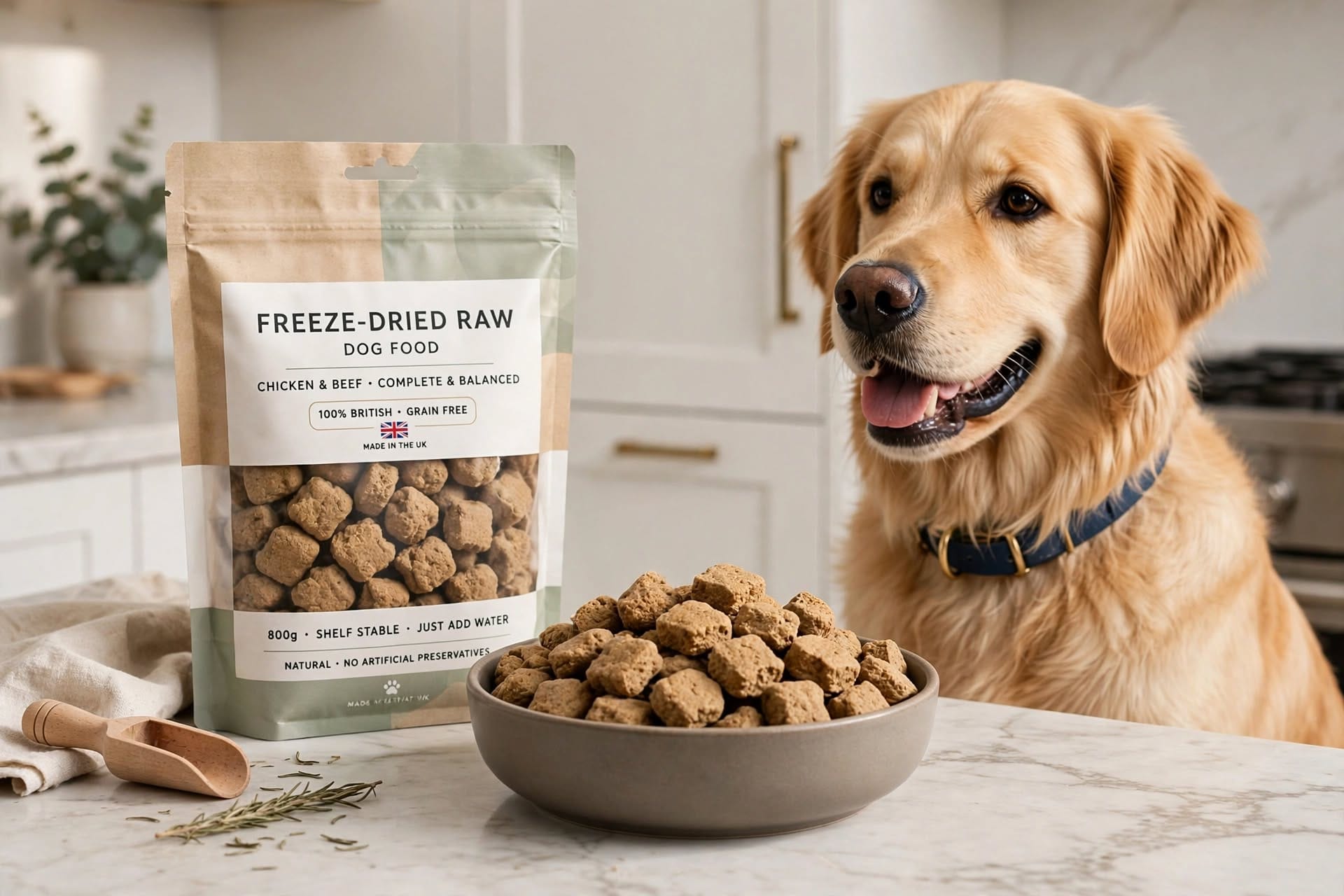
Table of Contents
- What Is Freeze-Dried Raw Dog Food?
- Why It’s Booming Right Now
- The Nutritional Case For It
- The Safety Question, Honestly
- HPP: The Difference That Actually Matters
- How Freeze-Dried Compares to Other Formats
- Who Should Be Extra Cautious
- How to Feed It Safely
- Is It Nutritionally Complete?
- What It Typically Costs
- FAQs
- How to Actually Check If a Brand Uses HPP
- Transitioning Your Dog to Freeze-Dried Raw
- Final Verdict
What Is Freeze-Dried Raw Dog Food? {#what-is-it}
Freeze-drying is a preservation process that removes moisture from raw meat, organ, and sometimes fruit or vegetable ingredients using very low temperatures under vacuum, rather than heat. The result is a shelf-stable product that owners rehydrate with water before serving, or in some cases feed dry as a topper or training treat.
It’s worth being precise about the difference from other formats, since the terms get used loosely: freeze-drying uses a cold process, while dehydrating typically uses warm air — a meaningfully different method that can affect nutrient retention differently. Both are distinct from frozen raw (kept frozen, never dried) and fresh-cooked (heat-treated, not raw at all). All of these sit in a different category from traditional extruded kibble, which is cooked at high temperatures during manufacturing.
This same raw-vs-cooked question comes up for cat owners too, and the underlying safety logic is similar — see our guide on raw chicken for cats if you’re weighing the same decision for a feline household member.
Why It’s Booming Right Now {#why-booming}
The growth here is genuinely dramatic — search interest has climbed more than 400% year over year, making it one of the fastest-rising categories in dog nutrition. This fits a broader pattern: premium and fresh dog food searches are up sharply too, reflecting a wider shift toward owners treating pet food choices the way they treat their own — prioritising less processing, recognisable ingredients, and perceived naturalness.
Freeze-dried products specifically solve a practical problem that’s kept a lot of interested owners away from raw feeding until now: frozen raw requires freezer space and planning, and can be messy and inconvenient for travel or training. Freeze-dried is shelf-stable, lightweight, and easy to portion, which has opened raw-style feeding up to owners who were curious but put off by the logistics.
The Nutritional Case For It {#nutrition}
This is one of the areas where freeze-dried raw genuinely has research support. A controlled feeding study comparing extruded kibble, fresh-cooked food, frozen raw, and freeze-dried raw diets in adult dogs found that protein digestibility was higher for freeze-dried and frozen raw formats than for fresh-cooked or extruded kibble.
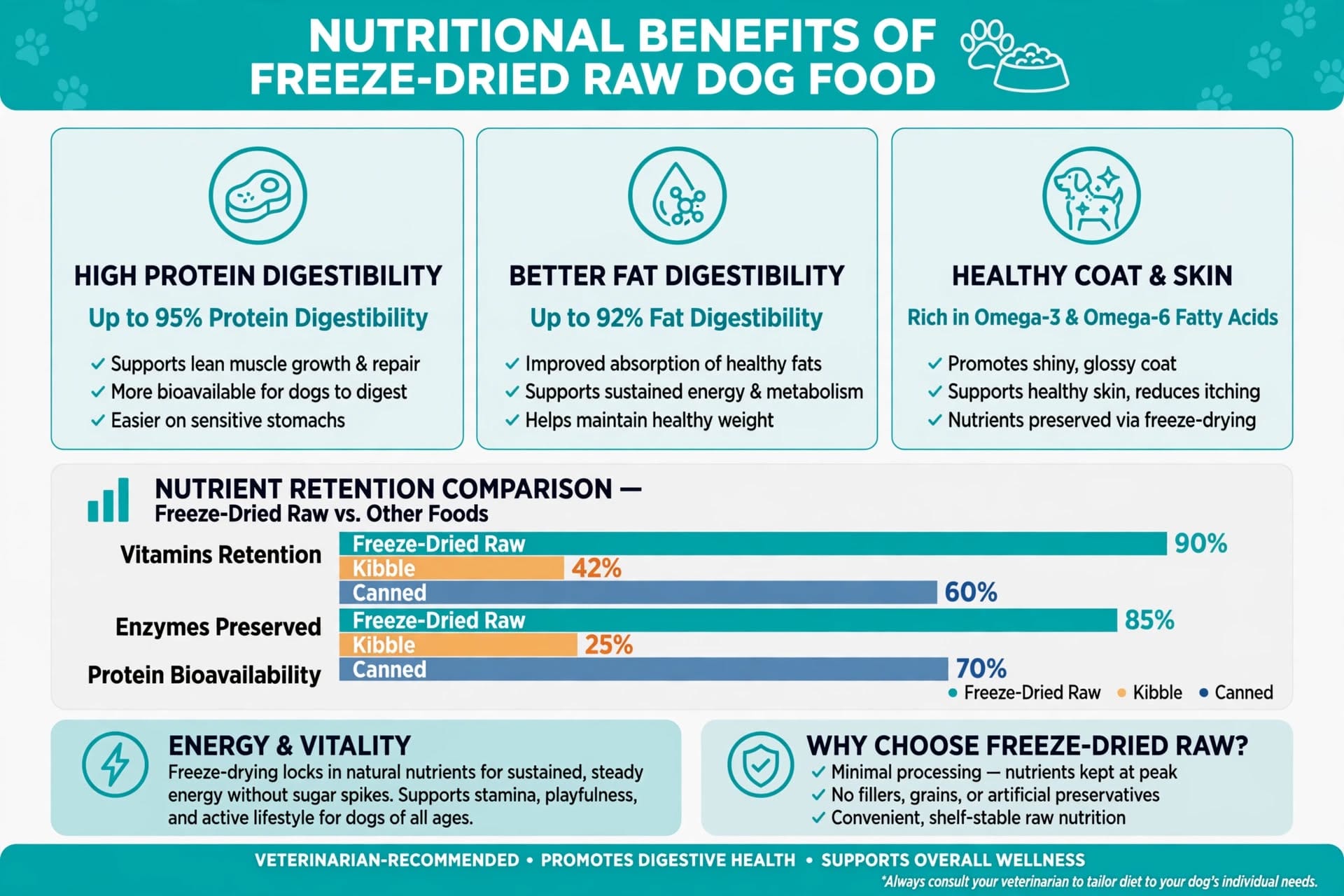
Fat digestibility followed a similar pattern, with freeze-dried performing well compared to frozen raw and extruded formats. Because freeze-drying doesn’t involve the sustained high heat that kibble manufacturing does, proponents argue it avoids the heat-related nutrient degradation associated with more heavily processed foods — a claim that’s broadly consistent with current research on protein and fat digestibility, even if the full picture on vitamins and other nutrients is still being studied.
The Safety Question, Honestly {#safety}
This is the part worth reading carefully, because it’s genuinely more nuanced than a lot of marketing suggests, and honestly more reassuring than the average raw meat comparison too.
The reassuring part: the very low moisture content that results from freeze-drying meaningfully reduces the survival of food-borne pathogens and overall microbial load compared to fresh raw meat. Independent testing of freeze-dried products has found bacterial counts within accepted safety limits in samples tested, which is a genuinely better picture than raw pet food safety testing has historically shown for some other raw formats.
The part that matters more than most people realise: freeze-drying alone, without an additional heat or pressure-based kill step beforehand, is not considered a reliable way to eliminate pathogens like Salmonella, E. coli, and Listeria. The FDA maintains a zero-tolerance policy for pathogen contamination in commercial pet food, but freeze-dried raw is still legally and practically classified as a raw product — the low moisture content slows bacterial growth and survival, but it isn’t the same as a validated kill step that actively destroys pathogens present at the time of processing.
Historical testing of raw pet food more broadly (including a widely cited FDA study on frozen raw products) has found meaningful contamination rates, and more recent research has identified antibiotic-resistant bacteria in a notable percentage of raw products tested. This is exactly the backdrop that explains why major veterinary bodies continue to generally recommend against raw diets, including freeze-dried raw, for the average household — while acknowledging that owners who want to feed raw can reduce (not eliminate) risk by choosing products that use validated safety steps.
HPP: The Difference That Actually Matters {#hpp}
High-Pressure Processing (HPP) is the specific step both the FDA and USDA identify as the preferred method for improving safety in raw pet food. It works by using extreme pressure (not heat) to inactivate pathogens, which means it can be applied without cooking the product — preserving the “raw” nutritional profile while directly addressing the contamination risk that freeze-drying alone doesn’t fully solve.
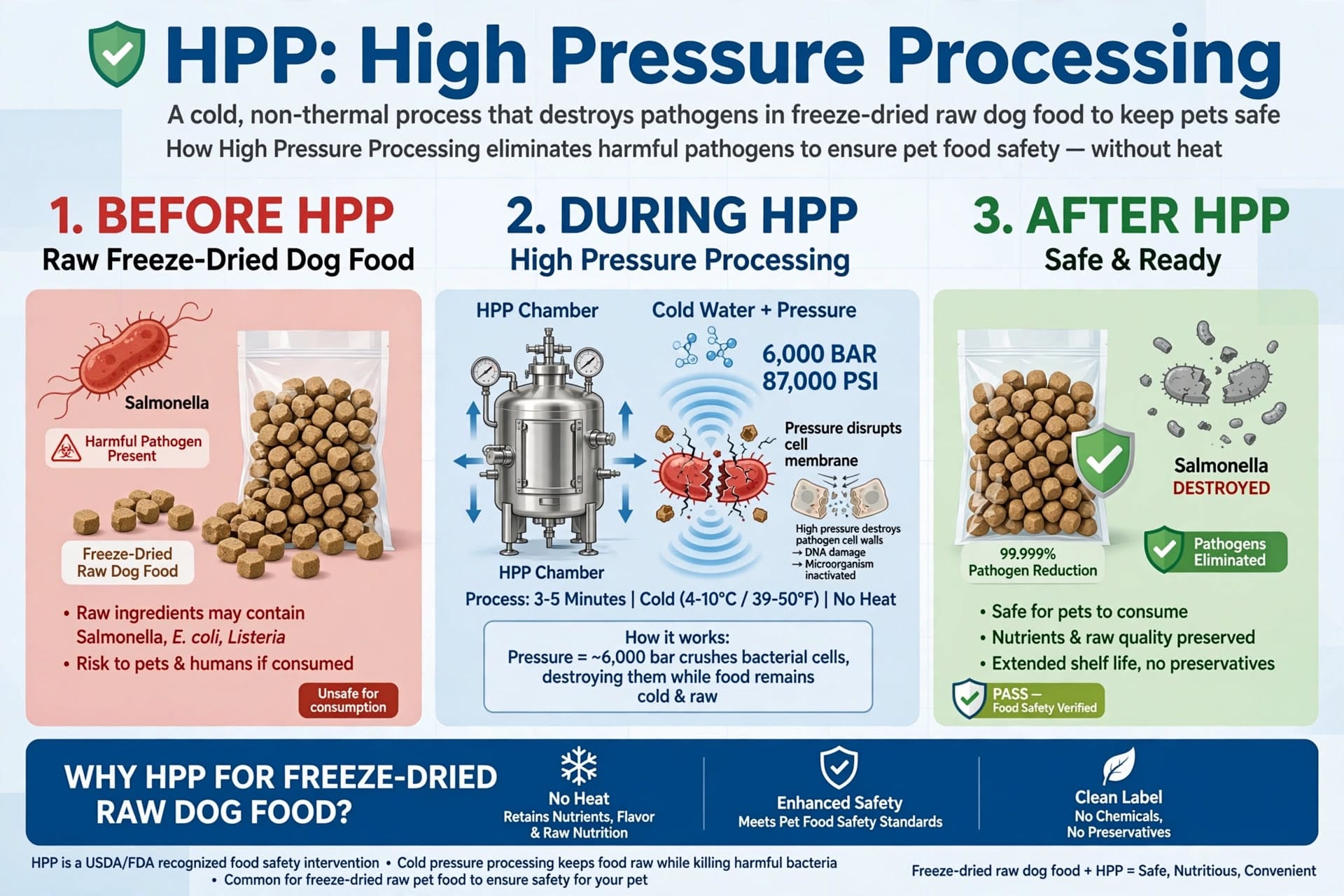
This is genuinely the single most useful thing to check when choosing a freeze-dried product: does the manufacturer apply HPP (or a comparable validated kill step) before freeze-drying, or does the product rely on freeze-drying and sourcing alone? Many manufacturers now do include this step and are increasingly transparent about it on packaging or their website; others don’t, and the “freeze-dried raw” label alone doesn’t tell you which category a given product falls into.
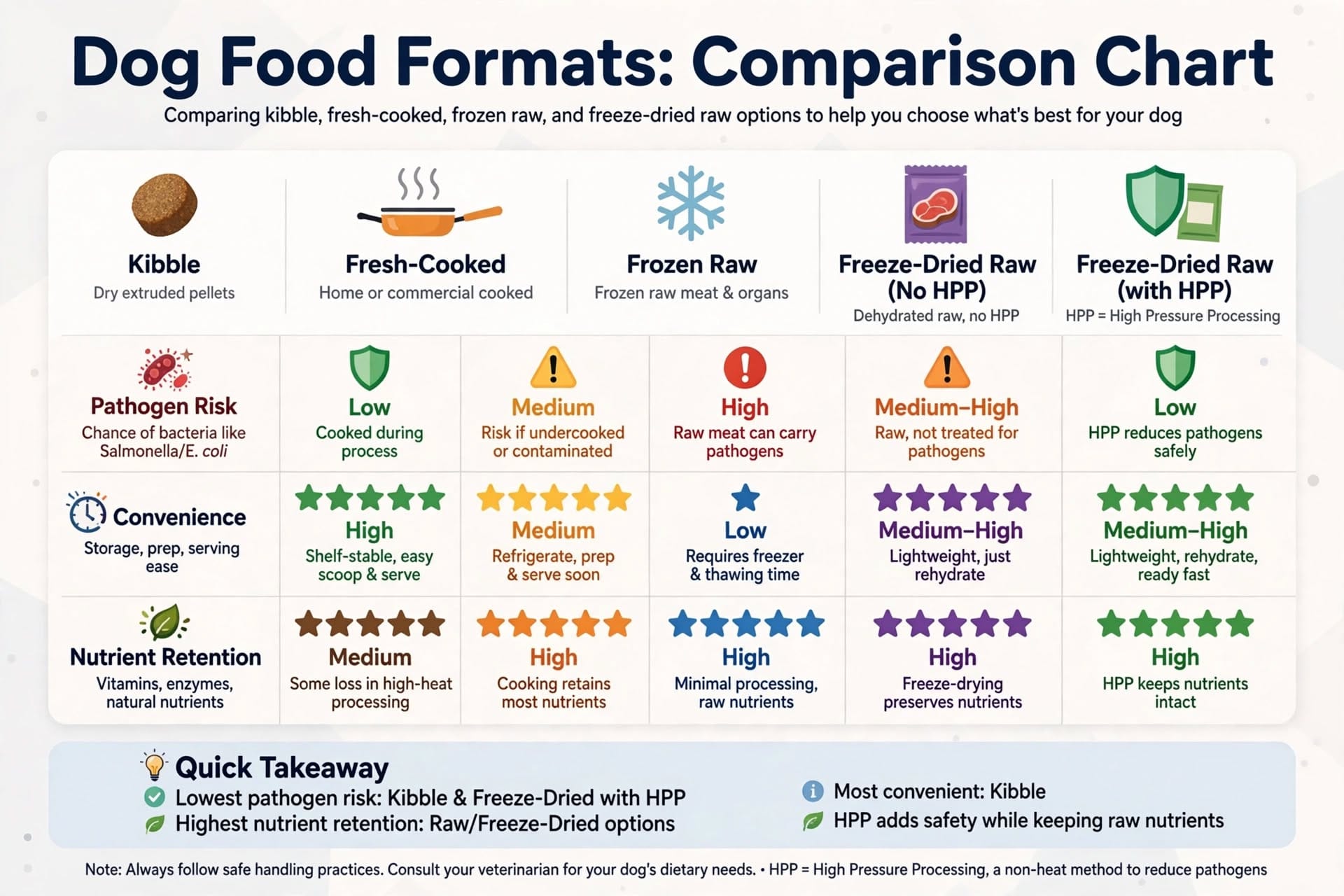
How Freeze-Dried Compares to Other Formats {#comparison}
| Format | Processing | Pathogen Risk | Convenience | Nutrient Retention |
|---|---|---|---|---|
| Kibble (extruded) | High heat | Lowest | Highest — no prep, long shelf life | Lower — heat can degrade some nutrients |
| Fresh-cooked | Gently cooked | Low | High — often delivered frozen, ready to serve | Good — mild heat treatment |
| Frozen raw | None (kept frozen) | Higher, unless HPP-treated | Lower — needs freezer space, thawing | High |
| Freeze-dried raw (no kill step) | Cold-dried only | Higher — reduced but not eliminated pathogens | High — shelf-stable, needs rehydrating | High |
| Freeze-dried raw (with HPP) | Cold-dried + pressure kill step | Lower — validated pathogen reduction | High — shelf-stable, needs rehydrating | High |
Who Should Be Extra Cautious {#who-cautious}
Regardless of format, raw and freeze-dried raw diets warrant extra caution for:
- Households with anyone immunocompromised, pregnant, very young, or elderly — the zoonotic risk (bacteria passing from the food or the dog to a person) applies to freeze-dried raw the same way it does to any raw product
- Puppies, senior dogs, or dogs with existing health conditions — less resilient to a food-borne illness if contamination is present
- Multi-pet households where cross-contamination during prep or feeding is more likely
- Anyone not prepared to handle it like raw meat — proper handwashing, separate utensils and bowls, and surface cleaning matter just as much as they would with raw chicken or beef bought for human meals
These are largely the same risk groups worth being cautious about with any raw feeding decision, dog or cat — our raw chicken for cats guide covers the household-risk side of this in more depth if you have both species at home.
How to Feed It Safely {#how-to-feed}
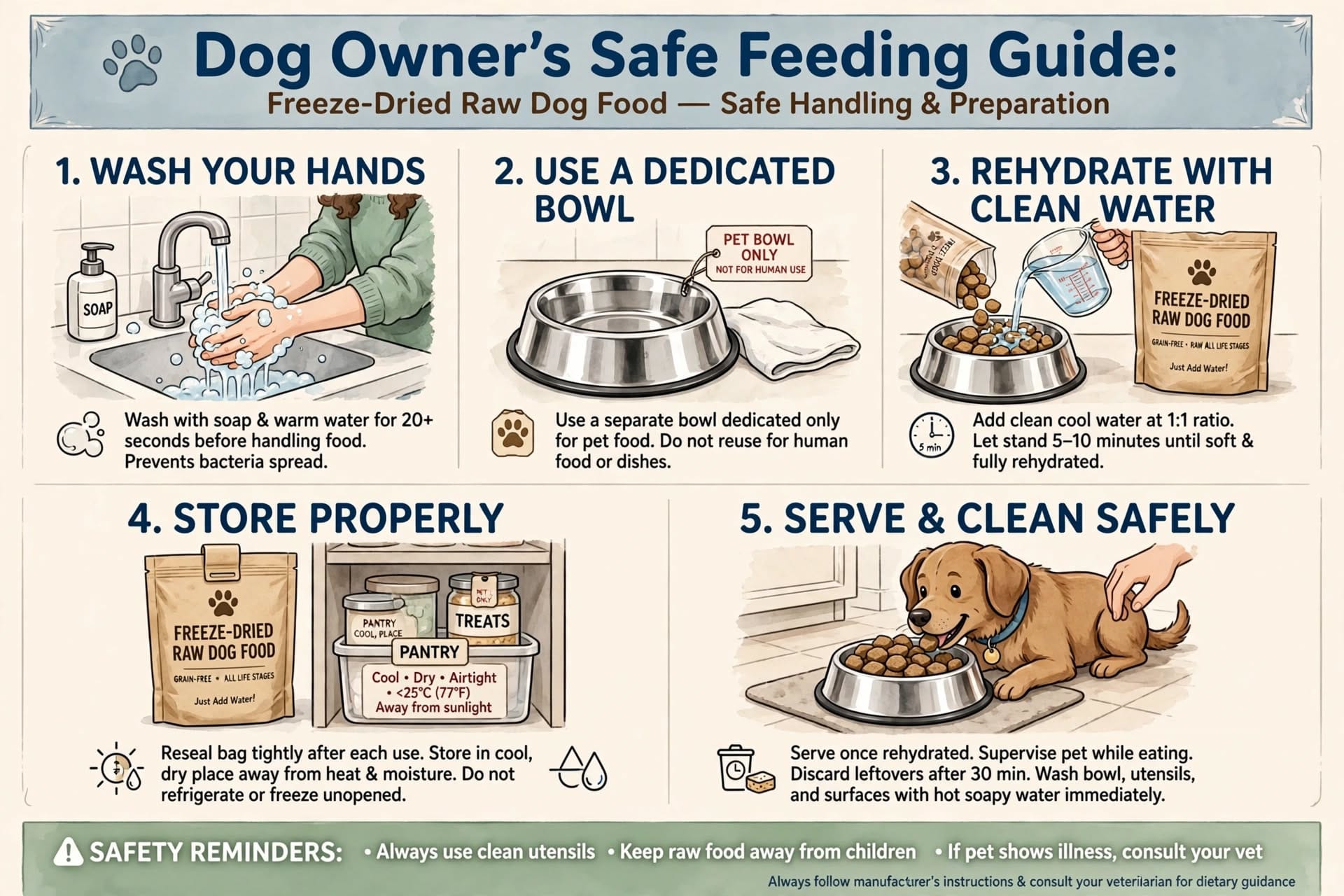
- Check for a validated kill step (HPP or equivalent) when choosing a product, and don’t assume “freeze-dried” alone means pathogen-free
- Handle it like raw meat — wash hands before and after, use dedicated bowls and utensils, and clean surfaces thoroughly
- Follow rehydration instructions precisely — most freeze-dried products are designed to be rehydrated with water to restore texture and moisture before serving
- Store it properly — typically somewhere cool, dry, and out of direct sunlight, in a sealed container or the original resealable packaging
- Don’t let high-risk household members handle it or clean up after a dog that’s just eaten it, as a precaution
- Introduce it gradually if switching from another food, the same way you would with any diet transition
Is It Nutritionally Complete? {#complete}
This varies significantly by product, and it’s worth checking rather than assuming. Look for a statement that the product meets AAFCO (or equivalent UK/EU) complete-and-balanced standards for your dog’s life stage. Some freeze-dried products are formulated as complete meals; others are designed as toppers or treats and aren’t meant to be fed as a dog’s entire diet. Feeding an incomplete product as a full-time diet risks long-term nutritional gaps that won’t necessarily show up immediately.
Checking formulation completeness matters just as much here as it does with grain-free kibble — our guide on grain-free dog food and the DCM heart disease link covers a real example of what can go wrong nutritionally when a diet’s formulation isn’t properly tested, regardless of how “natural” or premium it looks on the packaging.
What It Typically Costs {#cost}
Freeze-dried raw is generally one of the more expensive dog food categories, reflecting both the ingredient quality many brands use and the cost of the freeze-drying process itself, which is more resource-intensive than standard kibble manufacturing. Costs vary considerably by brand, dog size, and whether the product includes an HPP safety step, so it’s worth comparing cost-per-day at your dog’s actual portion size rather than just the price on the bag, since freeze-dried products are calorie-dense and portions are often smaller than the bag size suggests.
FAQs {#faqs}
Is freeze-dried raw dog food safer than regular frozen raw? Generally yes, in that the low moisture content reduces bacterial survival compared to fresh raw meat — but “safer” isn’t the same as “safe,” and freeze-drying alone doesn’t reliably eliminate pathogens the way a validated kill step like HPP does.
Do I need to rehydrate freeze-dried food, or can I feed it dry? Most freeze-dried raw meals are designed to be rehydrated with water before serving, both for palatability and to help with proper digestion — check your specific product’s instructions, since some toppers or treats are designed to be fed dry.
Is freeze-dried raw nutritionally better than kibble? Research suggests better protein and fat digestibility for freeze-dried raw compared to extruded kibble, but “better” depends on what you’re optimising for — a properly formulated, AAFCO-complete kibble isn’t nutritionally inferior in every respect, and the right choice depends on your dog’s individual needs and your risk tolerance around raw feeding.
What does HPP actually stand for and do? High-Pressure Processing — it uses extreme pressure rather than heat to inactivate pathogens in raw food, which is why both the FDA and USDA identify it as a preferred safety method for raw pet food that still wants to avoid cooking the product.
Can freeze-dried raw make my dog or my family sick? It’s possible, particularly with products that don’t use a validated kill step — this is exactly why handling it like raw meat and checking for HPP treatment matters, especially in households with anyone at higher risk from food-borne illness.
Is freeze-dried raw suitable for puppies? This is worth a specific conversation with your vet — puppies are more vulnerable to food-borne illness, and nutritional completeness matters even more during a critical growth stage, so checking both the safety processing and the AAFCO life-stage formulation matters more here than for a healthy adult dog.
How is freeze-dried different from dehydrated dog food? Freeze-drying uses a cold, vacuum-based process; dehydrating typically uses warm air to remove moisture. They’re often discussed together but aren’t the same process, and can differ in nutrient retention as a result.
Does freeze-dried raw food need to be refrigerated once opened? Most freeze-dried products don’t require refrigeration in their dry state, which is part of their appeal, but always check the specific product’s storage guidance — once rehydrated, treat it like any fresh food and refrigerate or discard leftovers promptly rather than leaving it out.
Can freeze-dried raw help with a dog’s coat or skin? Some owners report coat and skin improvements after switching to a raw-style diet, often attributed to higher fat and protein quality, though this is more commonly reported anecdotally than confirmed through large controlled studies specifically on freeze-dried raw.
Does switching to freeze-dried raw affect gut health the way probiotics do? They work differently — a diet change affects overall nutrition and digestibility, while probiotics target the gut microbiome specifically. Some owners use both together, particularly during the transition period when digestive upset is more likely, though there’s no strong evidence that freeze-dried raw specifically requires probiotic support.
Is freeze-dried raw a good option for a dog with food sensitivities? It can be, particularly single-protein or limited-ingredient formulations, since freeze-dried products often have shorter, more transparent ingredient lists than heavily processed alternatives — but true food allergies still need to be identified and managed with your vet’s guidance rather than assumed to be solved by switching format alone.
How to Actually Check If a Brand Uses HPP {#checking-hpp}
Since this is the single most useful safety differentiator, it’s worth knowing exactly where to look rather than just taking a brand’s word for it:
- Check the product page or packaging for terms like “HPP,” “high-pressure processing,” “cold pressure pasteurisation,” or “pathogen-reduced”
- Look for a specific safety statement, not just marketing language like “farm-fresh” or “human-grade” — those describe ingredient sourcing, not pathogen safety
- Contact the manufacturer directly if it’s not clear — a brand confident in its safety process should be able to answer this plainly and quickly
- Be cautious of brands that emphasise “natural” and “minimally processed” without addressing pathogen safety at all — this framing can imply safety without actually confirming it
- Check for recall history — a manufacturer’s track record with recalls is a practical, real-world indicator alongside their stated processing methods
Transitioning Your Dog to Freeze-Dried Raw {#transitioning}
Like any diet change, switching too quickly is one of the most common causes of digestive upset, regardless of how good the new food is. A gradual transition over 7-10 days — mixing increasing amounts of the new food with decreasing amounts of the old — gives your dog’s digestive system time to adjust. Watch for loose stools, vomiting, or reduced appetite during the transition, and slow down the pace if you see any of these rather than pushing through on schedule.
It’s also worth introducing freeze-dried raw as a smaller trial portion first, even before starting a full transition, particularly if your dog has never eaten a raw-style diet before — this lets you catch any individual sensitivity or reaction before committing to a larger bag.
Freeze-dried raw dog food is a genuinely interesting middle ground — it offers real, research-supported nutritional benefits and solves the practical convenience problems that have kept many owners away from raw feeding, without needing a freezer full of meat. The part worth taking seriously is the safety nuance most product marketing doesn’t lead with: freeze-drying reduces pathogen risk, but doesn’t reliably eliminate it, the way a validated kill step like HPP does. If you’re considering it, the single most useful question to ask a manufacturer isn’t “is this freeze-dried?” — it’s “does this go through HPP or an equivalent kill step before freeze-drying?” That answer tells you far more about actual safety than the freeze-dried label alone.
This guide is for general information and isn’t a substitute for professional veterinary advice. Talk to your vet before switching your dog’s diet, especially for puppies, senior dogs, or dogs with existing health conditions.
Further reading:
- Cornell Riney Canine Health Center: Raw Foods for Dogs
- PetMD: Freeze-Dried Food for Dogs — Pros and Cons
Related guides on WarmWag: