The Complete Dog and Cat Care Guide (UK)
Good dog and cat care isn’t one skill — it’s a handful of separate ones (nutrition, health awareness, training, and life-stage-specific care) that all work together. This guide brings every part of WarmWag together in one place: what to feed, what to watch for health-wise, how to train and settle a new pet, and where to go deeper on any specific question. Whether you’ve just brought home a puppy, you’re troubleshooting a training issue, or you want a genuine one-stop reference, this is meant to be that page.
Quick Answer
Complete dog and cat care rests on four pillars: correct nutrition for their life stage, awareness of genuine health and food-safety risks, consistent positive-reinforcement training, and care that adapts as they grow from puppy or kitten to senior. No single article can cover the full depth of each of these, which is exactly why this guide works as a map — a solid overview of each area, with links through to WarmWag’s full guides wherever you want more detail. Whether you’re dealing with a specific, urgent question right now or simply want to read through and build a fuller picture of responsible pet ownership, every section below stands on its own while also connecting to the rest.

Table of Contents
- Dog Nutrition
- Dog Health and Safety
- Dog Training Basics
- Puppy Care Essentials
- Cat Nutrition
- Cat Health and Safety
- Cat Care Tips
- Kitten Care Essentials
- Foods and Substances Toxic to Both Species
- Building Good Long-Term Habits
- Seasonal Care Considerations
- Common Myths in Dog and Cat Care
- The First 48 Hours With a New Pet
- Budgeting for Dog and Cat Care
- Dental Care for Dogs and Cats
- Grooming as Part of Overall Care
- FAQs
- Final Verdict
Dog Nutrition {#dog-nutrition}
Good dog nutrition means matching your dog’s diet to their life stage, size, and health status rather than treating every dog the same. Puppies need calorie-dense, carefully balanced growth formulas; adults need consistent maintenance feeding matched to activity level; and seniors often benefit from adjusted calories and joint support. Treats and supplements sit on top of this foundation — genuinely useful in the right circumstances, but not a substitute for a properly formulated main diet.
Dog Health and Safety {#dog-health}
Beyond day-to-day nutrition, dog health and safety awareness means knowing the genuine emergencies — the foods, substances, and symptoms that call for immediate action rather than a wait-and-see approach. Two of the most common and most under-recognised dog poisoning risks are chocolate and xylitol, and knowing the difference between them (xylitol acts faster and hides in more everyday products) can genuinely change how quickly you act.
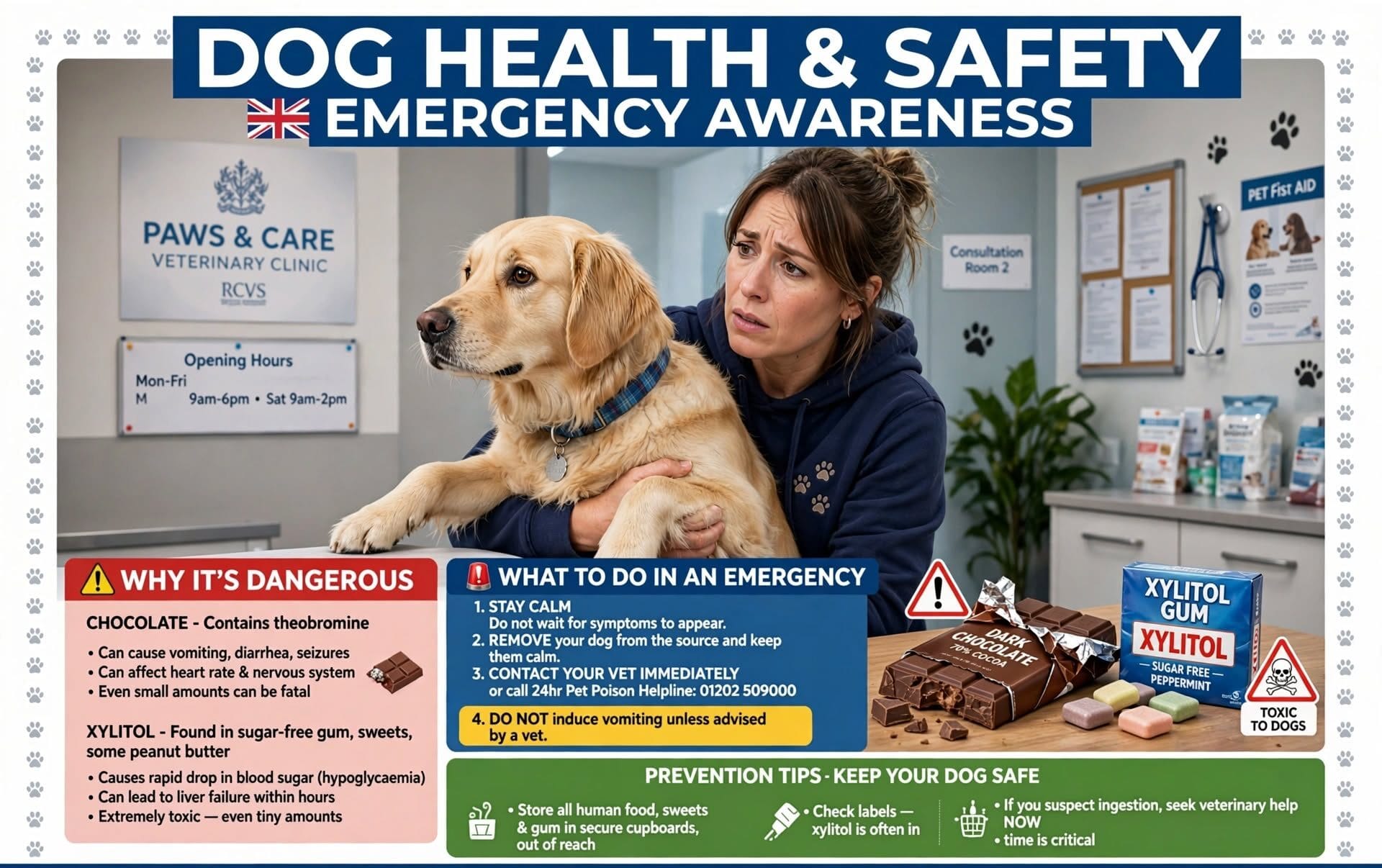
Beyond acute poisoning risks, general dog health awareness includes knowing your dog’s normal baseline (energy, appetite, coat condition, bathroom habits) well enough to notice when something changes. Regular vet check-ups matter even when nothing seems wrong, since many conditions are far easier to manage when caught early.
Dog Training Basics {#dog-training}
Good training is built on consistency and positive reinforcement rather than punishment, and it’s genuinely one of the highest-impact things you can invest time in early in a dog’s life — good manners make every other part of dog care easier, from vet visits to walks to having guests over.
Start with the fundamentals. “Sit,” “stay,” “come,” and “leave it” cover most everyday situations, and are worth teaching in a calm, distraction-free environment before gradually adding real-world distractions. Short, frequent sessions (5-10 minutes, several times a day) tend to work better than long, infrequent ones, particularly for puppies with shorter attention spans.
Reward what you want to see. Positive reinforcement — rewarding desired behaviour with treats, praise, or play — is generally more effective and creates a more trusting relationship than correction-based methods. Timing matters: the reward needs to come immediately after the desired behaviour for your dog to make the connection.
House training takes patience and consistency. A predictable schedule (regular meal times, frequent opportunities to go outside, especially after eating, waking up, and play) combined with immediately rewarding successful outdoor toileting is the most reliable approach. Accidents indoors are a normal part of the process, not a sign of a “bad” dog — punishing after the fact doesn’t help, since dogs don’t connect the correction with something that happened minutes earlier.
Leash manners prevent a lot of frustration later. Teaching a dog to walk without pulling, using positive reinforcement and stopping or changing direction when they pull rather than continuing forward, pays off for the entire length of their walking life.
Socialisation matters as much as commands. Calm, positive exposure to different people, environments, sounds, and (when appropriate) other animals, especially during the primary socialisation window in puppyhood, helps build a confident, well-adjusted adult dog.
Know when to get help. Persistent behavioural issues — reactivity, severe anxiety, aggression — are worth involving a qualified, positive-reinforcement-based trainer or a vet behaviourist for, rather than trying to solve alone through general advice.
Common training mistakes worth avoiding. Inconsistency between household members (one person allowing something another forbids) confuses a dog and slows progress significantly — agreeing on household rules before starting training matters as much as the training method itself. Training sessions that run too long can also backfire, since a tired or bored dog learns less effectively than one working in short, focused bursts. And punishing a dog for behaviour discovered after the fact — chewed shoes found an hour later, for instance — teaches nothing useful, since dogs don’t connect a correction with an action that isn’t happening in that moment.
Recall (coming when called) deserves special attention. It’s one of the most safety-critical behaviours to train well, and it’s built gradually — starting in a low-distraction indoor environment, rewarding generously every single time in the early stages, and only extending to higher-distraction outdoor environments once the behaviour is genuinely reliable. Never call a dog to you for something unpleasant (like ending playtime or a bath) during training, since this teaches them that coming when called sometimes leads to something they don’t want.
Managing multiple dogs during training adds complexity — training each dog individually before attempting group exercises prevents them from feeding off each other’s distraction or excitement, and makes it much clearer which dog has actually learned a given command.
Puppy Care Essentials {#puppy-care}
The first year covers an enormous amount of development, and a few essentials make the biggest difference during this window.

Vaccinations and vet visits. Puppies typically need a vaccination series starting around 6-8 weeks and continuing through roughly 16 weeks, followed by regular booster schedules — your vet will set the specific timeline for your puppy. Until the full initial series is complete, most vets recommend limiting exposure to unknown dogs and high-traffic public spaces, while still allowing safe, controlled socialisation.
Feeding a growing puppy. Puppy-specific food formulated for growth, fed according to the package guidelines for your puppy’s current weight (adjusted as they grow) supports healthy development — see the full dog nutrition guide above for more detail on growth-stage feeding specifically.
The socialisation window is time-limited. Roughly between 3 and 14 weeks, puppies are most receptive to new experiences shaping their long-term temperament — positive, low-stress exposure to new people, sounds, surfaces, and situations during this window has a genuinely outsized impact on adult behaviour.
Puppy-proofing your home. Puppies explore with their mouths, so securing anything chewable, toxic, or swallowable — including the foods covered in the toxic-foods section below — matters more during this stage than at any other point in a dog’s life.
Crate training, done right, isn’t cruel. Used correctly, a crate becomes a safe, den-like space a puppy chooses to use, not a punishment tool — gradual, positive introduction (treats, meals, short periods building up slowly) is key to this actually working as intended.
Teething brings its own challenges. Puppies typically lose their baby teeth and get adult teeth in around 3-6 months, and increased chewing during this period is normal, not a training failure — providing appropriate chew toys redirects this natural need away from furniture and belongings.
Sleep needs are significant. Puppies often sleep 18-20 hours a day in short bursts, which is normal and necessary for development — a puppy that seems suddenly cranky or nippy is often simply overtired, and a consistent nap routine can help as much as any training technique.
The first vet visit sets the tone for future ones. A calm, positive first experience (treats, gentle handling, no rushing) at the vet helps build a puppy’s comfort with future visits, which matters for their entire lifetime of veterinary care, not just the initial appointment.
Growth is uneven, and that’s normal. Puppies often grow in visible spurts rather than smoothly, and it’s common for paws, ears, or overall proportions to look temporarily mismatched during development — this evens out as they mature, and isn’t usually a cause for concern on its own.
Cat Nutrition {#cat-nutrition}
Cats are obligate carnivores, which makes their nutritional needs meaningfully different from a dog’s — they require nutrients (like taurine) that come specifically from animal protein, and get little genuine benefit from fruit or most plant-based foods, unlike dogs. Common cat nutrition questions tend to centre on specific foods: eggs, cheese, and raw meat are among the most searched.
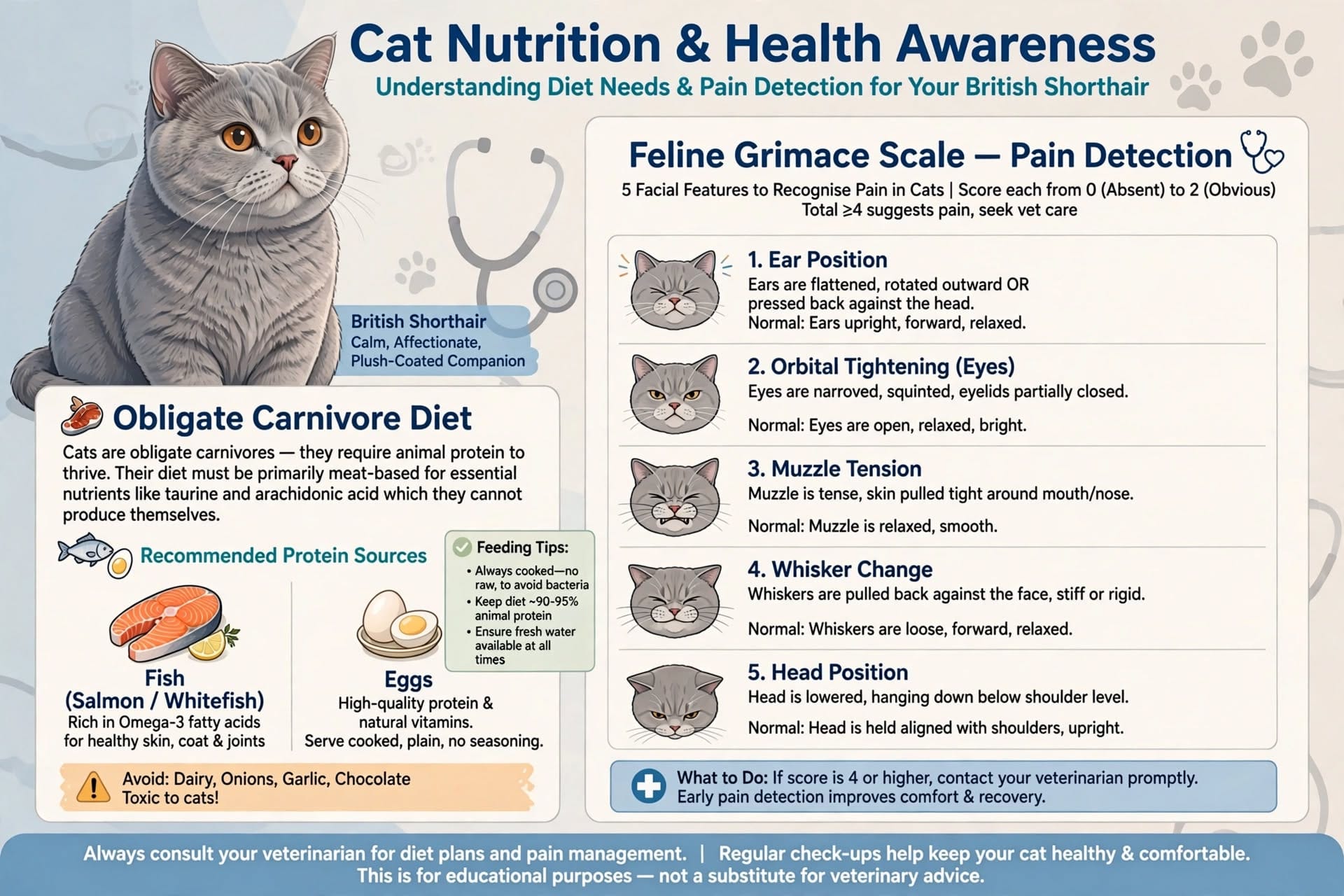
Safe serving size and how to prepare eggs properly for cats.
Read the full guide →
Most cats are lactose intolerant to some degree — here’s what’s actually safe.
Read the full guide →
The raw-feeding debate for cats, covered fairly from both sides.
Read the full guide →
Building Good Long-Term Habits {#long-term-habits}
The single biggest factor separating households where dog and cat care feels manageable from those where it feels overwhelming isn’t knowledge — it’s consistency. A few habits worth building early and maintaining throughout your pet’s life:
- Keep a simple health baseline in mind — normal weight, energy, appetite, and bathroom habits — so you notice changes quickly
- Stick to a feeding routine rather than free-feeding or inconsistent timing, which makes both weight management and appetite-change detection easier
- Don’t skip routine vet visits just because nothing seems wrong — many conditions are far more manageable when caught early
- Keep training and enrichment ongoing, not just a puppy or kitten phase activity — mental stimulation matters throughout a pet’s life
- Revisit nutrition needs at each life stage transition, since what worked for a puppy or kitten won’t necessarily fit an adult or senior pet
- Know your emergency resources — your vet’s number, your nearest emergency vet, and a poison control line, saved somewhere you can find quickly under stress
Seasonal Care Considerations {#seasonal-care}
Care needs shift meaningfully across the year, and knowing what to watch for each season helps you stay ahead of problems rather than reacting to them.
Winter brings cold-weather risks for both species — shorter-coated or smaller dogs may need extra layers on walks, paw pads can be affected by grit and salt on pavements (rinsing paws after walks helps), and antifreeze poisoning risk rises as more households top up their cars, since its sweet taste attracts curious pets despite being highly toxic.
Spring is when Easter chocolate and hidden eggs create a genuine seasonal spike in poisoning cases, and it’s also when many gardens see an increase in toxic plants (like lilies, especially dangerous for cats) coming into bloom.
Summer heat brings heatstroke risk, particularly for flat-faced breeds, senior pets, and those with existing heart or respiratory conditions — avoiding exercise during peak heat, ensuring constant access to water and shade, and never leaving a pet in a parked car (even briefly, even with windows cracked) all matter more during this season.
Autumn brings its own hazards — Halloween sweets and chocolate, fallen conkers and acorns (some of which can cause digestive upset or, in the case of acorns, contain toxins in large quantities), and the return of antifreeze risk as temperatures drop again.
Common Myths in Dog and Cat Care {#myths}
“A warm, dry nose means a dog is sick.” Nose temperature and moisture naturally fluctuate throughout the day for entirely normal reasons and aren’t a reliable indicator of illness on their own.
“Cats always land on their feet, so falls aren’t dangerous.” Cats have impressive righting reflexes, but falls — especially from height, sometimes called “high-rise syndrome” — can still cause serious injury, including broken bones and internal injuries.
“One year of a dog’s life equals seven human years.” This oversimplified rule doesn’t hold up well — aging varies significantly by breed and size, with larger breeds generally aging faster than smaller ones, making the real relationship far less linear than the popular saying suggests.
“Indoor pets don’t need parasite prevention.” Fleas, ticks, and other parasites can still reach indoor-only pets through other animals in the household, on clothing and shoes, or through open windows and doors — indoor status reduces but doesn’t eliminate the need for prevention.
“Purring always means a cat is happy.” Cats also purr when anxious, in pain, or unwell, sometimes as a self-soothing mechanism — purring alone isn’t a reliable sign that everything is fine, especially alongside other changes in behaviour.
“Dogs eat grass because they’re sick.” Occasional grass-eating is common and not necessarily a sign of illness in most dogs — though frequent grass-eating alongside vomiting or other symptoms is still worth mentioning to your vet.
The First 48 Hours With a New Pet {#first-48-hours}
Whether it’s a puppy, kitten, or adult rescue, the first two days in a new home set the tone for the adjustment period that follows.
Keep the environment calm and predictable. Limiting visitors, loud noises, and overwhelming new experiences during the first days gives a new pet time to settle before adding more stimulation. This applies just as much to a confident-seeming adult rescue as it does to a nervous puppy or kitten.
Set up their space before they arrive, not after. A designated sleeping area, food and water bowls, and (for cats) a litter box in a quiet, accessible location, all ready in advance, reduces the amount of change happening in real time once your new pet is actually there.
Expect some appetite and toileting changes. Stress from a new environment can temporarily affect eating and bathroom habits in both species — this often settles within a few days, but persistent refusal to eat or drink warrants a vet call rather than just waiting it out.
Introduce existing pets gradually, not all at once. Scent swapping (bedding or a cloth exchanged before a face-to-face meeting), then short, supervised initial meetings, tends to go better than an immediate full introduction, particularly between cats or between a new dog and an established cat.
Book a vet visit within the first week or two, even if nothing seems wrong. This establishes a baseline health record, catches anything that needs early attention, and starts building your new pet’s comfort with veterinary visits.
Patience matters more than a fixed timeline. Some pets settle within days; others take weeks or longer, particularly rescues with an unknown or difficult history. Progress isn’t always linear, and that’s normal rather than a sign something’s wrong.
Budgeting for Dog and Cat Care {#budgeting}
Ongoing costs are worth planning for honestly, since underestimating them is a common source of stress for new pet owners.
Recurring costs typically include food, routine vet care (vaccinations, boosters, annual check-ups), parasite prevention, and grooming where relevant — these are predictable and worth budgeting for monthly rather than treating as occasional surprises.
Emergency costs are the hardest to plan for precisely, which is exactly why many owners consider pet insurance or a dedicated savings buffer specifically for unexpected veterinary treatment — the poisoning emergencies covered throughout this guide are a good example of costs that can arrive with no warning.
Training and enrichment don’t have to be expensive. Basic training can be done at home with patience and consistency at minimal cost, though professional help for specific behavioural issues is a cost worth factoring in as a possibility, not a certainty.
Life-stage costs shift over time. Puppy and kitten costs front-load vaccinations and initial setup (bedding, carriers, initial vet visits); senior pet costs often shift toward more frequent vet visits and potentially management of ongoing health conditions. Planning for this shift rather than assuming costs stay flat across a pet’s life helps avoid being caught off guard.
Dental Care for Dogs and Cats {#dental-care}
Dental health is one of the more overlooked parts of dog and cat care despite being genuinely significant — dental disease is extremely common in both species by middle age, and untreated dental problems can contribute to pain, difficulty eating, and in some cases, wider health effects beyond the mouth itself.
Regular teeth brushing is the gold standard, using a pet-specific toothpaste (never human toothpaste, which can contain xylitol or other ingredients unsafe for pets) and a soft brush or finger brush designed for the purpose. Building this habit gradually, starting with short, positive sessions, works far better than attempting a full routine immediately with a pet unfamiliar with the process.
Dental treats and chews can help but don’t replace brushing. Look for products with genuine evidence of dental benefit rather than assuming any chew marketed for dental health delivers meaningful results.
Watch for signs of dental problems, including bad breath beyond normal, visible tartar build-up, reluctance to eat or chew on one side, pawing at the mouth, or excessive drooling — any of these are worth a dental check with your vet.
Professional dental cleanings, done under anaesthetic, are sometimes necessary for both dogs and cats, particularly as they age, since some level of tartar and early dental disease is difficult to fully address with home care alone once it’s established.
Grooming as Part of Overall Care {#grooming}
Grooming isn’t just about appearance — it’s a genuine part of health monitoring for both species, since it’s often during grooming that owners first notice lumps, skin changes, parasites, or areas of discomfort.
Coat type determines frequency, but even short-haired, low-maintenance breeds benefit from regular brushing, which distributes natural oils, reduces shedding around the home, and provides a routine opportunity to check your pet over physically.
Nail trims matter for comfort and mobility, particularly for less active dogs and indoor cats whose nails wear down less naturally through activity. Overly long nails can affect gait and, in severe cases, curl into the pad, causing pain and infection.
Ear checks are easy to build into a grooming routine — healthy ears are generally clean and odour-free, while redness, discharge, a strong smell, or head-shaking and scratching at the ears are all worth a vet visit rather than home treatment.
Grooming frequency and needs change with age. Senior pets often need more grooming assistance as their own flexibility and self-grooming ability (particularly in cats) declines, making owner-led grooming a more significant part of their comfort and hygiene than it was earlier in life.

FAQs {#faqs}
What’s the most important part of dog and cat care overall? Consistency across all areas — nutrition, health awareness, and training — matters more than perfecting any single one. A reasonably good routine maintained consistently beats an ideal routine followed sporadically.
How is cat care fundamentally different from dog care? Cats are obligate carnivores with different nutritional needs, are generally more independent, and are notably better at hiding illness and pain, which shifts the emphasis toward proactive health monitoring more than it does for dogs.
When should puppy or kitten care shift to adult care? Most dogs transition to adult feeding and care needs somewhere between 12-18 months depending on breed size (smaller breeds mature faster, larger breeds take longer), while cats typically transition around 12 months — your vet can advise on timing specific to your pet’s breed and individual development.
Do the same toxic foods affect both dogs and cats? Largely yes, though sensitivity can differ — cats are often more sensitive to onion and garlic relative to their size, while grapes and raisins are most severely documented in dogs specifically. See the toxic foods section above and its linked full guide for the complete, species-specific breakdown.
Is professional training necessary, or can I do it all myself? Many owners successfully handle basic training themselves using consistent positive reinforcement, but persistent behavioural issues (reactivity, anxiety, aggression) are worth involving a qualified professional for rather than troubleshooting alone — a trainer or behaviourist can often spot patterns and underlying causes that are genuinely difficult to see from inside the day-to-day situation yourself.
How often should a healthy adult dog or cat see a vet? Generally once a year for healthy adults, increasing to twice a year for seniors or pets with existing health conditions — though this can vary, so confirm the right schedule with your own vet.
Should I get pet insurance, and does it matter for good care? It’s a genuinely worthwhile consideration for many households — emergency treatment (like the poisoning scenarios covered above) can be costly, and having insurance in place can make it easier to say yes to necessary treatment immediately rather than hesitating over cost during a stressful moment.
Is it harder to care for multiple pets than a single one? It adds complexity — separate feeding to manage individual nutrition needs, more deliberate introductions, and sometimes more nuanced training — but it’s very manageable with the same core principles (consistency, positive reinforcement, individual attention) applied to each pet.
How do I know if my dog or cat is at a healthy weight? A simple hands-on check works for both: you should be able to feel (though not necessarily see) ribs without pressing hard, and there should be a visible waist when viewed from above. Your vet can confirm this more precisely at a check-up using a body condition scoring system, which is a more objective, repeatable measure than eyeballing weight alone, and is worth asking about at any routine visit if you’re unsure.
What’s the biggest difference between caring for a rescue pet versus one raised from puppyhood or kittenhood? Rescues sometimes carry an unknown history that can affect their behaviour, trust, and adjustment timeline — extra patience, and sometimes professional behavioural support, matters more here than with a pet whose full history and early socialisation you’re already familiar with.
Can I follow this guide for any breed, or do some breeds need very different care? The core principles here (nutrition matched to life stage, consistent training, health awareness, regular vet care) apply broadly across breeds, but individual breeds do carry specific tendencies worth knowing — certain breeds are more prone to particular health conditions, have different exercise or grooming needs, or respond better to specific training approaches. This guide is a solid foundation; breed-specific research adds useful detail on top of it.
Final Verdict {#final-verdict}
Good dog and cat care isn’t a single skill you master once — it’s an ongoing combination of nutrition matched to life stage, genuine health and safety awareness, consistent positive training, and care that adapts as your pet grows and ages. No single guide, this one included, replaces individualised veterinary advice for your specific pet, but having a solid map of each area — and knowing exactly where to go deeper — makes the whole picture far more manageable. Use the guides linked throughout this page whenever a specific question comes up; that’s exactly what they’re there for.
Whether you’re just starting out with a new puppy or kitten, troubleshooting a specific training or health question, or simply want a reliable reference to come back to, this guide is designed to grow with you — bookmark it, and revisit whichever section is most relevant as your pet moves through each stage of their life.
This guide is for general information and isn’t a substitute for professional, individualised veterinary advice. Talk to your vet about your pet’s specific nutrition, health, and care needs.
Further reading from UK authorities:
Thank you for reading this complete guide.