Table of Contents
- Can Dogs Eat Guava?
- Is Guava Safe for Dogs?
- Guava Benefits for Dogs
- How Much Guava Can Dogs Eat?
- How to Prepare Guava for Dogs
- Can Dogs Eat Guava Seeds and Skin?
- Can Puppies Eat Guava?
- Guava Risks and Side Effects
- Frequently Asked Questions
- Final Verdict
Can Dogs Eat Guava?
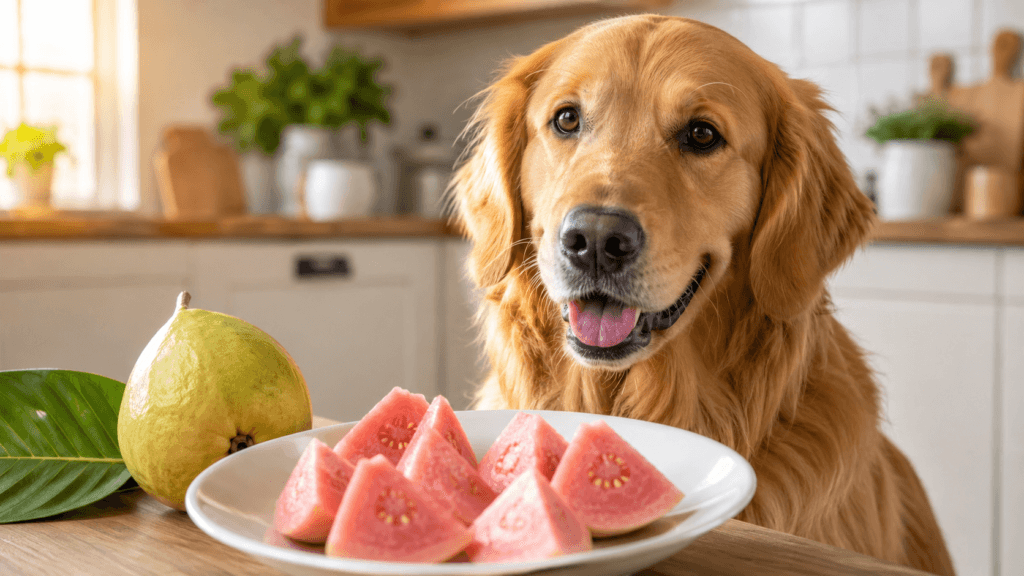
Yes, dogs can eat small amounts of ripe guava as an occasional treat, but it should be prepared carefully before you offer it to your dog.
Guava contains fiber, vitamin C, and other nutrients, and many dogs can enjoy a few small pieces without a problem. However, guava is not a necessary part of a dog’s diet, and eating too much may cause digestive upset because of its fiber and natural sugar content.
The safest approach is to choose a fresh, ripe guava, wash it thoroughly, remove any tough or unwanted parts, and cut the fruit into small, manageable pieces. If your dog has a sensitive stomach, diabetes, food allergies, or another medical condition, it’s a good idea to ask your veterinarian before adding guava to their diet.
So, can dogs eat guava? Yes—but moderation and preparation matter.
Quick Answer: Can Dogs Eat Guava?
Yes. Most healthy dogs can eat a small amount of ripe, plain guava as an occasional treat.
Guava provides nutrients such as fiber and vitamin C, but it should never replace your dog’s complete and balanced food.
Safe Guava Checklist for Dogs
 Ripe, plain guava can be offered in moderation.
- Wash the fruit thoroughly before preparing it.
- Cut guava into small pieces appropriate for your dog’s size.
- Start with a very small amount if your dog has never tried it.
- Too much guava may cause gas, loose stool, or diarrhea.
- Avoid giving your dog sweetened guava products.
- Guava seeds should not be deliberately fed in large quantities.
- Remove tough parts that could present a choking or digestive concern.
- Dogs with certain medical conditions may need individualized dietary advice.
 Ripe, plain guava can be offered in moderation.
 Too much guava may cause gas, loose stool, or diarrhea.
Bottom line: A few small pieces of properly prepared ripe guava can be an occasional treat for many healthy dogs, but it’s not something dogs need to eat regularly.
Is Guava Safe for Dogs?
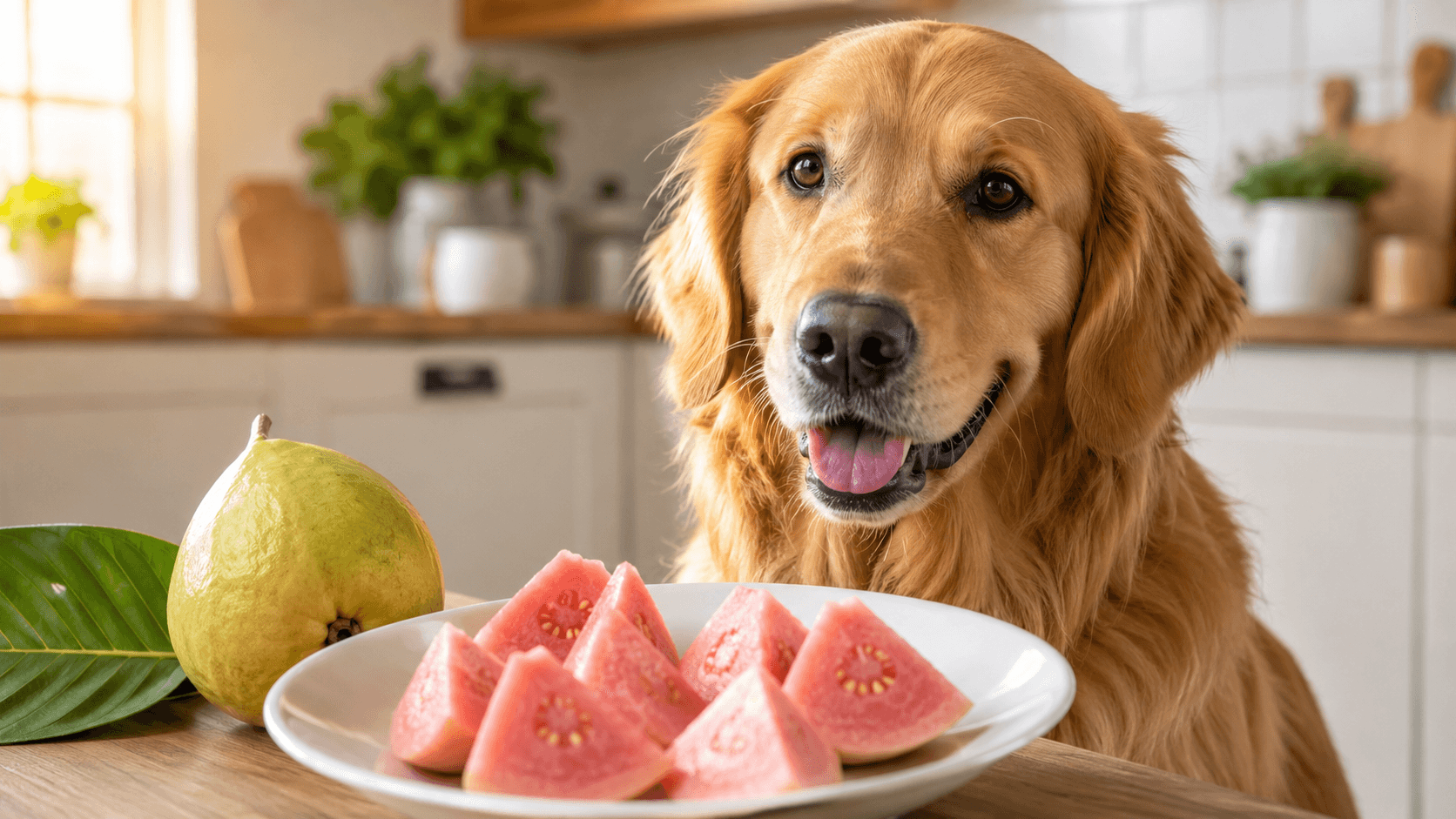
For most healthy dogs, small amounts of ripe guava can be safe when served properly.
However, “safe” doesn’t mean that every part of the fruit should automatically be given to your dog.
Whenever you introduce a new fruit, it’s important to think about:
- Which part of the fruit your dog is eating
- How the fruit was prepared
- How much your dog is eating
- Your dog’s individual health
- Whether your dog has previously tolerated similar foods
Guava is a soft tropical fruit, but its texture and seeds can vary depending on the variety and ripeness.
For this reason, dog owners should focus on offering small, manageable pieces of ripe fruit rather than giving a dog a whole guava and allowing them to eat it unsupervised.
Why Preparation Matters
Dogs don’t need fruit to survive, but many owners enjoy giving their pets small amounts of fresh produce as an occasional reward.
The challenge is that fruits are not all prepared in the same way.
Some have:
- Hard pits
- Tough skins
- Large seeds
- Small seeds
- Thick rinds
- Stems
- Leaves
Guava is no exception.
Before giving guava to your dog, inspect the fruit and prepare it in a way that makes it easy for your dog to eat.
For small dogs and puppies, cutting the fruit into particularly small pieces can also make portion control easier.
What Nutrients Does Guava Provide?
Guava is known for being a nutrient-rich fruit for humans, and it contains several naturally occurring nutrients.
Depending on the variety and serving size, guava can provide:
- Dietary fiber
- Vitamin C
- Vitamin A
- Folate
- Potassium
- Other plant compounds
However, there is an important distinction between a food containing nutrients and a food your dog needs to meet their nutritional requirements.
Your dog should receive the majority of their nutrition from a complete and balanced diet appropriate for their age and life stage.
Guava is best viewed as an optional treat.
That means you don’t need to feed guava to make your dog healthier, and you shouldn’t rely on it to correct a nutritional deficiency.
Potential Benefits of Guava for Dogs
1. Guava Contains Dietary Fiber
One of the notable nutritional features of guava is its fiber content.
Dietary fiber plays a role in normal digestive function and can be part of a balanced diet.
However, more fiber is not always better.
If a dog suddenly eats a large amount of guava, the extra fiber may contribute to:
- Gas
- Loose stool
- Diarrhea
- Stomach discomfort
This is one reason to start with a small portion.
If your dog tolerates a little guava well, you can continue to offer occasional small servings rather than giving a large amount all at once.
2. Guava Provides Vitamin C
Guava is naturally rich in vitamin C.
Dogs are generally able to synthesize vitamin C in their bodies, so healthy dogs don’t usually need fruit as their primary source of this vitamin.
Still, vitamin C is an important antioxidant nutrient involved in normal physiological processes.
This makes guava an interesting fruit from a nutritional perspective, but it doesn’t mean that giving your dog guava will prevent illness or replace veterinary care.
A small serving can be part of a varied treat routine, but the benefits shouldn’t be exaggerated.
3. Guava Contains Antioxidant Compounds
Guava contains naturally occurring plant compounds with antioxidant properties.
Antioxidants are involved in protecting cells from oxidative stress as part of normal biological processes.
However, it’s important to keep expectations realistic.
Guava is not a medicine.
It should not be promoted as a treatment for:
- Cancer
- Diabetes
- Infections
- Skin disease
- Digestive disorders
- Any other medical condition
If your dog has a health problem, the right approach is to work with your veterinarian.
Guava can simply be an occasional food treat for a dog that tolerates it.
4. Guava Can Add Variety to Treat Time
Some dogs enjoy exploring new tastes and textures.
For these dogs, a small piece of ripe guava can make treat time a little more interesting.
You might offer a tiny piece:
- After a walk
- During a training session
- As an occasional reward
- As part of a food enrichment activity
- Alongside your dog’s regular meal
However, don’t feel pressured to give your dog guava if they don’t like it.
Dogs have individual preferences.
One dog may happily eat a piece of guava while another may sniff it once and walk away.
That’s completely normal.
5. Guava Can Be an Occasional Whole-Food Treat
Plain fresh guava is a whole food, unlike many heavily processed snacks made for humans.
That can make it an appealing occasional treat option for dog owners who want to offer their pets a little variety.
But “whole food” doesn’t mean “unlimited.”
Guava still contains natural sugars and calories, and treats should remain a relatively small part of your dog’s overall daily food intake.
If your dog already receives several treats each day, remember to consider the total amount of extra food—not just the guava.
How Much Guava Can Dogs Eat?
The appropriate serving size depends on your dog’s:
- Body size
- Age
- Weight
- Activity level
- Overall diet
- Health
- Individual tolerance
There is no universal serving size that is right for every dog.
As a cautious starting point, you can use the following general guide:
| Dog Size | Suggested Starting Portion |
|---|---|
| Extra-small dogs | 1 tiny piece |
| Small dogs | 1–2 small pieces |
| Medium dogs | 2–4 small pieces |
| Large dogs | 4–6 small pieces |
| Extra-large dogs | A small handful of bite-sized pieces |
These are general starting guidelines, not veterinary prescriptions.
If guava is completely new to your dog, start at the lower end.
You can then observe how your dog responds.
If your dog develops digestive upset, stop feeding guava.
How to Introduce Guava for the First Time
Introducing any new food should be a gradual process.
You don’t need to give your dog a large serving just to find out whether they like it.
Instead:
Step 1: Prepare the Fruit
Wash the guava and prepare a small amount of ripe fruit.
Step 2: Cut It Small
Create a tiny piece that is appropriate for your dog’s size.
Step 3: Offer a Small Amount
Give your dog one small piece.
Step 4: Observe
Pay attention to your dog’s behavior and digestion.
Step 5: Wait Before Offering More
If your dog tolerates the fruit without any obvious problems, you can offer another small serving on a future occasion.
This approach makes it easier to identify potential food sensitivities.
It also prevents your dog from consuming too much of a new food at once.
How to Prepare Guava for Dogs
Preparing guava for your dog doesn’t have to be complicated.
Follow these basic steps.
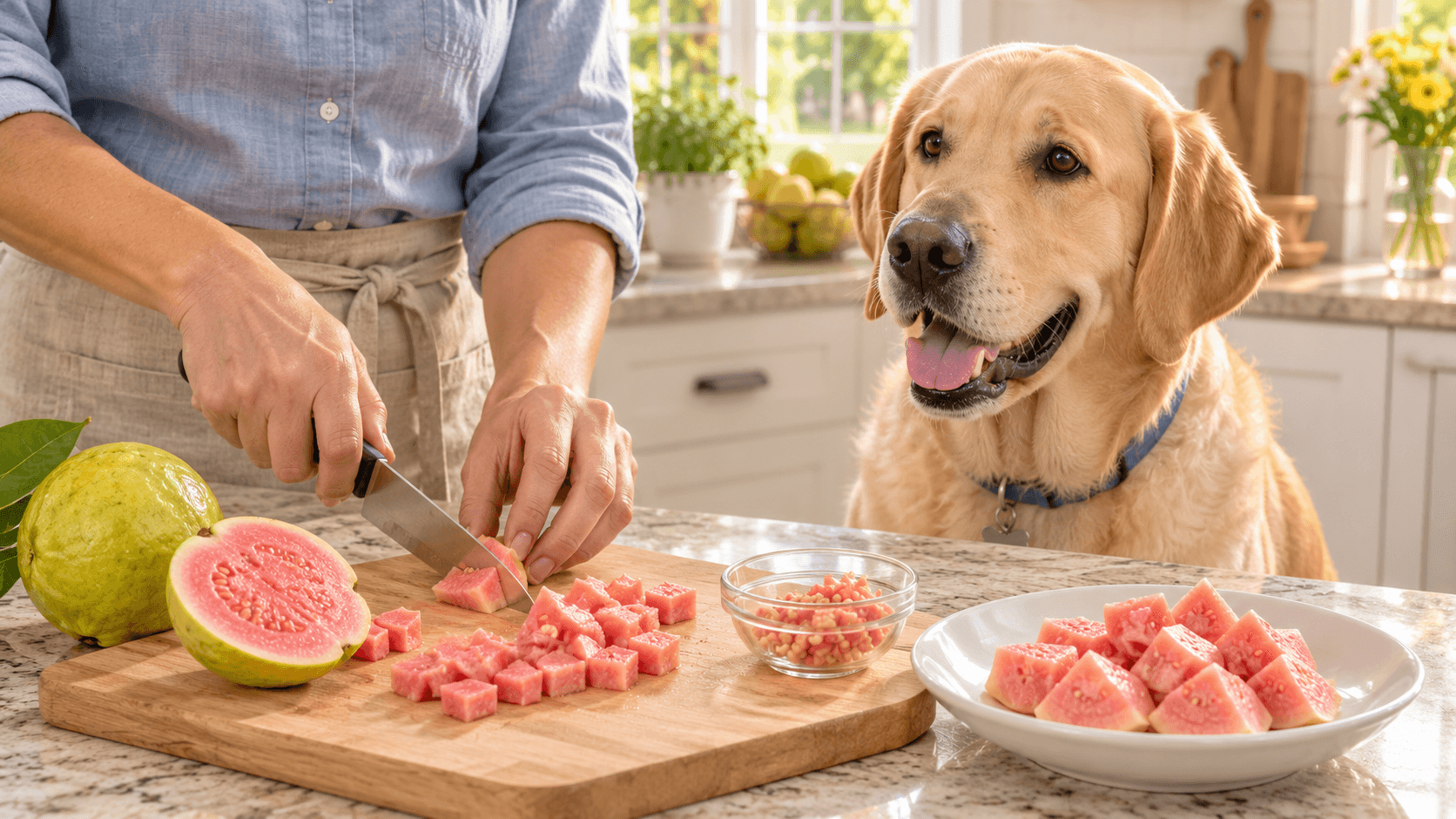
1. Choose Fresh, Ripe Guava
Select fruit that is fresh and free from mold or spoilage.
Avoid fruit with an unusual smell or visibly rotten areas.
2. Wash the Fruit
Rinse the guava thoroughly under clean running water before cutting it.
3. Inspect the Fruit
Check the fruit for tough stems or other parts that shouldn’t be included in your dog’s treat.
4. Cut the Guava
Cut the fruit into small, manageable pieces appropriate for your dog’s size.
5. Be Careful With the Seeds
Guava varieties can contain many small, hard seeds.
While guava seeds are not the same as the large toxic pits found in some fruits, you should still avoid intentionally giving your dog large quantities of seeds.
For a cautious approach, remove as many seeds as practical, especially when preparing guava for small dogs and puppies.
6. Serve a Small Portion
Start with a small amount and observe your dog’s reaction.
Can Dogs Eat Guava Seeds?
This is one of the most important questions to address when discussing Can Dogs Eat Guava?
Guava contains numerous small seeds, and dog owners often wonder whether they are safe.
Unlike some fruits with large pits that pose obvious choking or obstruction hazards, guava seeds are small.
However, that doesn’t mean you should deliberately feed your dog large quantities of them.
The safest practical approach is to remove as many seeds as reasonably possible, particularly when preparing guava for:
- Puppies
- Small dogs
- Dogs that eat quickly
- Dogs with sensitive digestive systems
If your dog accidentally consumes a few small seeds along with a small portion of guava, there is generally no reason to panic.
However, if your dog consumes a large amount of guava or you are concerned about what they have eaten, contact your veterinarian for individualized advice.
Can Dogs Eat Guava Skin?
For many dogs, the thin skin of a ripe guava is not considered inherently toxic.
However, when preparing guava specifically as a dog treat, removing the skin can be a sensible option, especially for small dogs and dogs with sensitive digestion.
The skin may be tougher than the soft inner flesh, and removing it also makes it easier to control exactly what your dog is eating.
If you choose to leave the skin on, make sure the fruit is thoroughly washed first.
For the simplest approach:
Wash → Peel if desired → Remove excess seeds → Cut small → Serve moderately
Can Puppies Eat Guava?
Puppies that are already eating solid food may be able to tolerate a tiny amount of properly prepared guava.
However, puppies require more careful portion control than adult dogs.
Their digestive systems are still developing, and their primary nutritional needs should be met through a complete and balanced puppy diet.
If you want to introduce guava to a puppy:
- Wait until your puppy is eating solid food.
- Start with an extremely small piece.
- Cut it into a tiny, manageable size.
- Avoid large amounts of seeds.
- Supervise your puppy while eating.
- Introduce only one new food at a time.
- Monitor for diarrhea, vomiting, or other digestive changes.
Remember that guava is an optional treat, not a necessary part of puppy nutrition.
If your puppy has a sensitive stomach or a medical condition, speak with your veterinarian before introducing new foods.
Can Guava Help a Dog’s Digestion?
Guava contains dietary fiber, which can contribute to normal digestive function as part of an overall balanced diet.
But that doesn’t mean guava is a treatment for digestive problems.
Giving your dog extra guava when they are already experiencing constipation or diarrhea could potentially make things worse.
If your dog has ongoing:
- Constipation
- Diarrhea
- Vomiting
- Gas
- Abdominal discomfort
- Changes in appetite
it’s better to identify the underlying cause with help from your veterinarian.
Don’t rely on fruit as a substitute for professional medical care.
Important Takeaway
Can dogs eat guava? Yes, many healthy dogs can enjoy a small amount of ripe, properly prepared guava as an occasional treat.
The key is moderation.
Give your dog a small serving, prepare the fruit carefully, and avoid turning guava into a daily staple.
If your dog has never eaten guava before, start with a tiny piece and watch how they respond.
And remember: a complete and balanced dog food should remain the foundation of your dog’s diet.
Can Dogs Eat Guava Every Day?
While many healthy dogs can eat a small amount of guava without a problem, there is no need to feed guava every day.
Your dog gets the nutrients they need from a complete and balanced diet designed for their life stage. Fruits such as guava should be considered an occasional extra rather than a daily nutritional requirement.
Feeding guava too frequently may also increase your dog’s intake of:
- Natural sugars
- Calories
- Dietary fiber
For some dogs, too much fiber can lead to loose stools or digestive discomfort.
If you want to include guava in your dog’s treat rotation, occasional small servings are a more sensible approach than making it a daily staple.
Can Dogs Eat Fresh Guava?
Yes, fresh ripe guava is generally the best form to offer your dog.
Fresh fruit allows you to control the ingredients and portion size.
Before serving:
- Choose ripe, fresh guava.
- Wash it thoroughly.
- Remove the stem and any tough unwanted parts.
- Remove as many seeds as practical.
- Cut the flesh into small pieces.
- Give your dog a small portion.
Avoid adding sugar, salt, honey, syrup, or seasonings.
Plain guava is all your dog needs if you decide to offer this fruit as a treat.
Can Dogs Eat Ripe Guava?
Yes. Ripe guava is generally the most suitable type of guava to offer dogs because it is softer and easier to chew.
The exact color of ripe guava can vary depending on the variety. Some guavas have pink or red flesh, while others have white or pale flesh.
When selecting guava for your dog, avoid fruit that is:
- Moldy
- Rotten
- Fermented
- Extremely overripe
- Covered with visible spoilage
A fresh, ripe piece of guava is a much better option than spoiled fruit or a processed guava snack.
Can Dogs Eat Unripe Guava?
It’s better to avoid giving your dog large amounts of unripe guava.
Unripe fruit tends to be firmer and may be more difficult for some dogs to chew and digest.
It can also have a more acidic or astringent taste that some dogs may dislike.
If you want to share guava with your dog, choose a ripe fruit and prepare it into small pieces.
This makes the treat easier to manage and allows you to control how much your dog consumes.
Can Dogs Eat Guava Juice?
It’s generally better to skip guava juice and give your dog a small amount of whole fresh guava instead.
Commercial fruit juices may contain:
- Added sugar
- Artificial flavors
- Preservatives
- Concentrated fruit sugars
- Other unnecessary ingredients
Juice also removes much of the benefit of eating whole fruit, particularly when it comes to the physical structure and fiber of the fruit.
Dogs don’t need fruit juice as part of a healthy diet.
If you want your dog to enjoy guava, a few small pieces of fresh, properly prepared fruit are a simpler choice.
Can Dogs Eat Dried Guava?
Be cautious with dried guava.
Dried fruit is more concentrated than fresh fruit, which means a small amount can contain more sugar and calories than an equivalent portion of fresh fruit.
Commercial dried guava may also contain:
- Added sugar
- Syrups
- Preservatives
- Artificial sweeteners
- Other ingredients
Always check the ingredient label.
If you’re looking for a simple way to share guava with your dog, fresh fruit is generally easier to portion and control.
Avoid any dried fruit product containing ingredients that are unsafe for dogs.
Can Dogs Eat Guava Jam or Jelly?
No, guava jam and jelly are not good choices for dogs.
These products are typically made with significant amounts of added sugar and may contain additional ingredients that your dog doesn’t need.
Even if the main ingredient is guava, the finished product is very different from plain fresh fruit.
Instead of sharing your breakfast toast with guava jam, offer your dog a tiny piece of fresh guava separately.
This keeps the treat simple and avoids unnecessary ingredients.
Can Dogs Eat Guava Candy?
Guava candy should not be given to dogs.
Candy can contain:
- Large amounts of sugar
- Artificial sweeteners
- Flavorings
- Preservatives
- Other ingredients that may be inappropriate for dogs
Some sugar-free products may contain xylitol, an ingredient that is highly toxic to dogs.
Never assume a candy is safe simply because it is made with guava.
If your dog accidentally eats candy, check the ingredient list and contact your veterinarian promptly if it contains xylitol or another potentially harmful ingredient.
Can Dogs Eat Guava Smoothies?
It’s better not to share a human guava smoothie with your dog.
Smoothies often contain multiple ingredients, and some may not be appropriate for dogs.
A smoothie might include:
- Added sugar
- Milk
- Sweetened yogurt
- Protein powder
- Artificial sweeteners
- Chocolate
- Other ingredients
Instead, if your dog enjoys guava, simply offer a few small pieces of plain fresh fruit.
This gives you much better control over what your dog is eating.
Can Dogs Eat Guava With Yogurt?
Some dogs can tolerate small amounts of plain, unsweetened yogurt, but dairy doesn’t agree with every dog.
If your dog already tolerates plain yogurt, you could occasionally combine a tiny amount with properly prepared guava.
However, always check the label.
Avoid yogurt products containing:
- Added sugar
- Artificial sweeteners
- Xylitol
- Chocolate
- Other potentially unsafe ingredients
There is no nutritional requirement to combine guava and yogurt, so keeping the portions small is important.
Can Dogs Eat Guava With Other Fruits?
Yes, but introduce new fruits carefully.
If your dog already tolerates guava, you can occasionally offer it alongside other dog-friendly fruits.
However, don’t introduce several new foods at the same time.
For example, if your dog has never eaten guava, don’t give them guava, mango, strawberries, and pineapple together for the first time.
If your dog develops diarrhea or vomiting, it becomes much harder to determine which food caused the problem.
Instead:
Introduce one new food → start small → observe your dog → continue only if tolerated.
This simple approach makes it easier to identify food sensitivities.
Can Dogs Eat Guava as a Training Treat?
Yes, small pieces of guava can be used as an occasional training reward for dogs that enjoy the fruit.
The key is to cut the pieces very small.
You don’t need to give your dog a large chunk every time they perform a behavior correctly.
Tiny pieces can work well for:
- Sit
- Stay
- Come
- Leave it
- Recall
- Loose-leash walking
- Basic obedience
However, remember that training sessions can involve many rewards.
If you use guava frequently during training, the calories and total amount can add up.
For longer training sessions, consider alternating guava with your dog’s regular training treats.

Can Dogs Eat Guava if They Are Overweight?
An overweight dog may be able to enjoy a very small amount of guava, but treats should be carefully managed.
Guava contains natural sugars and calories, so it still contributes to your dog’s total daily food intake.
If your dog is overweight, consider:
- Measuring meals carefully
- Limiting high-calorie treats
- Using tiny reward portions
- Increasing appropriate exercise
- Following your veterinarian’s weight-management recommendations
A small piece of guava may fit into some weight-management plans, but your veterinarian can help determine what is appropriate for your individual dog.
Remember, replacing a high-calorie treat with a small piece of fruit may be useful in some cases, but simply adding fruit on top of your dog’s normal daily food won’t necessarily help with weight management.
Can Dogs With Diabetes Eat Guava?
Dogs with diabetes need carefully managed nutrition.
Although guava is a whole fruit, it still contains naturally occurring sugars and carbohydrates.
For this reason, don’t assume that guava is automatically appropriate for a diabetic dog.
If your dog has diabetes, ask your veterinarian before introducing guava or any new treat.
Your veterinarian can consider your dog’s:
- Blood glucose control
- Current diet
- Medications
- Body weight
- Overall health
and help determine whether a small portion of fruit can fit into their individual nutrition plan.
Can Dogs With a Sensitive Stomach Eat Guava?
Dogs with sensitive digestive systems may need extra caution when trying new foods.
Even foods that are generally safe for healthy dogs can cause problems in individual animals.
If your dog frequently experiences:
- Gas
- Diarrhea
- Vomiting
- Food intolerance
- Digestive upset
don’t introduce a large serving of guava.
If your veterinarian agrees that you can try it, start with a very small piece and monitor your dog.
If your dog reacts poorly, stop feeding guava.
There’s no nutritional requirement for your dog to eat guava, so there’s no reason to continue offering it if it causes digestive problems.
Can Dogs With Food Allergies Eat Guava?
Guava isn’t generally considered one of the most common food allergens for dogs, but individual dogs can react differently to foods.
If your dog has a known food allergy or is currently following an elimination diet, don’t introduce guava without veterinary guidance.
An elimination diet works best when the diet is carefully controlled.
Adding a new food can make it difficult to determine whether your dog is reacting to another ingredient.
If your veterinarian has recommended an elimination diet, follow their instructions closely.
Can Senior Dogs Eat Guava?
Many healthy senior dogs can enjoy small amounts of properly prepared guava.
However, older dogs are more likely to have health conditions that affect their dietary needs.
These can include:
- Diabetes
- Kidney disease
- Dental problems
- Obesity
- Gastrointestinal disease
- Food sensitivities
If your senior dog has difficulty chewing, you can mash ripe guava into a soft texture before offering a very small amount.
If your dog has a chronic medical condition or eats a prescription diet, ask your veterinarian before introducing guava.
Can Dogs Eat Guava if They Have Kidney Disease?
Dogs with kidney disease may need carefully controlled nutrition.
Depending on the individual dog, their diet may require specific management of nutrients such as phosphorus, protein, sodium, and others.
Because kidney disease varies significantly between dogs, there isn’t one universal answer for every patient.
If your dog has kidney disease, consult your veterinarian before adding guava to their diet.
Your veterinarian can determine whether an occasional small serving fits your dog’s specific nutritional plan.
Can Dogs Eat Guava if They Have Pancreatitis?
Dogs with a history of pancreatitis often require careful dietary management.
If your dog has pancreatitis or has previously experienced pancreatitis, don’t introduce guava or other new treats without veterinary advice.
Your veterinarian may recommend a specific diet based on your dog’s individual history and current condition.
Following that plan is more important than adding a new fruit.
Can Dogs Eat Guava During an Upset Stomach?
If your dog already has diarrhea, vomiting, or another digestive problem, it’s best not to introduce guava at that time.
Adding a new food can make digestive symptoms more difficult to evaluate.
Instead, follow your veterinarian’s advice about feeding and hydration.
Contact your veterinarian if your dog has:
- Persistent vomiting
- Severe diarrhea
- Blood in stool
- Significant weakness
- Signs of dehydration
- Severe abdominal pain
- Loss of appetite
Guava should be an occasional treat for a healthy, stable dog—not a home remedy for unexplained digestive illness.
What Happens If a Dog Eats Too Much Guava?
If your dog eats a large amount of guava, the most likely concern is digestive upset.
Depending on the amount consumed and your dog’s individual sensitivity, you may notice:
- Gas
- Loose stool
- Diarrhea
- Vomiting
- Reduced appetite
- Abdominal discomfort
The risk may be higher if your dog isn’t used to eating fruit or suddenly consumes a large quantity.
If your dog has eaten a lot of guava, monitor them closely.
Contact your veterinarian if your dog develops severe or persistent symptoms.
If the fruit was spoiled or contained other ingredients, tell your veterinarian exactly what your dog consumed.
Can Guava Cause Diarrhea in Dogs?
Yes, too much guava may cause diarrhea in some dogs.
The fruit contains dietary fiber and natural sugars, and a sudden increase in either can affect a dog’s digestive system.
This is particularly true for dogs that:
- Have sensitive stomachs
- Rarely eat fruit
- Eat a large serving
- Are given several new foods at once
If your dog develops diarrhea after eating guava, stop offering the fruit and monitor their condition.
If diarrhea is severe, persistent, bloody, or accompanied by vomiting or weakness, contact your veterinarian.
Can Guava Cause Vomiting in Dogs?
Vomiting isn’t expected from a small serving of properly prepared guava, but individual dogs can react differently.
Your dog may vomit after eating guava if:
- They ate too much
- They have a sensitive stomach
- They reacted poorly to the new food
- They consumed spoiled fruit
- Another underlying problem is present
If your dog vomits once and otherwise appears completely normal, monitor them closely.
Repeated vomiting or vomiting accompanied by other concerning symptoms warrants veterinary attention.
Can Dogs Eat Guava Leaves?
It’s best not to intentionally feed guava leaves to your dog.
When discussing Can Dogs Eat Guava?, the focus should be on the ripe edible fruit.
There is no nutritional reason to add guava leaves to your dog’s diet, and there isn’t a need to experiment with other parts of the plant.
Keep your dog’s treats simple and stick with appropriately prepared fruit.
Can Dogs Eat Cooked Guava?
Dogs generally don’t need cooked guava.
Cooking isn’t necessary to make ripe guava suitable as an occasional treat, and many recipes containing cooked guava also include ingredients that aren’t appropriate for dogs.
Avoid recipes containing:
- Sugar
- Syrups
- Chocolate
- Xylitol
- Excessive salt
- Artificial sweeteners
- Large amounts of butter
If you want to share guava with your dog, plain fresh fruit is usually the simplest choice.
Can Dogs Eat Guava Desserts?
No, you should avoid sharing human guava desserts with your dog.
Guava cakes, pastries, pies, and other desserts can contain ingredients such as:
- Added sugar
- High amounts of fat
- Chocolate
- Artificial sweeteners
- Dairy
- Alcohol
- Other ingredients unsuitable for dogs
A piece of fresh guava is very different from a slice of human dessert made with guava.
Always consider the complete recipe rather than focusing only on the fruit ingredient.
Can Guava Help Dogs With Constipation?
Guava contains fiber, but it should not be considered a guaranteed treatment for constipation.
Constipation can have many causes, including:
- Dehydration
- Dietary issues
- Pain
- Medication
- Foreign-body ingestion
- Underlying health conditions
If your dog is repeatedly struggling to pass stool, speak with your veterinarian.
Don’t give large quantities of guava in an attempt to treat constipation at home.
A veterinarian can identify the underlying cause and recommend the appropriate treatment.
Can Guava Improve a Dog’s Immune System?
Guava contains vitamin C and other nutrients, but it’s misleading to describe it as a special immune-system booster or disease treatment for dogs.
A healthy immune system depends on many factors, including:
- Balanced nutrition
- Genetics
- Age
- Exercise
- Preventive veterinary care
- Vaccination
- Overall health
Guava can be an occasional treat, but it shouldn’t be promoted as a cure or substitute for appropriate veterinary care.
Can Guava Help a Dog’s Skin and Coat?
Guava contains nutrients that can contribute to an overall healthy diet, but there is no reason to consider it a special treatment for skin or coat problems.
A healthy coat depends on factors such as:
- Genetics
- Complete nutrition
- Parasite prevention
- Grooming
- Skin health
- Overall medical condition
If your dog has persistent itching, redness, hair loss, or skin irritation, speak with your veterinarian rather than trying to treat the problem with fruit.
Important Safety Reminder
The answer to Can Dogs Eat Guava? is generally yes for healthy dogs, but individual circumstances matter.
If your dog is healthy and has no dietary restrictions, a few small pieces of ripe, properly prepared guava can be an occasional treat.
But if your dog has:
- Diabetes
- Kidney disease
- Pancreatitis
- Food allergies
- Chronic digestive problems
- A prescription diet
it’s best to get personalized veterinary advice before adding guava.
What Is the Safest Way to Give Guava to a Dog?
The safest approach is to keep guava plain, fresh, ripe, and portion-controlled.
A simple preparation routine looks like this:
Wash → Inspect → Remove tough parts → Remove as many seeds as practical → Cut into small pieces → Serve a small amount
You don’t need to make guava complicated.
Avoid turning it into a sweetened snack or mixing it with ingredients your dog doesn’t need.
If you’re offering guava for the first time, one tiny piece is enough to start.
Can Dogs Eat Guava Seeds or Should You Remove Them?
Guava seeds are small and different from the large pits found in fruits such as peaches or plums. However, that doesn’t mean you should deliberately give your dog a large quantity of seeds.
For the most cautious approach, remove as many seeds as practical before serving, particularly if you have:
- A puppy
- A small-breed dog
- A dog that gulps food
- A dog with a sensitive digestive system
If your dog accidentally eats a few small guava seeds along with a small piece of fruit, there is generally no reason to panic.
However, if your dog eats a large quantity of guava or you notice unusual symptoms, contact your veterinarian for guidance.
The goal isn’t to make every piece of fruit perfectly seed-free. The goal is simply to prepare the fruit responsibly and avoid deliberately feeding large amounts of seeds.
Can Dogs Eat Guava Skin?
Guava skin is not generally considered a toxic part of the fruit, but removing it can make the treat easier to manage.
The skin may be firmer than the inner flesh, and peeling the fruit allows you to offer your dog the softest portion.
If you choose to leave the skin on, wash the fruit thoroughly first.
For puppies, small dogs, or dogs with sensitive digestion, peeling the guava is a simple extra precaution.
Remember that the answer to Can Dogs Eat Guava? depends not only on the fruit itself but also on how you prepare and serve it.
Can Dogs Eat Guava With the Seeds Removed?
Yes. Ripe guava with the seeds removed or with as many seeds as practical removed can be offered in small amounts to many healthy dogs.
This is one of the simplest ways to serve the fruit.
Cut the guava into small pieces that your dog can comfortably chew.
Avoid giving a large whole guava to a dog and allowing them to eat it unsupervised.
Small pieces make it easier to:
- Control portions
- Reduce gulping
- Monitor your dog’s intake
- Introduce the fruit gradually
Can Dogs Eat Frozen Guava?
Plain frozen guava can be offered in small amounts, but you should consider your dog’s size and eating habits.
For dogs that tend to swallow food quickly, large frozen pieces may be difficult to manage.
A safer approach is to:
- Wash and prepare the guava.
- Remove as many seeds as practical.
- Cut it into small pieces.
- Freeze the pieces.
- Offer a small amount.
For puppies and small dogs, allowing the fruit to soften slightly before serving may make it easier to eat.
Frozen guava should be a treat—not a replacement for fresh drinking water.
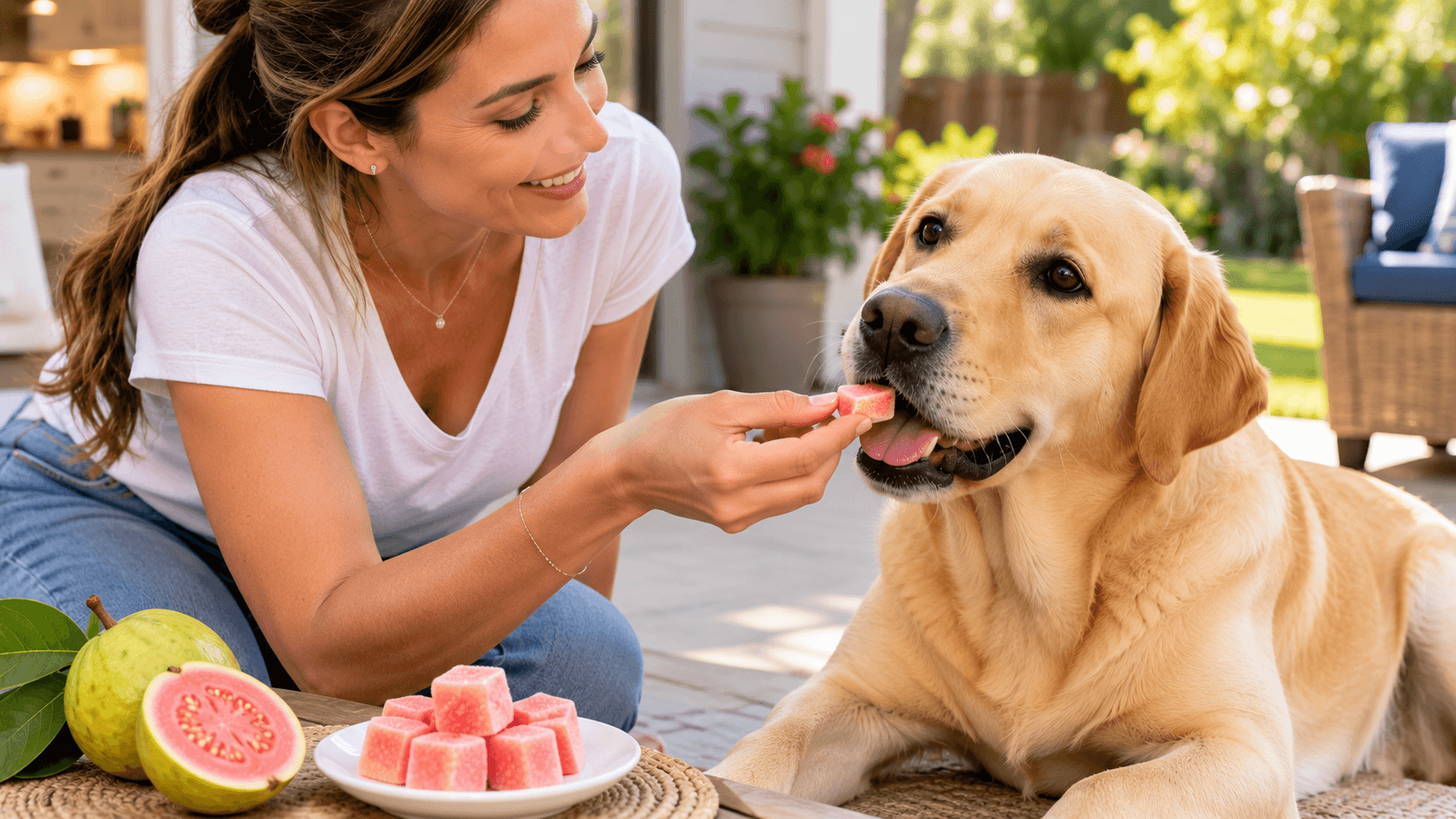
Can Dogs Eat Guava as a Homemade Frozen Treat?
Yes, you can make a simple frozen dog treat using plain guava.
For example, you could blend a small amount of ripe guava with water and freeze it in tiny portions.
However, keep the recipe simple.
Avoid adding:
- Sugar
- Honey
- Chocolate
- Artificial sweeteners
- Xylitol
- Excessive dairy
The simpler the ingredients, the easier it is to know exactly what your dog is eating.
Remember that even homemade treats contribute to your dog’s total daily calorie intake.
Can Dogs Eat Guava in a Fruit Salad?
It’s better to avoid sharing a human fruit salad with your dog unless you know exactly what ingredients are included.
Fruit salads may contain ingredients that aren’t suitable for dogs, including:
- Grapes
- Raisins
- Sweetened dressings
- Syrups
- Artificial sweeteners
- Alcohol-containing ingredients
Instead, prepare a separate small serving of dog-friendly fruit.
If you’re serving guava alongside other fruits, make sure every ingredient is appropriate for dogs and that the total serving remains small.
Can Dogs Eat Guava and Mango Together?
Both guava and mango can be enjoyed by many healthy dogs in small portions when properly prepared.
However, if your dog has never eaten either fruit before, don’t introduce both at once.
Start with one fruit.
If your dog tolerates it well, you can introduce another fruit at a later time.
This makes it easier to identify the cause if your dog develops an upset stomach.
For mango, always remove the large pit before serving.
You can learn more about mango safety in our guide:
Can Dogs Eat Guava and Watermelon Together?
Many healthy dogs can enjoy small portions of both fruits, provided each is prepared appropriately.
However, there’s no need to serve several fruits together in one large bowl.
Fruit should remain an occasional part of your dog’s overall diet.
If you’re serving watermelon, remove the seeds and rind and offer only the appropriate flesh.
For more information, see our complete guide:
Can Dogs Eat Guava and Strawberries Together?
Yes, these fruits can potentially be part of an occasional treat rotation for dogs that tolerate them.
However, serving multiple fruits together increases the total amount of natural sugar and fiber.
Keep portions small and introduce new foods separately.
If your dog already tolerates strawberries, you could occasionally offer a tiny amount alongside guava.
Our related guide can help you learn more:
Can Dogs Eat Guava During Hot Weather?
A small piece of chilled or frozen guava can be an enjoyable occasional treat during warm weather.
However, fruit should never replace water.
Your dog should always have access to clean, fresh drinking water.
If your dog shows signs of heatstroke—such as severe panting, weakness, confusion, collapse, or other serious symptoms—don’t attempt to manage the problem with fruit.
Heatstroke is a veterinary emergency.
Can Dogs Eat Guava Before Exercise?
There’s no special nutritional requirement for dogs to eat guava before exercise.
A small piece may be offered as an occasional treat, but guava isn’t a substitute for a balanced diet or a specialized sports supplement.
For active dogs, focus on:
- Appropriate nutrition
- Adequate hydration
- Proper rest
- Age-appropriate exercise
If your dog participates in intense athletic activities, speak with your veterinarian about an appropriate nutrition plan.
Can Dogs Eat Guava After Exercise?
A small amount of guava can be offered as an occasional reward after exercise if your dog already tolerates it.
However, hydration should be your priority after physical activity.
Give your dog access to fresh water and allow them to cool down appropriately.
Don’t give a large amount of fruit immediately after intense exercise.
Can Dogs Eat Guava at Night?
Yes, there is no special reason that dogs must avoid a small amount of guava at night if they tolerate the fruit well.
However, if your dog has never eaten guava before, it’s better to introduce it earlier in the day.
That way, you have more time to observe your dog for any digestive reaction.
Avoid giving a large serving immediately before bedtime.
Can Dogs Eat Guava Before Bed?
A tiny piece of properly prepared guava is unlikely to cause a problem for most healthy dogs, but there’s no particular benefit to feeding guava before bed.
If your dog is prone to digestive upset, giving a new food right before bedtime may be inconvenient if it causes stomach problems.
For first-time introductions, earlier in the day is a more practical choice.
Can Dogs Eat Guava as a Reward?
Yes.
If your dog enjoys guava, tiny pieces can be used as occasional rewards.
The trick is portion control.
Instead of giving one large piece, cut the fruit into tiny pieces.
This is particularly useful for training because you may need to reward your dog several times.
You can also alternate between guava and your dog’s usual training treats.
What Should You Do If Your Dog Eats Too Much Guava?
If your dog accidentally eats a large amount of guava, don’t immediately assume the worst.
The first thing to do is determine:
- How much was eaten?
- Was the fruit fresh?
- Were seeds consumed?
- Was the skin consumed?
- Were any other ingredients involved?
A dog that eats too much fresh guava may develop digestive upset.
Monitor for:
- Vomiting
- Diarrhea
- Gas
- Abdominal discomfort
- Loss of appetite
- Unusual lethargy
If symptoms are severe or persistent, contact your veterinarian.
If your dog ate a processed guava product, check the ingredients immediately.
If the product contains xylitol or another potentially dangerous ingredient, seek veterinary advice promptly.
What Should You Do If Your Dog Eats Guava Seeds?
If your dog accidentally eats a few guava seeds, monitor them calmly.
Small amounts are unlikely to cause serious problems in most healthy dogs.
However, if your dog consumes a large quantity of guava or many seeds, contact your veterinarian for individualized advice.
You should also seek professional help if your dog develops:
- Repeated vomiting
- Severe diarrhea
- Significant abdominal pain
- Weakness
- Difficulty breathing
- Collapse
When preparing guava in the future, remove as many seeds as practical.
What Should You Do If Your Dog Eats Guava Candy?
If your dog eats guava candy, check the ingredient list immediately.
If the candy contains xylitol, contact a veterinarian or emergency veterinary service immediately.
Xylitol can cause a dangerous drop in blood sugar and other serious complications in dogs.
Don’t wait for symptoms to appear if you know your dog has consumed a product containing xylitol.
If the candy contains only sugar and your dog ate a small amount, it may not cause serious toxicity, but digestive upset is possible.
When in doubt, contact your veterinarian.
Can Guava Cause an Allergic Reaction in Dogs?
Food allergies are possible in dogs, although they are less common than many owners assume.
If your dog develops symptoms after eating guava, watch for:
- Itching
- Red skin
- Hives
- Swelling
- Vomiting
- Diarrhea
A serious allergic reaction may cause difficulty breathing, collapse, or severe swelling and requires immediate veterinary attention.
If you suspect your dog is reacting to guava, stop feeding it and contact your veterinarian.
Is Guava Better Than Commercial Dog Treats?
Not necessarily.
Fresh guava has the advantage of being a simple whole-food option, but that doesn’t automatically make it superior to every commercial dog treat.
The best choice depends on:
- Ingredients
- Calories
- Portion size
- Your dog’s health
- Your dog’s preferences
A properly formulated commercial dog treat can fit into a healthy diet.
Guava can simply be another occasional option.
The most important thing is to avoid excessive treats and maintain a balanced primary diet.
Can Guava Replace a Dog’s Regular Food?
Absolutely not.
Guava should never replace your dog’s complete and balanced diet.
Dogs require a carefully formulated balance of nutrients, including appropriate amounts of:
- Protein
- Fat
- Carbohydrates
- Vitamins
- Minerals
- Essential nutrients
Fruit alone cannot provide everything a dog needs for long-term health.
Think of guava as a small optional treat, not a meal.
How Often Should You Give Your Dog Guava?
There is no universal schedule.
Some dogs may enjoy a few small pieces occasionally, while others may not tolerate the fruit at all.
A practical approach is to include guava as part of a varied treat rotation rather than feeding it every day.
For example, you might occasionally offer:
- A tiny piece of guava
- A few blueberries
- A small strawberry
- Another appropriate dog treat
The important point is that treats should remain limited and should not displace your dog’s complete and balanced meals.
10 Common Mistakes Dog Owners Make When Feeding Guava
1. Giving Too Much
A large amount of fruit can cause digestive upset.
2. Giving a Whole Guava
Large pieces are harder to portion and may encourage dogs to gulp.
3. Ignoring the Seeds
Remove as many seeds as practical, especially for puppies and small dogs.
4. Feeding Spoiled Fruit
Never give your dog moldy, rotten, or fermented guava.
5. Sharing Guava Candy
Processed sweets may contain unsafe ingredients.
6. Giving Guava Juice
Commercial juice often contains unnecessary sugar and additives.
7. Introducing Multiple New Foods
If you introduce several new foods at once, it becomes difficult to identify the cause of digestive problems.
8. Forgetting About Total Treat Intake
Guava still counts toward your dog’s overall daily calories.
9. Assuming Every Dog Can Eat It
Individual dogs have different health needs and tolerances.
10. Treating Guava as Medicine
Guava is a fruit, not a treatment for disease.
Frequently Asked Questions About Can Dogs Eat Guava?
1. Can dogs eat guava?
Yes. Most healthy dogs can eat small amounts of ripe, plain guava as an occasional treat when it is properly prepared and portioned.
2. Is guava safe for dogs?
For many healthy dogs, small amounts of ripe guava are generally safe. Remove or minimize seeds, cut the fruit into small pieces, and avoid processed guava products.
3. Can dogs eat guava seeds?
Dogs should not be intentionally fed large amounts of guava seeds. For a cautious approach, remove as many seeds as practical before serving.
4. Can dogs eat guava skin?
Guava skin is not generally considered toxic, but removing it can make the fruit easier to manage, especially for puppies, small dogs, and dogs with sensitive digestion.
5. Can puppies eat guava?
Puppies that are eating solid food may be able to tolerate a tiny amount of properly prepared guava. Start with a very small piece and monitor your puppy.
6. Can dogs eat dried guava?
Fresh guava is generally easier to portion. If offering dried guava, avoid products with added sugar or potentially harmful ingredients and give only a very small amount.
7. Can dogs eat guava juice?
It’s better to avoid commercial guava juice because it may contain added sugar and other unnecessary ingredients. Fresh whole guava is a simpler option.
8. Can dogs eat frozen guava?
Yes, small pieces of plain frozen guava can be offered to dogs that tolerate the fruit. Cut pieces appropriately for your dog’s size and eating habits.
9. Can dogs eat guava every day?
There is generally no need to feed guava every day. Small occasional servings are a better approach for most dogs.
10. What happens if a dog eats too much guava?
Too much guava may cause digestive upset, including gas, loose stool, diarrhea, vomiting, or stomach discomfort. Contact your veterinarian if symptoms are severe or persistent.

When Should You Call Your Veterinarian?
Most healthy dogs that eat a small amount of plain, properly prepared guava will not experience serious problems.
However, contact your veterinarian if your dog develops concerning symptoms after eating guava.
Seek veterinary advice if your dog experiences:
- Repeated vomiting
- Severe or persistent diarrhea
- Significant abdominal pain
- Extreme lethargy
- Loss of appetite that continues
- Difficulty breathing
- Facial swelling
- Collapse
- Other unusual or severe symptoms
You should also contact your veterinarian if your dog has eaten a large amount of guava, a large quantity of seeds, or a processed product containing potentially dangerous ingredients.
When in doubt, professional veterinary guidance is always the safest option.
Final Verdict: Can Dogs Eat Guava?
So, can dogs eat guava?
Yes. Most healthy dogs can enjoy a small amount of ripe, properly prepared guava as an occasional treat.
Guava contains fiber, vitamin C, and other naturally occurring nutrients. However, those nutritional benefits don’t mean dogs need guava in their daily diet.
The safest approach is simple:
Choose fresh ripe guava. Wash it thoroughly. Remove as many seeds as practical. Consider removing the skin. Cut the fruit into small pieces. Start with a tiny serving.
Avoid guava candy, jam, sweetened juice, and other processed products.
If your dog has diabetes, kidney disease, pancreatitis, food allergies, chronic digestive problems, or follows a prescription diet, speak with your veterinarian before introducing guava.
The Simple Answer
Can dogs eat guava? Yes—plain, ripe, properly prepared guava can be an occasional treat for many healthy dogs when served in moderation.
The key is preparation, portion control, and knowing your individual dog’s health needs.
Guava should complement—not replace—a complete and balanced diet.
Related Dog Fruit Guides
If you’re researching which fruits are appropriate for dogs, you may also find these WarmWag guides helpful:
More Dog-Friendly Fruit Guides
Curious about other fruits dogs can eat? Explore our complete dog fruit guides for more helpful safety and serving information.
Trusted Pet Health Resources
For additional information about pet nutrition, animal health, and potential pet hazards, these trusted resources may be helpful.