Foods Toxic to Dogs and Cats: The Complete UK Safety Guide
Most pet poisoning cases start the same way — a dog or cat gets hold of something from the kitchen counter, the bin, or a dropped plate, and their owner has no idea whether it’s a genuine emergency or nothing to worry about. This guide brings together everything on WarmWag about food safety for dogs and cats in one place: what’s genuinely dangerous, what’s fine in moderation, what’s different between the two species, and exactly what to do if the worst happens.
If You Think Your Pet Has Eaten Something Toxic Right Now
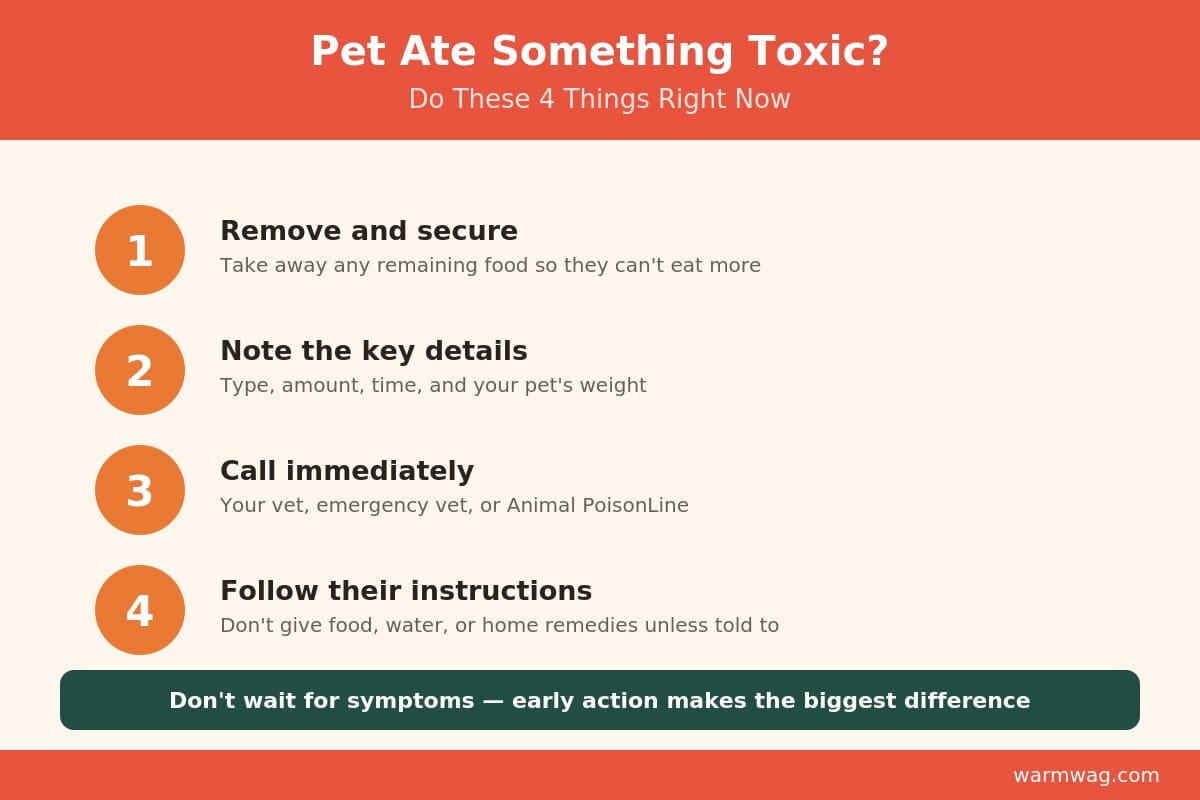
Don’t wait for symptoms. Remove any remaining food, note what it was, roughly how much, and your pet’s weight, then call your vet, an emergency vet, or the Animal PoisonLine immediately. See our full step-by-step guides for the two most common emergencies:
- What to Do If Your Dog Eats Chocolate
- What to Do If Your Dog Eats Grapes
- Is Chocolate Toxic to Cats UK?
Table of Contents
- The Most Dangerous Foods for Dogs and Cats
- At-a-Glance Danger Ranking
- How These Cases Usually Happen at Home
- Seasonal Risk Calendar for UK Pet Owners
- When Your Vet Will Want You to Come In vs Monitor at Home
- Household Hazards Beyond Food
- Foods That Affect Dogs and Cats Differently
- Foods That Are Safe in Moderation
- Fruits: The Full Breakdown
- Vegetables and Everyday Foods
- How to Poison-Proof Your Kitchen
- What Symptoms Point to Which Toxin?
- FAQs
The Most Dangerous Foods for Dogs and Cats {#dangerous}
These are the foods responsible for the vast majority of genuine emergency calls to UK vets and the Animal PoisonLine. If your pet has eaten any of these, don’t wait and see — call your vet straight away.
Chocolate
Chocolate contains theobromine, which dogs and cats can’t break down the way humans can. Dark chocolate and cocoa powder are the most dangerous, but any chocolate is worth taking seriously. Full details, including a toxicity table by chocolate type and exactly what to do: What to Do If Your Dog Eats Chocolate and Is Chocolate Toxic to Cats UK?
Xylitol
Xylitol is an artificial sweetener found in sugar-free gum, some peanut butter, baked goods, and toothpaste. In dogs, it triggers a rapid, dangerous release of insulin, causing blood sugar to crash — this is a genuine, fast-moving emergency, arguably more urgent than chocolate in some cases. Its effect on cats is less studied, but vets recommend the same caution.
Grapes and Raisins
Grapes, raisins, sultanas, and currants can cause acute kidney failure in dogs. The exact toxic mechanism still isn’t fully understood, which means there’s no reliably “safe” small amount — some dogs react to a handful, others to far less. Full emergency guide: What to Do If Your Dog Eats Grapes, and see our full Can Dogs Eat Grapes and Can Dogs Eat Raisins guides for more detail.
Onions, Garlic, Leeks, and Chives
All members of the allium family — including onion and garlic powder, which hide in stock cubes, gravy, and pre-made meals — damage red blood cells in both dogs and cats, leading to a type of anaemia. Cats are generally more sensitive than dogs. Symptoms can be delayed by a few days, which makes this one easy to miss. See our guides: Can Dogs Eat Onions and Can Dogs Eat Garlic
Macadamia Nuts
Toxic to dogs even in small amounts, though the exact mechanism isn’t fully understood either. Symptoms — weakness, tremors, and a raised temperature — usually appear within 12 hours.
Alcohol and Caffeine
Both affect dogs and cats far more severely than humans, given their smaller body size. Alcohol can cause dangerously low blood sugar, poor coordination, and in serious cases, coma. Caffeine (found in coffee, tea, energy drinks, and some medications) overstimulates the heart and nervous system.
Raw Bread Dough
Yeast dough continues to rise in a warm stomach, causing painful bloating, and ferments to produce alcohol as a byproduct — meaning a dog or cat that eats raw dough can end up dealing with both a blockage risk and alcohol poisoning at the same time.
At-a-Glance Danger Ranking {#danger-chart}
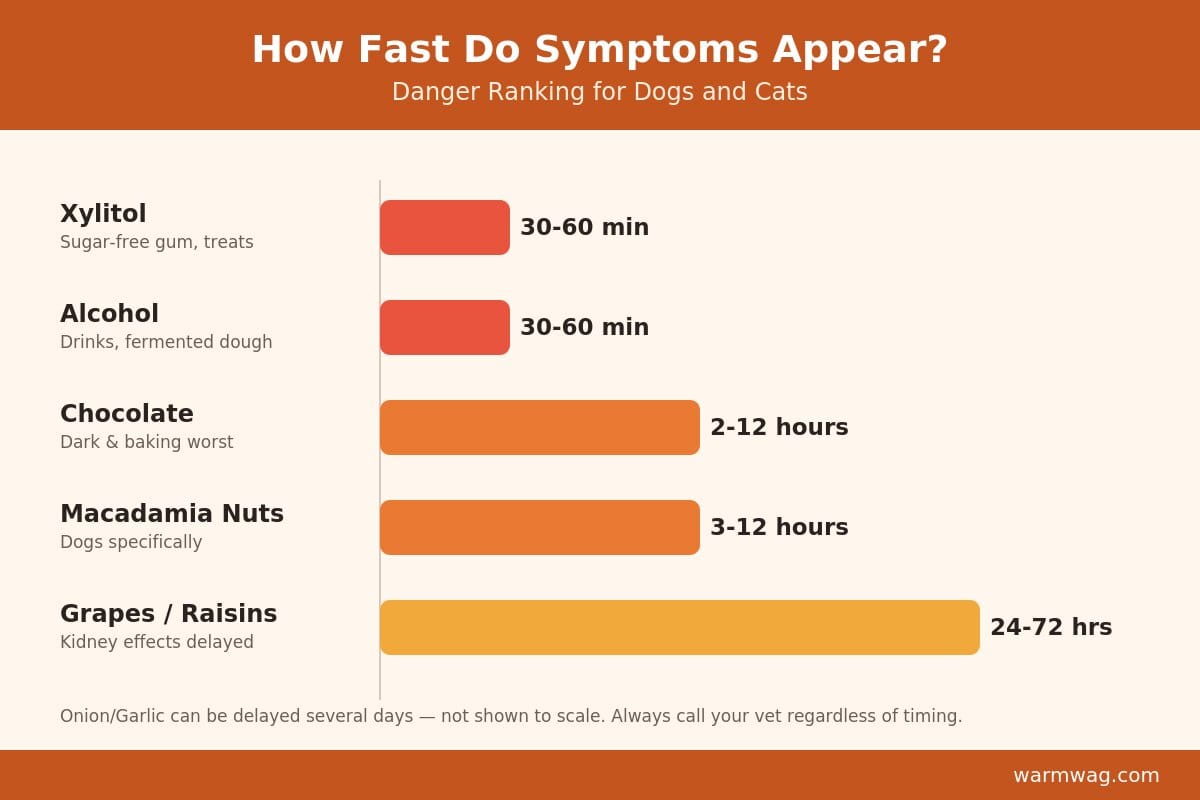
Not every toxic food carries the same level of urgency. This table ranks the most common culprits by how little it takes to cause harm and how quickly symptoms typically appear — useful for judging how fast you need to act.
| Food | How Little Is Dangerous | Symptom Onset | Most At Risk |
|---|---|---|---|
| Xylitol | Very little — even small amounts | 30-60 minutes | All dogs; effect on cats less studied |
| Dark chocolate / cocoa powder | Small amount, especially for small dogs | 2-12 hours | Small breeds, dogs with heart conditions |
| Grapes / raisins | Unpredictable — no known safe amount | Often delayed 24-72 hours | Any dog; some individuals more sensitive than others |
| Onion / garlic (allium family) | Moderate amount, but can accumulate | Can be delayed several days | Cats generally more sensitive than dogs |
| Macadamia nuts | Small amount | 3-12 hours | Dogs specifically |
| Milk chocolate | Larger amount needed | 2-12 hours | Small dogs still at meaningful risk |
| Alcohol | Small amount for pet’s size | 30-60 minutes | Small pets, puppies, kittens |
This table is a general guide for judging urgency, not a substitute for calling your vet — when in doubt, always call rather than trying to judge severity yourself.
How These Cases Usually Happen at Home {#patterns}
Knowing the common patterns makes prevention much easier, since most cases follow a handful of predictable scripts rather than being totally random accidents.
Counter-surfing and dropped food account for a huge share of cases — a dog or cat grabbing something that fell, or was left within reach “just for a minute.” Chocolate, grapes, and onions from meal prep are common culprits here.
Bins without secure lids are a recurring theme, especially after cooking with onion, garlic, or when disposing of chocolate wrappers or fruit cores.
Holidays and gatherings dramatically increase risk — more food is out, more people are in the house (some of whom don’t know the household’s rules), and treats like chocolate, mince pies, and dried-fruit cake are far more likely to be at floor or table height.
Well-meaning family members and guests sometimes hand over food without realising it’s dangerous — a grape as a “healthy treat,” a bit of onion-seasoned leftover, or a square of chocolate as a reward.
None of this is about blaming anyone for a slip-up — it happens in careful, loving households constantly. Recognising the pattern just makes it easier to spot the risk before it becomes a problem.
Seasonal Risk Calendar for UK Pet Owners {#seasonal}
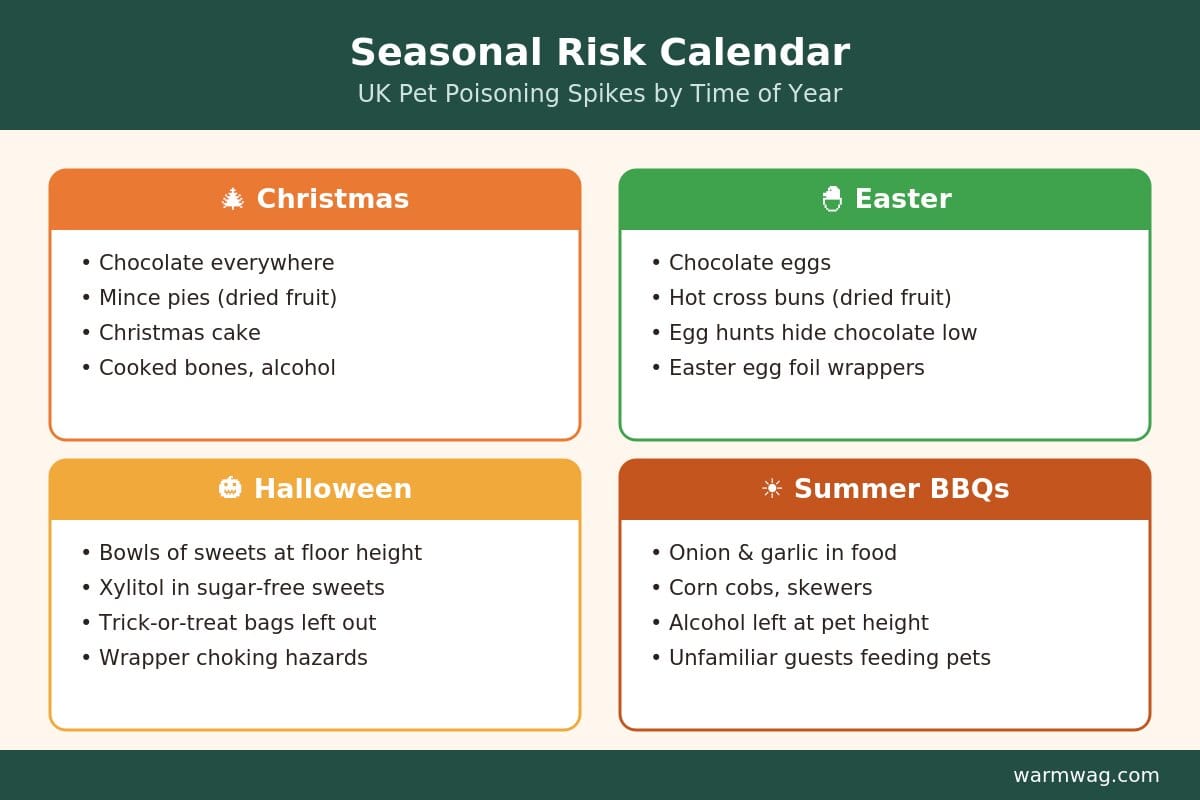
Certain times of year bring a genuine, documented spike in food-related emergency vet visits. Planning around these dates is one of the most effective prevention steps you can take.
| Time of Year | Main Risks | Why |
|---|---|---|
| Christmas | Chocolate, mince pies (dried fruit), Christmas cake, alcohol, cooked bones | More chocolate and dried fruit in the house than any other time of year |
| Easter | Chocolate eggs, hot cross buns (dried fruit), Easter egg hunts | Chocolate hidden at floor level, sometimes in the garden |
| Halloween | Chocolate and sweets, xylitol in sugar-free sweets | Bowls of sweets left accessible, trick-or-treat bags within reach |
| Summer BBQs / garden parties | Onion and garlic from food, corn cobs, alcohol, skewers | More food and drink at ground level, more visitors unfamiliar with house rules |
When Your Vet Will Want You to Come In vs Monitor at Home {#when-to-go}
This is genuinely one of the most common questions owners have, and it depends on several factors your vet will walk through with you on the phone:
Usually asked to come in immediately: any ingestion of xylitol, a chocolate amount that’s a meaningful percentage of your pet’s body weight, any amount of grapes or raisins, macadamia nuts, or any pet already showing symptoms like vomiting, tremors, or lethargy.
Sometimes advised to monitor at home: a very small amount of a lower-risk food (like milk chocolate) in a large, healthy adult dog, provided you’re able to watch closely and call back immediately if anything changes.
Always worth calling regardless: if you’re unsure of the amount, unsure what was actually eaten, or dealing with a puppy, kitten, senior pet, or one with an existing health condition — these cases have a much smaller margin for error.
Your vet will ask about the type and amount eaten, your pet’s weight, when it happened, and any symptoms so far — having these details ready before you call speeds everything up.
Household Hazards Beyond Food {#household}
A genuinely complete safety picture goes beyond the kitchen. A few worth knowing, even briefly:
| Hazard | Risk | Notes |
|---|---|---|
| Cocoa mulch (garden/landscaping) | Contains theobromine, same as chocolate | Risk on walks, not just at home |
| Human medication | Can be fatal even at small doses | Paracetamol is particularly dangerous for cats |
| Antifreeze | Deadly even in small amounts | Sweet taste attracts pets |
| Lilies (cats) | Highly toxic, even pollen brushed onto fur | A dedicated guide on toxic plants is coming soon on WarmWag |
| Xylitol in toothpaste/gum | Same insulin-crash risk as food xylitol | Often overlooked since it’s not “food” |
Foods That Affect Dogs and Cats Differently {#different}
This is the part most generic pet-safety lists skip, but it matters — dogs and cats aren’t interchangeable when it comes to food risk.
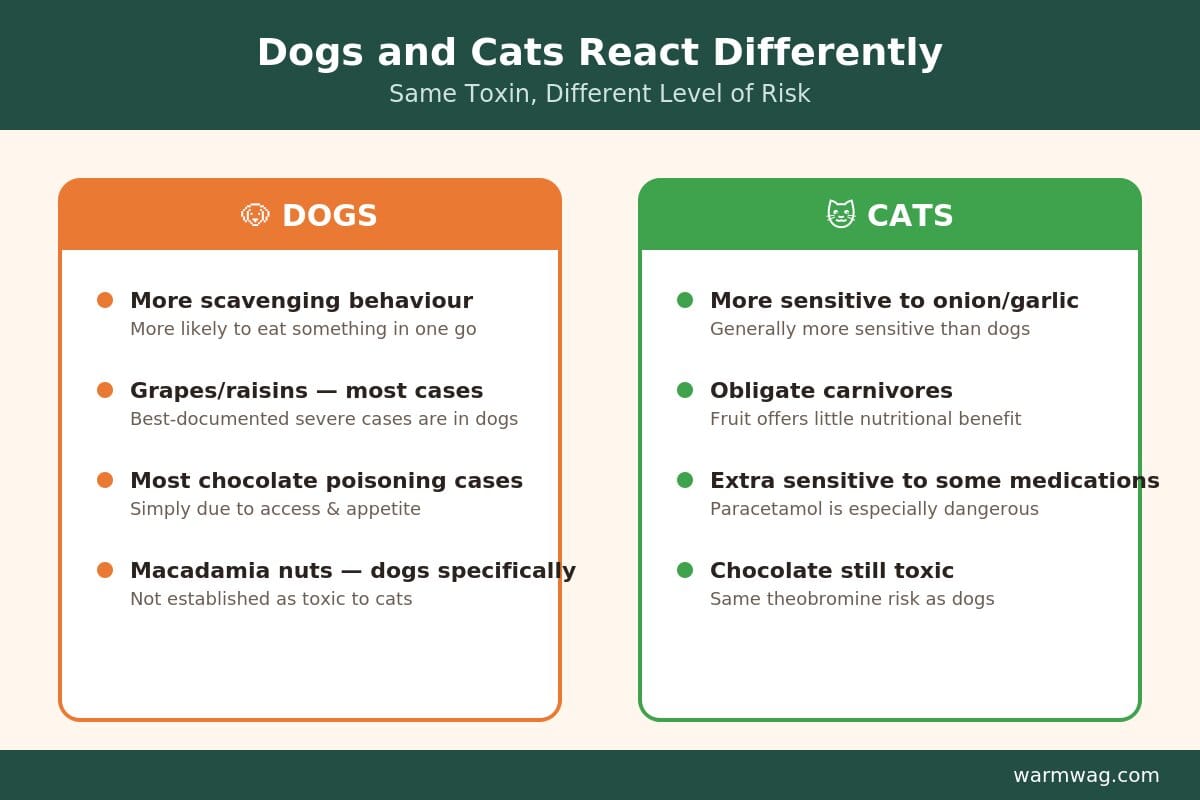
More sensitive in cats: Onion and garlic toxicity, raw fish (linked to thiamine deficiency with regular feeding), and reactions to unfamiliar proteins tend to hit cats harder or faster than dogs.
More commonly a problem in dogs: Grapes and raisins (the most severe, best-documented cases are almost all in dogs), and chocolate poisoning generally, simply because dogs are more likely to scavenge and eat something in one go rather than nibble cautiously the way many cats do.
Genuinely different responses: Cats are obligate carnivores with essentially no dietary need for fruit or most plant matter, so while a dog might get some benefit from small amounts of safe fruit, the same fruit offers a cat little more than empty calories — worth bearing in mind before assuming a “dog-safe” fruit is worth sharing with your cat too. See Can Cats Eat Eggs UK? and Can Cats Eat Raw Chicken UK? for protein-focused guides that reflect what cats actually benefit from.
Foods That Are Safe in Moderation {#safe-moderation}
Not everything on a “watch out” list is an emergency — plenty of human foods are absolutely fine for dogs in small, sensible amounts. A few of the most searched:
- Can Dogs Eat Eggs UK? — yes, cooked and plain
- Can Dogs Eat Sweet Potato UK? — yes, cooked
- Can Dogs Eat Pumpkin? — yes, plain and cooked
- Can Dogs Eat Cucumber? — yes, a low-calorie option
- Can Dogs Eat Carrots? — yes, raw or cooked
Fruits: The Full Breakdown {#fruits}
WarmWag has individual guides covering nearly every common fruit — some are genuinely healthy treats, others need caution around seeds, pits, or sugar content. Rather than repeating the detail here, jump straight to the fruit in question:
Generally safe in moderation: Bananas · Apples · Blueberries · Strawberries · Watermelon · Pineapple · Mango · Pears · Cantaloupe · Honeydew · Raspberries · Blackberries · Kiwi · Papaya · Coconut · Cranberries · Guava · Dragon Fruit · Passion Fruit · Pomegranate · Figs · Dates · Lychee
Needs caution — pits, seeds, or acidity: Cherries · Peaches · Plums · Apricots · Nectarines · Oranges · Lemons · Grapefruit · Avocado
Best avoided: Grapes · Raisins
For a full overview with more nuance than a list can offer, see our complete Can Dogs Eat Fruit guide.
Vegetables and Everyday Foods {#vegetables}
Beyond fruit, a handful of everyday kitchen items come up again and again in owner questions — some are genuinely risky, others are safe but frequently misunderstood.
- Can Dogs Eat Onions? — no, avoid entirely, including cooked, powdered, or hidden in gravy and stock
- Can Dogs Eat Garlic? — no, avoid entirely; garlic is actually more concentrated than onion gram-for-gram
- Can Dogs Eat Walnuts? — best avoided; the main concern is mould toxins that can develop on stored walnuts, not the nut itself
- Can Dogs Eat Almonds? — not toxic in the way macadamia nuts are, but a genuine choking and digestive-blockage risk, plus high fat content
- Can Cats Eat Cheese UK? — small amounts only; most adult cats are lactose intolerant and larger portions cause digestive upset
Other everyday items worth a mention even without a dedicated guide yet: cooked bones (splinter risk, never safe regardless of species), corn on the cob (the cob itself is a common cause of intestinal blockage requiring surgery, distinct from the corn kernels themselves being fine), and mushrooms (wild garden mushrooms can be genuinely toxic and are worth removing from any area your dog has access to, since identifying safe versus dangerous varieties reliably isn’t realistic for most owners).
How to Poison-Proof Your Kitchen {#prevention}
- Store chocolate, xylitol-containing products, grapes, raisins, and onions somewhere your pet genuinely can’t reach — not just “out of sight” on a counter
- Read labels on peanut butter, baked goods, and “sugar-free” products for xylitol before sharing with a dog
- Keep bins secured with a lid your pet can’t nose open
- Be extra vigilant around Christmas, Easter, and Halloween, when chocolate and dried fruit (in cakes and mince pies) are far more likely to be within reach
- Make sure everyone in the household, including visitors, knows what not to feed the dog or cat, however persuasive the begging
What Symptoms Point to Which Toxin? {#symptoms}
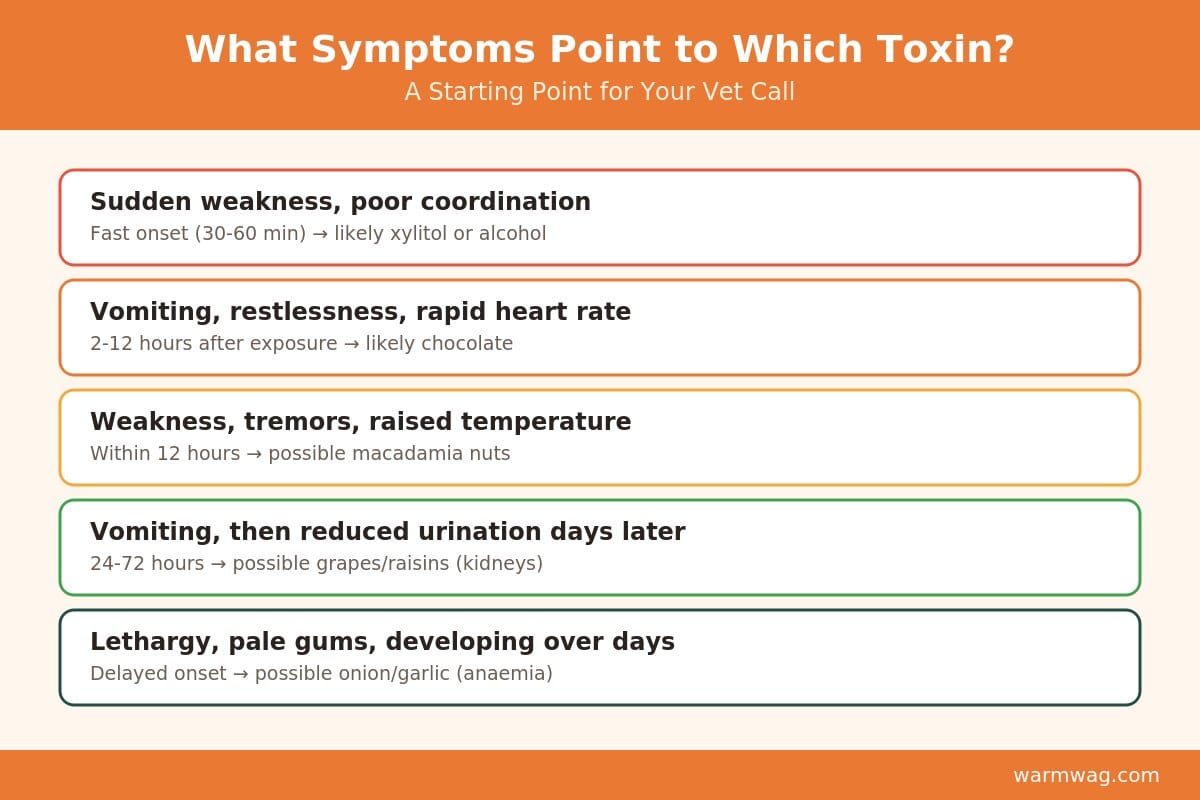
If you’re not certain what your pet got into but they’re showing symptoms, this table can help narrow it down — though it’s a starting point for your call to the vet, not a diagnosis.
| Symptom | Possible Cause | Notes |
|---|---|---|
| Sudden weakness, poor coordination, low blood sugar signs | Xylitol, alcohol | Fast onset (30-60 min) points here first |
| Vomiting, diarrhoea, restlessness, rapid heart rate | Chocolate | Especially if onset is 2-12 hours after a known exposure |
| Vomiting, lethargy, reduced appetite, developing over days | Onion/garlic (delayed anaemia) | Ask if any allium-family food was in recent meals |
| Vomiting followed by reduced urination 24-72 hours later | Grapes/raisins | Kidney involvement — always treat as urgent even before this stage |
| Weakness, tremors, raised temperature, within 12 hours | Macadamia nuts | Usually resolves with supportive care but still needs a vet visit |
| Distended abdomen, retching, discomfort | Raw bread dough | The rising dough itself causes the bloating |
FAQs {#faqs}
What’s the single most dangerous food for dogs? Chocolate and xylitol are both extremely dangerous and among the most common causes of emergency vet visits, but grapes and raisins deserve equal caution since there’s no known safe amount.
Are dogs or cats more at risk from toxic foods? Dogs are involved in more poisoning cases overall, mainly because they tend to scavenge and eat things quickly rather than investigate cautiously. But cats are often more sensitive per gram to certain toxins, particularly onion, garlic, and some human medications.
My pet ate something on this list — what do I do right now? Remove any remaining food, note the type, amount, and time, and call your vet or the Animal PoisonLine immediately rather than waiting for symptoms. See our chocolate emergency guide for a full step-by-step walkthrough that applies to most food-poisoning situations.
Is it fine to give my dog a “safe” fruit every day? Even safe fruits are best as an occasional treat rather than a daily habit, given the sugar content — check the specific fruit’s guide above for portion guidance.
Do cats need fruit or vegetables in their diet at all? No — cats are obligate carnivores and get everything they need from a complete, meat-based diet. Fruit and vegetables aren’t toxic in small amounts for most cats, but they offer little nutritional benefit either.
How long should I monitor my pet after a smaller, lower-risk exposure? Even for lower-risk situations, 24-72 hours of watching for vomiting, lethargy, or appetite changes is a sensible window, since some reactions (particularly to onion/garlic and grapes) can take days to fully show. Call your vet again if anything changes rather than assuming it will pass.
Can puppies and kittens handle less than adult pets? Yes, considerably less in most cases — smaller body weight means a smaller absolute amount reaches a dangerous dose, and their organs are still developing, which can make recovery harder. Treat any exposure in a young pet as more urgent than the same exposure in a healthy adult.
Does my pet’s breed matter? Size matters more than breed in most cases, since dose relative to body weight is the key factor. That said, some evidence suggests certain breeds (like Japanese breeds such as Akitas and Shiba Inus with allium-family foods) may be extra sensitive to specific toxins — worth mentioning to your vet if relevant.
Where can I find more detail on a specific food? Use the linked guides throughout this page — each one covers that specific food in far more depth than a summary list can, including exact serving sizes where relevant.
This guide is for general information and isn’t a substitute for professional veterinary advice. If you believe your pet has eaten something toxic, contact your vet or an emergency vet service immediately.
Explore More on WarmWag
This pillar guide brings together our food safety content in one place, but each linked article goes into far more depth on that specific topic. A few starting points depending on what brought you here:
- Just found out your dog ate chocolate? Start with What to Do If Your Dog Eats Chocolate for the full emergency walkthrough
- Wondering about a specific fruit? The Fruits: The Full Breakdown section above links to every fruit guide on the site
- New cat owner? Our cat-specific guides — Can Cats Eat Eggs UK?, Can Cats Eat Cheese UK?, and Can Cats Eat Raw Chicken UK? — cover feeding questions specific to cats rather than assuming dog advice applies equally
- Planning ahead for a risky season? Revisit the Seasonal Risk Calendar above before Christmas, Easter, or Halloween each year
A quick honest note on cost: emergency treatment for food poisoning can range from a straightforward same-day visit to a multi-day hospital stay depending on severity, and costs vary between practices and regions. Rather than guessing at a figure, it’s worth asking your vet directly what a likely range looks like for your situation, and checking what your pet insurance policy covers before you need it.
Further reading from UK vet sources: